
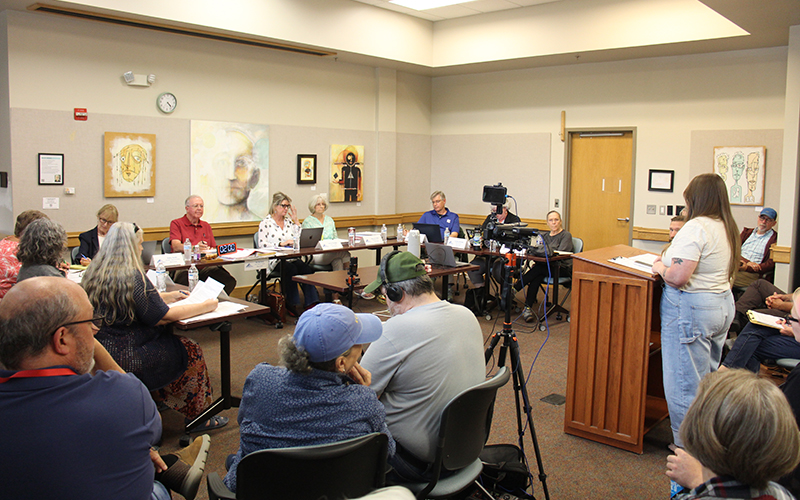
Press photo/Shelby Powell - The Fontana Regional Library Board of Trustees listens to public comment on the proposed Collection Development Policy.
The Fontana Regional Library Board of Trustees is looking at a proposed policy that outlines new criteria for how the libraries develop their collections.
The proposed policy cuts much of the current policy’s content and guidelines, in particular guidance on how to develop a collection in favor of community interest. Drafts of the new policy were released to the public via a public information request. This article will discuss the final June 2026 draft of the proposed policy unless otherwise stated.
Work on the proposal started in July 2025 in a committee made up of Macon County trustee Kathy Smith, Jackson County trustee Marva Jennings and Swain County trustee Cheryl Taylor. Jennings has left the committee following Jackson County’s withdrawal from the FRL in July 2026, leaving Taylor and Smith as the board’s remaining members.
Collection development
The current policy begins with a series of paragraphs identifying its mission, goals and objectives, which include “support for intellectual freedom” and a pledge to "protect the freedom of all to choose their own information.” It says collection decisions are made in conjunction with “the goals and objectives of FRL’s Long Range Plan, including the following: Committing to excellent service and convenient access for all users. Developing library services that incorporate both physical and digital collections. Embracing diversity, equity, and inclusion. Partnering with community members to promote lifelong learning.”
Most of these items are cut or rephrased in the proposed policy, which states “political inclusiveness and neutrality are essential for intellectual freedom in public libraries.”
A statement on the policy’s objective says, “The FRL recognizes the role of library professionals in ensuring the information rights and intellectual freedom of adults, and at the same time, fostering the healthy development of minors.”
The proposed policy states the staff “should not appear as if they or the library collections are sponsoring a particular political or ideological viewpoint or agenda.”
Selection criteria
The current policy identifies a set of general criteria for curating materials: present and potential relevance to community needs; suitability of physical form for library use; subject and style for intended audience; cost; importance as a document of the times; relation to existing collection and other materials on the subject; attention by critics and reviewers; recognition as award-winning or classic titles; potential user appeal; and requests by library patrons.
Selectors are encouraged to develop collections that fulfill the library’s mission and that meet the needs and interests of the communities the libraries serve. The current policy states, “Selectors are expected to exercise impartiality in materials acquisition practices.”
The proposed policy presents its selection criteria as: “purpose and scope for the general collection; age appropriateness for minor audiences; suitability of subject and style for the intended audience; timelessness (i.e., classics in both fiction and non-fiction); space requirements and price; community interest; literary or informational value; availability of materials through other FRL libraries and through NC Cardinal Library System or through electronic resources or other formats.”
Unlike the existing policy, the proposed policy makes no reference to historical, geographical or cultural relevance and removes provisions that prioritize locally important collections. Provisions preventing staff from “weeding” these locally important collections were also removed. There is a weeding section in the proposed policy which leaves out the detailed explanation on how weeding is conducted, instead simply saying the library system uses the “CREW (Continuous Review, Evaluation and Weeding) method” to remove materials.
The proposed policy establishes a mandatory three-year waiting period before a title can be reconsidered following a board decision on a challenged title. In the section on displays, the proposed policy states librarians must make a “good faith effort to provide balanced information when selecting materials for display on controversial matters.”
The current policy says collections are developed to meet “the majority of the educational, informational and recreational” needs of the FRL’s service area; that statement is removed from the proposed policy.
Review sources and acquisition
The current policy outlines several sources from which to search for new materials. It suggests some specific sources and encourages selectors to search best book and movie lists, specialized bibliographies, news shows, popular magazines and newspapers, online services and booksellers.
The proposed policy cuts some sources and adds others, encouraging librarians to “ensure a variety of political and ideological viewpoints.” The proposed policy states it “supports the judgement of FRL librarians over professional critics, library vendors and library publishers, due to viewpoint bias in many review sources.”
The proposed policy adds a section related to the development of the Juvenile Collection for children from infancy through 11 years of age and designates individuals ages 12-17 as teens rather than Young Adult.
The idea that minors should not be classified as any kind of adult is a view previously shared by board chair Bill McGaha. The section directs librarians to move juvenile and teen materials containing content “harmful for minors, obscene or unlawful,” to adult sections.
Footnotes
The policy document includes a set of footnotes and appendixes detailing perceived issues with current library content and policy, echoing complaints shared by some current and former members of both the FRL and Macon County trustees over the past four years.
The footnotes state, “material removals, relocations, cancellations, or restrictions will be in accordance with this Collection Development Policy and based on permissible reasons as detailed in this Policy and not on disagreement with a viewpoint.”
The proposed policy includes definitions for “Harmful to Minors” found in N.C. GS 14-190.13, which describes “offensive” or “sexually explicit” depictions as illegal, except when the materials have “serious literary, artistic, political or scientific value for minors.”
The proposed policy’s definition of “harmful to minors” also includes materials “promoting unlawful activity or containing obscene content, material inappropriate for a minor’s developmental stage, illegal drug use, cutting, suicide, and other self-harm, in a way that normalizes something with dangerous consequences that a minor cannot fully understand or comprehend.”
The proposed policy includes a section from House Bill 805 which bars state funds from being used for gender transition procedures. This law has nothing to do with libraries. A section from GS 14-190.1, which forbids dissemination of obscenity to minors, is also added and a host of definitions of various sexual activity were discussed in footnotes. However, these definitions and footnotes do not include the text of GS 14‑190.15, which exempts public libraries, schools, churches, museums, government agencies and other such institutions from penalty when conducting their “legitimate duty.”
A separate footnote states reviewers “have failed to provide neutrality and a reasonable balance of viewpoints” on “the subject of underage gender transition.” The footnote alleges the FRL contains several examples of titles discussing transgender issues or stories, saying the FRL has failed to provide sufficient materials “that offered other viewpoints on transgenderism.” The footnote states, “Teen fiction has a higher percentage of trans fictional characters than are present in the general population, but Teen fiction lacks characters dealing with the aftermath of puberty blockers and gender surgery.”
FRL and Macon County trustees have made statements against the American Library Association and Pen America’s “Banned Books Week.” The event is held annually to encourage education on materials which have been banned, challenged or censored by various entities, and FRL libraries have taken part in the event to encourage patrons to learn more about the titles.
The current policy does not address banned books. The proposed policy includes a definition of “banned book” as a book that is illegal to buy, sell, own or distribute in any county served by the FRL or in any other location in the U.S. A footnote to the proposed policy directs any challenged book display to clearly identify “that none of the books in the display are banned in the FRL or in this nation.”
Public response
A collection of written statements to FRL trustees and public comments at the June 22 FRL board meeting outlined community dissent with the proposed policy changes.
Cathy Stevens, writing to trustees, expressed concerns that the proposed policy would violate First Amendment rights, saying, “There have been lawsuits successfully levied against county library boards for First Amendment violations who have adopted similar policies in Texas and Wyoming. I encourage members of the FRL board to research these cases as they ended up costing taxpayers, like myself, hundreds of thousands of dollars to settle.”
Constance Neely said, “The 2024 collection development policy clearly stated, ‘As a North Carolina governmental entity, a county or branch public library part of the FRL system cannot acquire, retain, or remove any resource based on a patron’s objections to the content or viewpoint,’ and that protection was removed from this draft. Removing that clause does weaken the policy’s First Amendment protection.”
Neely also said the policy is vague in defining what materials are “inappropriate for a minor’s developmental stage,” which could create loopholes for patrons to challenge materials based on their personal views “even if that is not the board’s intent.”
Amy Medlock challenged a statement from Jackson trustee Deborah Smith that the proposed policy has been reviewed by an attorney and would not infringe on First Amendment protections, saying she has “access” to a constitutional lawyer and believes the way the policy is written exposes discriminatory intent.
Shelby Powell can be reached at reporter@thefranklinpress.com.