
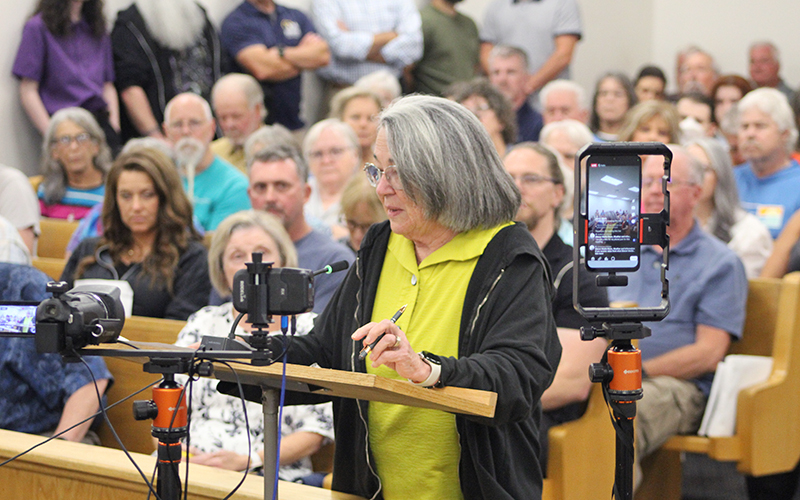
Dozens of people attended the July 14 Macon County Board of Commissioners meeting to voice their objections of the county Planning Board’s redistricting recommendation.
The Planning Board voted on July 2 to recommend the county revise the Board of Commissioners districts. The county currently elects five commissioners from three electoral districts, with one each coming from Districts 1 (Highlands, Ellijay, Flats and Sugarfork) and 3 (Burningtown, Cartoogechaye, Cowee and Nantahala) and three coming from District 2 (Iotla, Millshoal, Union, Smithbridge and all Franklin precincts). District 2 has roughly triple the population of Districts 1 and 3.
Under the board’s recommended “3-2” structure, Districts 1 and 3 would expand to take in residents currently residing in District 2. How the precincts will be divided is to be decided later. One commissioner would be elected from each district, with two at-large seats open to any resident in the county.
Commissioner John Shearl has been the most vocal proponent of this structure, saying the at-large districts would give prospective candidates in Districts 1 and 3 more opportunities to run for office. He says the current system gives District 2 candidates more chances to run and residents more chances to vote for their preferred candidates. Across multiple meetings, Shearl has mentioned there are residents of Districts 1 and 3 who would like to run for office but are not interested in running against their current district representatives.
At the July 2 meeting and throughout other commissioners and Planning Board meetings, the majority of people speaking have advocated for other board structures, most commonly a board structure with five districts and one commissioner apiece, with the residents of the district exclusively voting for their representative. This model has been called a “pure” voting model. Other speakers requested the board take steps to alleviate the perceived advantage held by District 2 candidates without recommending a specific system, and others requested that the change be placed on a ballot for voters to determine in a general election. Of dozens of public speakers across months of conversation, only one person requested the Planning Board’s recommended 3-2 system.
The commissioners would have four options if the goal is to place a reform on the ballot:
- Option A would have all commissioners elected at large, and the remaining options would each establish five districts.
- Option B would see district residents voting on their district candidates.
- Option C would have district residents vote for their representatives in the primary with candidates elected at large in the general.
- Option D would see candidates running from their districts but voted on at large.
Of the proposals discussed by the Planning Board, only one item cannot be placed on the ballot — the 3-2 system it recommended. If a 3-2 system is approved by commissioners, the proposal will be sent to the N.C. General Assembly to be voted on as a local bill. If passed in Raleigh, it will be the county’s responsibility to implement the change without another vote.
Shearl started the July 14 commissioners meeting by saying he would not seek action on redistricting at the meeting. “I think we need to spend some time out in the community for the next several months and talk to people that did not show up for the Planning Board meetings.”
Public comment
More than 10 speakers discussed redistricting in the public comment period, with Joanne Roesner starting the discussion.
“It is incomprehensible to me that public servants would consider placing individual political ambition above the goal of ensuring fair representation of Macon citizens,” Roesner said. “It is equally unconscionable that elected officials here, and members of the Planning Board, would completely disregard the bulk of public comment in making their decisions on this issue.”
Roesner said the only advantage granted by the recommended 3-2 system was to prospective candidates rather than to voters or residents. She advocated for a five-district, pure model where candidates are elected only by residents of their districts and for this new model to be implemented via voter referendum, which she said would allow the members of her community to exert greater control over the district’s representation and better control the future of their communities.
“The incorporation of District 2 precincts into the current District 1 and District 3 precincts results in an overshadowing of rural voices by residents of [District 2], who may not be familiar with the issues in Scaly Mountain,” Roesner, a Scaly Mountain resident, said. “I live on a dirt road, my power goes out all the time and I want to keep it that way.”
Kim Leister asked commissioners to consider the benefit to community members over political candidates when making a decision.
Lisa Walker echoed concerns the county Planning Board had disregarded public input when making its decision and advocated for the five-district pure voting system. She also said she was concerned about “fearmongering” about the board’s current structure being unconstitutional. Shearl has said District 2 having multiple representatives is a violation of the N.C. constitution following the 2002 Supreme Court case Stephenson v. Bartlett, in which the court ruled multi-candidate districts for the legislature violated the constitution.
Walker said Shearl’s argument was refuted during previous Planning Board meetings, where Highlands commissioner Amy Patterson noted the court’s decision specified the reason these state districts are unconstitutional is because representatives of these districts are only elected by residents of the districts. Both Patterson and Walker said the ruling does not apply to Macon County because its commissioners are currently voted on at-large.
Constance Neely said the Planning Board ignored the public's concerns and preferences when making its decision and called out board members who did not speak on the issue before casting their votes.
“When the public shows up in good faith and board members respond with silence, it undermines the confidence in the process,” she said. “It raises serious concerns about how that outcome was reached and if that decision was reached in advance of the session. You are not obligated to accept the recommendation of 3-2, you have the authority and the responsibility to say no.”
Margarett Pickett said the Highlands Board of Commissioners agreed that a five-district pure model was its preference, and she advocated for the model on behalf of the town. Highlands commissioner Amy Patterson confirmed the board came to this consensus, but has not made a formal vote on the subject. Loraine Ross and Ricky Siegel said they did not believe the current system offers District 2 an unfair advantage or that it is unconstitutional.
Amy Patterson walked the commissioners through the history of the current board structure. She said the 1976 decision to establish districts was born of a lack of data. She said when approached by Highlands taxpayers asking for better representation, the then three county commissioners agreed to establish three districts to enable Highlands and Nantahala to each provide a candidate from their districts. Patterson said the county originally proposed a five-district model but was lacking in recent population data to divide the Franklin township into precincts, per historic reporting from The Press. She believes District 2 was given three commissioners primarily because they did not have adequate population data to divide the district into three. She said the measure passed overwhelmingly via referendum.
“Even though the county commissioners didn’t think it was going to be necessary, they did in fact go ahead and put it on a ballot, had a referendum and the good people of Macon County, fear-minded as they are, all said yes. That’s the only fair way of doing it,” Patterson said.
Shelby Powell can be reached at reporter@thefranklinpress.com.