
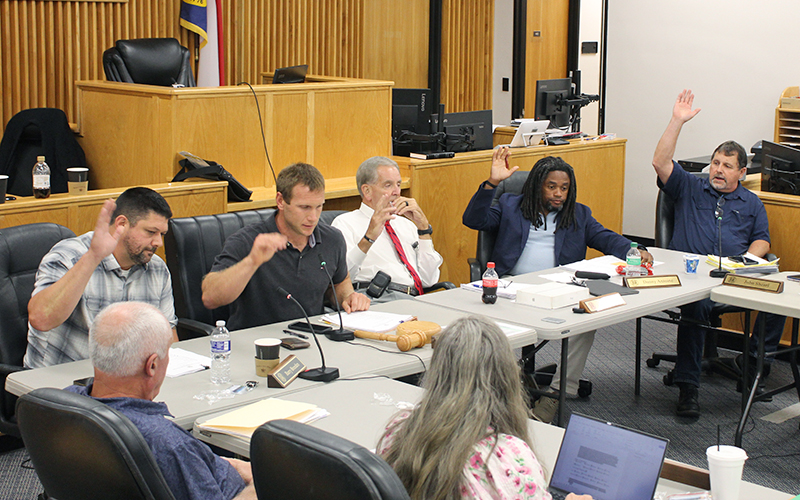
The Macon County Board of Commissioners voted July 14 to bar the Sheriff’s Office from using county funds for Flock cameras.
The Macon County Sheriff’s Office has been using Flock license plate reader cameras since the spring of 2024 under a contract signed in 2023 by then-county manager Derek Roland for $31,950. In the 2026-27 budget, with 12 total cameras, the office expected to pay $47,000. Flock has attracted national attention and widespread opposition in recent months as communities, organizations and advocates share privacy and Fourth Amendment concerns.
Flock, based in Atlanta, was founded in 2017 and advertises a slate of public safety and surveillance tools for both public and private users. The most common of Flock’s services is its automatic license plate reader (LPR) cameras and associated software, which allows users to collect data on every vehicle which passes through the camera’s range. A vehicle’s license plate, color, make and identifying features like damage and personalization are logged into a “fingerprint” used by the company to track the vehicle over time. For law enforcement entities contracting with Flock, this data can be used to track a vehicle in real time as it passes a broad network of Flock cameras. If users choose to share this data with other Flock law enforcement partners, they can track individual vehicles across municipalities, counties, states and nationwide.
Various law enforcement agencies, including the Macon County and Jackson County sheriff’s offices say their contracts with Flock have allowed them to more efficiently resolve crimes, locate missing persons and improve the quality of their drug enforcement. Flock says their products can reduce crime in areas where the cameras are stationed by discouraging criminals from taking action.
Critics of the LPRs in general have argued the surveillance infrastructure constitutes privacy and Fourth Amendment violations. The American Civil Liberties Union has argued Flock uses the cameras to track and log the movements of private citizens without a warrant. There have also been allegations of law enforcement using data from the cameras to stalk spouses or romantic interests and to target certain populations.
Flock says it put into place safety measures to prevent those types of abuses, has created an “audit assistance tool” to help track unusual activity on its software, and encrypts its data to keep it safe from unauthorized users. Flock also pushes back against claims that its LPRs only track vehicle information, not demographic or facial information. The company website also says it does not sell customer data, which is owned by the customers, or share data collected via LPRs – which is owned by the customers – without the customers’ consent.
Public comment
More than a hundred people filled the fourth floor courtroom at the Macon County Courthouse to talk about a variety of subjects. More than 12 people spoke about the Flock cameras, with all expressing discontent with the Sheriff Office’s use of the surveillance tools. The Macon County Republican Party showed an organized opposition to the cameras.
County GOP Chair Patty Trick said the data Flock collects allows an investigator to build a “life analysis,” an invaluable tool in the military. She said the company sells the ability to build military-style intelligence to be used against civilians.
“This isn’t just taking photos of speeders,” she said. “Flock uses AI to build a vehicle fingerprint, logging the make, the color and even your bumper stickers to track movements over days without a warrant. Combined with software like the upcoming Leonardo signal trace, it reads electronic signals from phones, smart watches, tire pressure sensors and even pet microchips to build a total digital profile.”
Trick said just some of the data collected by Flock can be used to build an accurate profile of who someone is and where they go. “The Supreme Court’s recent ruling at Chatrie v. United States made clear that government tracking of location history, even brief windows, even stored by third parties, is a Fourth Amendment search,” she said.
Bill Trick, treasurer of the county GOP, said, “It sounds like China to me … I’m not anti-law enforcement by any stretch of the imagination, but this goes above and beyond and it needs to stop. There are a number of communities that have already stopped it.”
Bill Trick also described the website deflock.org, which shares information on the locations of Flock cameras and details on the data collected and privacy concerns presented by the surveillance infrastructure.
Dylan Castle, county GOP vice-chair and current District 2 commissioner candidate, said the cameras are a violation of constitutional freedoms.
“While these cameras in Macon County many not have violated someone’s freedoms yet, surely you can see the potential for abuse, not just locally but by anyone who is capable of gaining access to this data,” Castle said. “What happens if, in a year or two, the courts discovered that these indeed violate the Constitution? Are you OK with facing the citizens of Macon County and saying, ‘We had the chance to wait but we proceeded anyway, hope you can accept our apologies?’”
Jimmy Goodman, GOP precinct chair for Burningtown, said he disagreed with the prospect he was free to search as soon as he leaves his property and advocated against “any mass surveillance” in Macon County. GOP precinct chairs Bodie Catlin (Highlands) and Michael Lyons (Union) echoed these comments.
Josh Holden compared the database to George Orwell’s 1984 and said, “History has proven beyond a reasonable doubt that sinful men in government positions cannot be trusted with much power, if any at all.”
Donald Parrott said he felt the cameras imposed surveillance on innocent people as a consequence for bad people. “If I’m raising four boys and one of them does something wrong, I can’t beat the others,” he said.
“In 1967 this was so important in the Constitution that the Supreme Court … expanded the Fourth Amendment,” Parrott said. “The reason they did that was to stop electronic surveillance.”
Jamie Miller compared the license plate readers to a location tracking app her mother wants her to use. “I love my mother, but I’m 45. I don’t want my mother to know exactly where I am at every single moment of the day. And I love my government, but I don’t trust you as much as I trust my mother.”
Scott Baste said he was concerned to discover there were 22 Flock cameras set up in Macon County, saying, “This is your job to watch out for our community, and this didn’t happen. This is already here … I think we need to get out ahead of these things. As a community, as a commission, we need to know, we need to see what’s coming down the road.”
Discussion
Sheriff Brent Holbrooks said the cameras have been used since 2024. The MCSO has access to 16 cameras – 12 controlled by the Sheriff’s Office and four in place through Macon County Schools (two at the roundabout between Macon Middle School and Mountain View Intermediate and two at Cartoogechaye Elementary). These cameras were placed with grant funds but are only accessible by the Sheriff’s Office in compliance with state law.
Holbrooks said the cameras are used “daily to assist in investigation of numerous crimes, including breaking and entering, larceny, abductions, narcotic-related offenses, also non-criminal issues such as dementia patients, Silver and Amber alerts.”
He said the cameras have helped the department to track and seize greater amounts of narcotics using fewer officers and saving the department on overtime pay. This, Holbrooks said, allows the department to devote its personnel to other cases.
“In fact, some of our most successful narcotic seizures have been aided by this information,” he said. “Additionally, our LPRs very recently helped us … in recovering a kidnapped child [in Jackson County].”
Holbrooks said there are no state statutes prohibiting LPRs and the courts “have generally recognized that … individuals do not have an expectation of privacy in public,” including on public roadways.
Holbrooks also said cutting its contract with Flock would unfairly target law enforcement, when other private entities like Lowe’s or Home Depot are able to access the same technology.
“They all have facial recognition. I mean, you want to censure us but want to leave everybody else alone? This don’t make sense,” Holbrooks said.
He added the county was aware of the readers when commissioners approved the 2023 budget with resources for Flock cameras.
Commissioner John Shearl said, “Tag readers is all it said on the budget … tag readers is a broad spectrum.” He said he thought the readers would be mounted on law enforcement vehicles, rather than contracting with a company.
Shearl said he supported the budget “knowing you and trusting you and respecting you and your obligation to uphold the Constitution of the United States, with no concern that these might be a violation.” He said it would not be until a case makes its way to the Supreme Court that a finding of unconstitutionality would be made.
“I think the attendance here tonight has proven that the only people in society that appreciate these [cameras] is law enforcement,” Shearl said. He said his son is connected to law enforcement and “cussed me like a dog” in a discussion about the LPRs. He said Flock-contracted entities are withdrawing from contracts for a reason, and the reason was privacy concerns.
“You’re wrong,” Holbrooks said.
Lt. Lee Tritt from the Sheriff's Office said the N.C. State Bureau of Investigation manages the Flock program in North Carolina. He said there are many different companies offering LPRs, and the SBI implemented the technology following a successful pilot program which placed cameras along state roads. Tritt is a retired special agent of the SBI.
“I agree with a lot of what John [Shearl] said, actually. I’m against government overreach,” Tritt said. “But I also like to look at stats, and my big thing is since the implementation of this, it has been a game changer.”
In 2023, he said the Sheriff’s Office worked 376 total cases, resulting in 115 felony charges and seizing 1,241 grams of methamphetamines. In 2024, the Flock cameras were set up in March, and the department saw 324 cases for the year, with 365 felony charges for the year. He said they seized 5,803 grams of meth in 2024. Tritt said the difference came from the effectiveness of the cameras. He said using the devices also allows the department to track suspect vehicles using far fewer deputies, allowing them to spend their time on other cases. Tritt added they can build cases faster and secure more reliable guilty verdicts.
Alex Gruth, regional sales director for Flock, attended the meeting. He said there “have been 40 court cases across the United States that have affirmed that ALPRs do not violate the Fourth Amendment because it does not track the whole being of a person.” Flock says their cameras do not track members of the public because the cameras take a snapshot of their location at one point in time rather than following them.
Gruth also said the Supreme Court’s ruling on Chatrie vs United States does not map cleanly onto Flock cameras because the geofencing technology it ruled against tracks the present whereabouts of individuals. He said the data is owned entirely by the customers and is deleted every 30 days, and Flock cameras do not have the ability to connect to wireless devices.
Shearl said Flock’s safety measures to prevent abuse of their systems was ineffective if it could not stop frequent, and recent, cases of officer abuse.
“Don’t tell me you’ve got safety nets that protect the citizens of this country, because most of the things that I’ve researched, this company is secretive. Most of these agencies have left Flock because of lies that’s been told,” Shearl said.
Gruth said fewer than 2% of Flock customers exited contracts. To cases of false charges, he said these were instances of failure of individual department policy and training rather than the responsibility of Flock.
After Gruth finished speaking, Shearl directed other questions toward Holbrooks, asking if he believed in the Constitution.
“One hundred percent,” Holbrooks said. Asked if he thought the cameras violate the Constitution, he said, “I do not, but … if I had any inclination that there is anything being sold or any violation, I’ll pull them up myself.”
“But not until it’s proven in the U.S. Supreme Court. How many people have you violated until it is?” Shearl said. Holbrooks said he was not violating anyone.
Shearl asked if the data was shared with other entities, and Holbrooks said no, that investigation data is private, but the department works with neighboring law enforcement entities on investigations using the Flock system.
During the conversation, Chief Deputy Derek Jones said Shearl had asked him to “break the law” by requesting to see Flock data about his vehicle. Shearl said he drove by a camera and got out of the vehicle “to see what the system picked up when I got out of my vehicle.” He asked for the images.
“It’s my car. It’s my tag that I paid for and I believe that I have every right in the world to see what the government and this Flock camera system is picking up on me anytime,” he said.
Holbrooks said plate data collected by law enforcement is not public record.
Following the meeting, Jones said he had been contacted by Shearl on the Monday prior to the meeting and he had two phone conversations with Shearl where he attempted to explain how G.S. 20-183.33 bars the office from disclosing data on license plates collected by LPRs.
“I tried to explain that not only by policy and procedure, but by law I cannot give him this information. I further explained that nobody knew what direction he traveled until he made it known to me, he wasn’t under any type of investigation for anyone within the MCSO to be checking his whereabouts by the ALPR, and explained further safeguards,” Jones said.
Shearl said the department’s use of Flock treats suspects in a crime as “guilty until proven innocent.” Holbrooks denied this, saying the department will “do our due diligence” when investigating.
The vote
Commissioner Barry Breeden said this was a hot topic, but he saw both sides of the discussion. He agreed with Holbrooks it is unfair to sanction the Sheriff’s Office when other entities can contract with Flock and collect the same data the same way.
Commissioner Gary Shields said he would prefer a court to determine whether the technology is unconstitutional.
Commissioner Danny Antoine said, “There’s enough dividing us in this country and yes, this is a super important topic … it’s a tough situation.” He said he sees both sides of the situation as well.
Commissioner Chair Josh Young said he saw both sides as well, but sees it as a bipartisan issue where most members of the public speaking are opposed.
In two votes initiated by Shearl, the board voted unanimously to prevent the Sheriff’s Office from using county funds on Flock’s services and to terminate its existing contract with Flock as quickly as possible. Gruth said there would be a three-day notice, but no exit fee for leaving the contract. Following the meeting, Jones told The Press the Sheriff’s Office lost access to both the 12 MCSO cameras and the four Macon County Schools cameras, which he said no one has access to now. Flock, rather than the Sheriff's Office, will need to remove the cameras, but they were still in place as of July 21.
Macon County Schools public information officer Renee Burt said no representatives, either from the Sheriff's Office or from Flock, have contacted the school system about managing the remaining cameras contracted through the school system.
“Regardless of how this turns out, guys, there’s no ill will,” Holbrooks said to the commissioners. “If you vote to defund the Flock system, it is what it is. I want the citizens to know that we’re going to continue to work hard to protect, for whatever it’s worth.”
Following the meeting, Holbrooks said, “While the commissioners' decision is certainly disappointing, I respect the decision that was made. I firmly believe Flock Safety is an effective law enforcement tool, and the results speak for themselves. It has proven its value in helping agencies solve crimes, and combat narcotics … Our mission remains the same today as it was yesterday – to serve, protect, and keep Macon County as safe as possible.”
Shelby Powell may be reached at reporter@thefranklinpress.com