
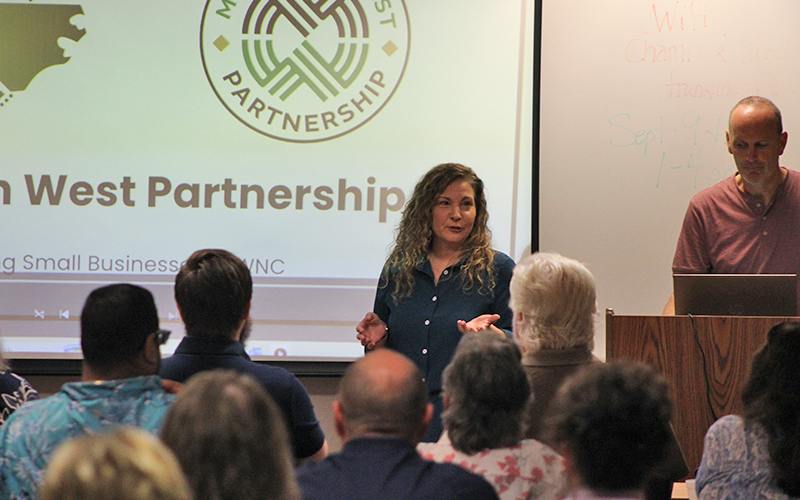
Representatives from Southwestern Community College, Mountain West Partnership and Sequoyah Fund attended the Franklin Chamber of Commerce’s July Eggs and Issues forum on July 10 to discuss what they offer to help local small businesses.
SCC Small Business Center director Marne Harris began the forum with a presentation on the college’s free offerings for small businesses. These include training, counseling and access to a resource center to help ensure those interested in starting small businesses are prepared for success.
Harris said 99.6% of businesses in North Carolina are small businesses and 80% of the businesses served by SCC have 10 or fewer employees.
“So the earlier that somebody can get to us, the better,” she said. “We help people save time and money.”
Southwestern works in partnership with institutions at the state and community level to help provide different resources for small businesses. SCC can help put small businesses in touch with marketing agencies, accountants, attorneys and other essential services to get them as close to guaranteed success as possible.
“If we do not have the answer or the expertise to help you, then we can always get access to that across the state,” Harris said. “We get a lot of people for marketing; we get a lot of people capital — access to capital is a big want.”
Harris said they help many small businesses prepare loan and grant applications. She said the ideal clients are the ones prepared to really put in the work and partner with other businesses and community organizations.
“We all know that starting a business can be romantic … so we like to stress passion. You’ve got to have that grit.” Harris said. “We always appreciate those clients that come to use that already have a business plan … we know that those people are ready and the people that connect to their community and different partnerships are involved: we see those be the most successful.”
Mountain West director Elissa Hashemi then gave a presentation on the partnership’s small business support. In addition to helping county governments secure grants, supporting seniors with the Area Agency on Aging and administering workforce development programs, the Southwestern Commission helps to develop local businesses through the organization Mountain West Partnership. Hashemi started by discussing WeSpeak WNC, a networking program developed since 2021.
“What’s behind that is we know why people come. It’s our rivers, it’s our mountains, but why do they stay?” she said. “It’s that little shop they walked into and that shop owner they talked to. It’s that meal they had they can’t forget and the awesome services.”
“So WeSpeak is really about supporting the businesses that make this area so unique,” Hashemi said.
Mountain West holds WeSpeak networking events county by county, and most recently hosted an event in Franklin in 2024, bringing in 25 people (business owners and representatives of services) to connect local business with resources, vendors and partners that will help them grow. Hashemi recalled a more recent Jackson County networking event in which several local farms brought produce to cater the event, and left with contacts for future catering gigs.
Among the bigger problems WeSpeak is trying to solve – echoed by presentations from SCC and Sequoyah – is the lack of awareness many small businesses have of the abundant resources for business success in Western North Carolina. Hashemi said she is often surprised to talk to business owners with a decade or more of experience who are still unaware of what is in their area to take advantage of.
“Because when we’re in our businesses … we rarely step out to work on them and to network,” she said. Hashemi said at WeSpeak events, “All of the CDFIs [Community Development Financial Institutions], all the small business centers and so many other resources – we work with so many other resources, we work with over 40 partners that are here just to serve us businesses – are in the room too.”
Mountain West also focuses “on the talent pipeline” to help keep businesses in touch with prospective employees. Hashemi said the organization has helped to provide students in Jackson County with restaurant experience and students in Macon County with tours of five businesses to learn about what they do and what services they offer, to learn what kinds of career opportunities can be there for them in WNC.
Sequoyah Fund CEO Russ Seagle discussed the Cherokee funding organization.
“We’re not a bank. We don’t compete with banks; we supplement what banks do,” he said.
Sequoyah was formed in 1998 and later became a Community Development Financial Institution in 2007. The CDFI fund was created by the U.S. Treasury in 1994 to help directly invest in “underbanked” communities, Seagle said, “places where people were not able to access traditional banking services or traditional bank capital for one reason or another.”
“Just because a bank tells you 'no' doesn’t mean you’re a bad person. They may have a policy reason why they can’t lend you money. They may have a very good reason why they can’t deploy money into that community or for that type of business,” Seagle said. “Well, we’re built differently.”
Sequoyah lends to and trains, alongside other services, local small businesses banks may not be able to serve. The fund lends money to EBCI and non-EBCI members across the same area as Southwestern Commission, including throughout Macon County.
“We supply funds for small businesses, both for startups and existing business expansions, but we also try to build the capacity of those business owners by giving them business skills. Not only do we farm that out to organizations like [SCC and Mountain West], but we do a lot of in-house counseling when it’s necessary,” Seagle said.
Often, Seagle said the fund will reject a loan only to work closely with a business owner to develop a new plan strong enough to receive funding. They help applicants improve their financial literacy, improving their credit scores and offering home improvement loans for EBCI members.
“We’re not built for profit maximization, we’re built for impact,” Seagle said. “But every dollar that we deploy creates jobs, it sustains family, and one of the best stories that we hear is people come in and they say ‘I want to help my people. I want to create a legacy for my family, I want to create jobs for my neighbors.'”