
Macon County will hold a public hearing in September to discuss tightening its High Impact Land Ordinance to more effectively constrict data centers from having easy access to Macon County.
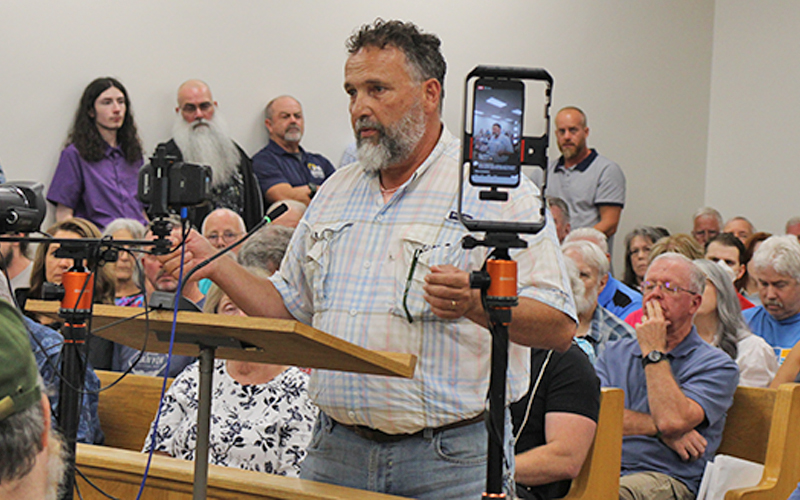
The Macon County Board of Commissioners was forced to move its July 14 meeting into the fourth floor courtroom in the face of a crowd of people looking to speak on a slate of issues including surveillance and redistricting. Over 30 people spoke in total, with more than 10 speaking about their desire to prevent data centers from being built in Macon County.
Barriers to data centers would come in the form of an amendment to the county’s ordinance that restricts “the high-impact uses of land” (including slaughter and processing plants, airfields, sawmills and server-based facilities). These restrictions include placing noise, space and vegetation buffers between the facilities and residential properties and prohibiting such businesses from operating between 11 p.m. and 6 a.m. The ordinance was previously modified in 2023 to add cryptocurrency mining operations to the list. The idea was between expensive land and an inability to use the facility 24 hours per day, crypto-mining operations would pass over Macon County.
Since then, county Planning Director Joe Allen discussed at the July 2 Planning Board meeting a desire to amend the policy to more clearly restrict data centers. He shared a video from a crypto-mining facility in Cherokee County to showcase the amount of noise produced by similar facilities to be targeted by the ordinance. Though several Planning Board members expressed discomfort at imposing any restrictions on private businesses, they generally opposed the presence of data centers in the county.
The proposed amendment would alter the existing policy definition of server-based facilities to read, “the operation of specialized computer equipment for the operation of crypto-mining, data centers, server-based facilities and similar activities that typically consume large amounts of electricity and water or generate a constant ambient noise from computer and cooling systems.” The definition is broader than the 2023 amendment, which focused more specifically on cryptocurrency mining.
County attorney Eric Ridenour started Tuesday’s meeting by speaking on the proposed amendment, saying he would like to curb some of the public comments and save time by correcting any misconceptions that the county is interested in attracting or allowing data centers to be built on county land.
Following the public comment period, Ridenour responded to community concerns that the proposed amendment is not strict enough to prohibit the facilities without creating loopholes for developers. Ridenour said instead the goal of the language is to create significant enough barriers to development that developers overlook the county.
“There’s a method to the madness,” he said. “If it looks like it … could have been drafted by a kindergartener, that shows a little bit of the intent.”
Public comment
The majority of people spoke against data centers and in favor of a legislative solution to preventing a center from being built in the county. Some speakers cited the ecological and environmental impact of data centers, their tendency to use excessive amounts of water and electricity, the noise nuisance they tend to cause for neighbors and their lack of payoff to the local economy as the source of their opposition.
Matt Jackson started the public comment period saying he was glad to know how many community members had attended the Franklin Town Council meeting on July 6 to support a data center moratorium passed by the council.
“I saw pickup trucks and Subarus alike. I saw sandals and boots, I saw locals and I saw damn Floridians,” he said. “They all agreed on the same thing: they didn’t want any data centers in our area.”
Jackson said he, as a realtor, is proud to be able to say the county has very few restrictions on land use, which is always attractive to buyers, but he said this benefit should be for residents rather than businesses. He requested the board consider stricter measures than the proposed amendment to keep data centers out.
Other speakers echoed Jackson’s concerns that the language was not clear enough to restrict the centers, including Michael Scarborough, Judy Hartley and Leland Shockley. Matt Jackson, Rob James and Judy Hartley also requested the board consider a full moratorium to restrict any data centers from being built until the Planning Board makes its decision.
Michael Lyons said he does not like the idea of data centers coming in on county land, but understands there is often too much money involved to say no. He said the county should make its ordinance strict so a data center's developers would need to "invest heavily in everything needed to make sure this is as clean as possible."
Betsy Baste approved of the board’s apparent support for excluding data centers from Macon County and said she would like to broaden the language in the ordinance to make it more difficult for the facilities to establish.
Chuck Watson said he and his family have lived in the county for more than 100 years, and while he does not have the strongest understanding of what they are and what they offer, he said a data center “doesn’t seem like where we need to be in Macon County.”
Rob James repeated a statement he made at the Franklin meeting that in his 20 years of computer industry experience he has seen businesses and industry professionals engage in the same kind of advertising in the past. James added the AI product data centers create an enormous ecological impact to water and electric infrastructure without generating a profit.
“There’s a website out there called ‘isAIprofitable.com,’” he said. “The only companies that are in the green are the hardware companies selling the silicone – or virtual shovels – to these miners … let’s not sacrifice our future for this house of cards.”
Hartley spoke on the manufactured obsolescence of AI data centers, which are built without long-term use in mind. She said the centers will create a mess for residents to clean up in the future, and will come with pollution, waste and a high ecological impact.
Sarah Johnson discussed the lesser-known ecological impact of light pollution. She pointed out Western North Carolina, especially Macon County's location in the Nantahala National Forest, generates a lot of dark sky tourism from visitors looking to star gaze in a place relatively free from light pollution. She said this is one of the only places in the Eastern United States where gazers can see the Milky Way, and her business of bioluminescent tours, which depends on low light pollution, will be threatened if a data center is built.
“I really suggest it would be wise to do what you can to limit your light pollution because your tourism from dark skies actually pays more than your regular tourism because they stay overnight,” Johnson said. “They spend money in your community longer than a regular day tourist.”
Johnson also pointed out Macon County is currently in an extinction crisis with four or more species of salamanders endangered.
“We really need to do what we can to save this because those little words in your legal language, every little bitty word, you’ve got a lot hanging on it,” she said. Other speakers discussed the centers’ environmental impact, including Leland Shockley and Nathan Pannell. Pannell also said it was the responsibility of the Appalachian community to come together to protect its residents from the business interests of Raleigh and beyond.
Shelby Powell can be reached at reporter@thefranklinpress.com.