
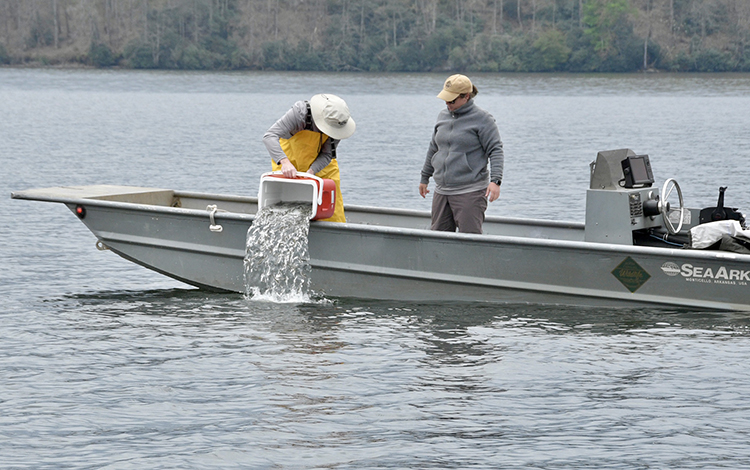
Most people don’t think of reeling in salmon when fishing the waters of Macon County. But, anglers on Nantahala Lake can hook these cold-water fish, thanks to a joint effort by North Carolina Wildlife Resources Commission and the Friends of Nantahala Lake.
Kokanee salmon were first stocked in Nantahala Lake as forage fish in the 1960s, however the stockings were considered unsuccessful and discontinued, according to Amanda Bushon, a fisheries biologist with NC Wildlife. However, during that time, the salmon began naturally reproducing and created a fish population that became a popular and unique catch for anglers.
Kokanee average in size from 9-12 inches and weigh about a pound. The record catch for a Kokanee salmon on Nantahala Lake was on June 11, 2014. Jeffery Todd Smith caught the 4-pound, 1-ounce fish using dodgers and flashers as lure. Just a few days earlier on June 5, Fred Mix had broken the previous record set in 2009, by hooking a 3-pound, 1-ounce salmon. In an interview at the time, Smith said he had been trolling the lake for two years hoping to catch a record-breaking salmon. June 11 was his birthday; he took the day off from work and spent nine hours trolling before catching his goal.
However, by 2017, there was concern that the number of salmon in the lake was decreasing. Bushon said there was limited historic data about the salmon population in the lake, but surveys at the time suggested the Kokanee salmon density in the lake was low.
“This perceived decline in angler catch also coincided with the first collections of Blueblack Herring in Lake Nantahala,” she said.
Blueback Herring is an anadromous shad species native to the Atlantic Coast, but the invasive species has shown up in several Western North Carolina reservoirs during the last two decades. Bushon said the herring’s impact on the Kokanee salmon is not known, but that both are planktivores and may compete for food.
“Due to the angler reports and the results of our surveys, we decided to begin stocking Kokanee salmon on an experimental basis to try and improve and preserve the existing fishery” Bushon said.
This year marks the second in a five-year project aimed at increasing the Kokanee salmon population in the 1,065-acre lake in Macon and Clay counties. The project is funded by the Federal Aid in Sportsfish Restoration program. The Montana Fish, Wildlife and Parks provide the eggs, which are reared at the Bobby N. Setzer State Fish Hatchery in Transylvania County.
The Friends of Nantahala Lake also got involved when residents began noticing a decline in the fish population, especially the salmon. The group wanted to be actively involved in the efforts to protect, preserve and improve the species’ population in the lake. “It is unique to our area of the country,” said Marci Cooper, vice president of the friends group.
N.C. Wildlife stocked 43,400 Kokanee salmon in the lake in 2020 and another 38,500 this year. Bushon said the salmon are about three inches long when they’re released in the lake. The goal is to stock 30,000 each year, but that number depends on how well they thrive in the hatchery. Additional stockings are planned for 2022, 2023 and 2024. “Following the experimental stockings, we will evaluate the stocking efforts and determine future management strategies,” Bushon said.
The daily creel for Kokanee salmon is four fish; there is no size limit. Mike Cooper said summer is when the salmon are most active and predictable in the lake. The fish are most active in water temperatures in the low 50s. Because they live in deep cold water, Cooper said catch and release can be difficult on the fish because of the exposure to the warmer water near the surface. “Once they are pulled out of real deep water, they have a high mortality rate.”
Marci Cooper said over the course of the stocking project they hope they will gain a better understanding of the positive and negative impacts on the fish population. “We want to have a nice, healthy sustainable population in the lake,” she said.
“We want to make sure we are supplementing the natural reproduction,” added Mike Cooper.
The state’s cold-water fisheries management program focuses on Brook Trout, Brown Trout and Rainbow Trout. Bushon said although many Western North Carolina reservoirs contain cold-water habitats that would support salmonids year around, there is no plan to stock Kokanee salmon in other water bodies in North Carolina. If successful, the stockings will once again provide Nantahala Lake anglers a unique catch not found elsewhere in the state.
Since water quality can affect the fish population, along with other environmental concerns surrounding the lake, the Friends of Nantahala Lake are working with Kimberlee Hall, a professor in the Environmental Health Program at Western Carolina University, to conduct quarterly water sampling at six sites along the lake.
Marci Cooper said these projects reflect the group’s overall goal to understand long-term impacts on the lake and the “importance of protecting this asset. We all have to do what we can to preserve it,” she said.