
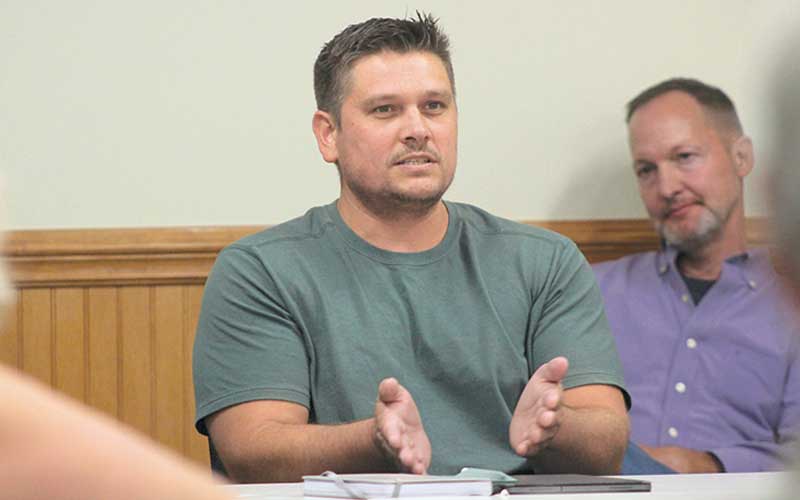
After meeting once every two months to talk about the opioid crisis, housing crisis and other behavioral health issues in Macon County, on Aug. 17, the Macon County Behavioral Health Task Force heard from a recovering opioid addict about his experiences and treatment.
Stephen Johnson, saying he was a year clean as of the Aug. 17 meeting, said it was interesting hearing everyone speak before him.
“You’re talking about me,” Johnson told the group at the beginning of his presentation.
Johnson and his wife have been patients at Hazelwood Healthcare of Franklin, which offers methadone and buprenorphine (Suboxone) treatments, where patients take medication and receive education and counseling.
Johnson said his addiction story started as a teenager with marijuana. His introduction to harder drugs came after an appendectomy when he was prescribed hydrocodone in his first semester at Florida Atlantic University in Boca Raton, Florida.
“For whatever reason, I enjoyed the feeling that hydrocodone gave me,” Johnson said. “After that, I found I could get them through the same people I got weed from.”
Johnson said he told himself and others while doing drugs that it would be the last time and he wanted to stop, but ended up using again.
“It’s not just as easy as saying I’m going to wake up tomorrow and not do this,” Johnson said.
Johnson and his wife were both users and said that the path to recovery took a while, including going to detox and doing programs. In September 2021, Johnson became a patient of Dr. Matt Holmes of Hazelwood Healthcare.
“I was actually against the use of medicine to get off drugs,” Johnson said.
Johnson started going to Hazelwood to support his wife.
“[At first], I thought it would look good to Social Services…but it worked,” Johnson said.
The effect of using opioids led to Johnson and his wife losing custody of their kids after an episode where his wife overdosed. That led Johnson to start the Hazelwood opioid treatment program.
Quitting took several weeks, Johnson said, as the prime motivation to continue using was to stop the withdrawals.
Johnson said he just got his kids back full-time and is still fighting for custody.
Former Sheriff Robert Holland said he’s against the increasing legalization of marijuana and said it’s a gateway drug to worse drugs, to which Johnson agreed. This led to a discussion about the controversial claim that there is marijuana laced with fentanyl. One task force member said that combination is impossible because the two drugs burn differently.
Johnson said he’s dealing with the stigma of the pill-based treatment when he talks to his parents. He also feels the same at his church, which Johnson said he’s very involved with.
Asked by Ronnie Beale what he thinks would be the biggest help to solve the opioid crisis, Johnson said it’s getting rid of the stigmas.
“There’s no reason for the people who are trying to help to argue about how the help happens,” Johnson said. “It’s real disheartening to hear my church family be disappointed that I’m still using medicine to get through my addiction.”
Beale responded that it would be like telling a diabetic to stop taking insulin.
While admitting he’s done bad things, Johnson said he wants people to understand that treating addicts like statistics doesn’t help them get better.
“A very important thing is to love the addict,” Johnson said. “At the end of the day, we’re still people.”
Johnson complimented the Hazelwood program for treating him and his wife like people, showing care and interest in them and not having to work or jump over hurdles for their approval.
During his speech to the group, Holmes said he understands why people are skeptical of the Hazelwood treatment programs.
“The goal of the medicine itself is to suppress withdrawals, to stop withdrawals,” Holmes said, adding that Hazelwood currently has 170 people in treatment.
Holland asked if Holmes recommends people coming off the Suboxone treatment. Holmes said they do not, saying some people can recover without treatment, but not many. Sheriff Brent Holbrooks said he knows a guy who has been on Suboxone treatment for four years and doesn’t want to come off. Holmes said he’s had patients who died less than a year after leaving the program.
Angel Medical Center CEO Clint Kendall said they got their first batch of Suboxone that week and says when the pilot program goes through, they’re pushing to use it.
There was discussion about the obstacles to using this type of treatment. Holbrooks said most of the issues they have in the Macon County Jail are caused by meth and Suboxone. Another point made was that many treatment facilities won’t let patients in unless they get off their mental health drugs. Johnson made the point during his presentation that one program would only take him if he went to the hospital first and started going through withdrawals.
Holmes said in the past, multiple failed illicit drug tests got someone removed from the program, but not anymore.