
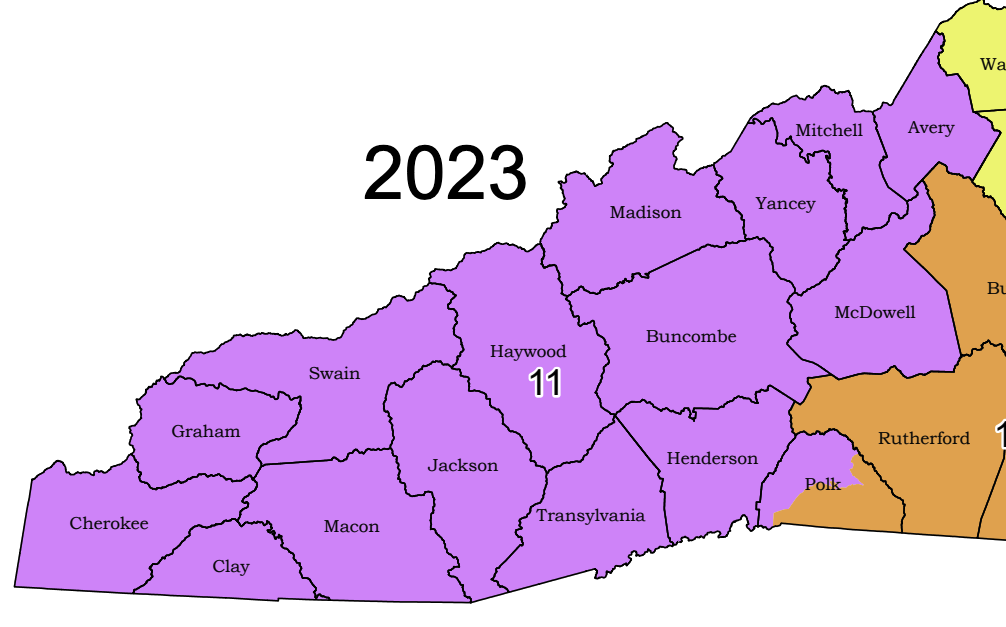
Local representatives will remain with mostly intact districts after the North Carolina General Assembly passed new district maps into law recently.
Votes on the three maps – the U.S. House, N.C. Senate and N.C. House - took place on Oct. 24 and 25. All three passed along partisan lines, with Republicans voting in favor and Democrats again. New election maps do not need the governor’s approval to become law.
“The maps were drawn by the guidelines set forth and meet all the necessary criteria. The North Carolina Constitution states that the state legislature is permitted to draw the maps and the North Carolina Supreme Court has affirmed that duty,” Rep. Karl Gillespie, a Franklin Republican, said in a statement. “Regarding the House maps, I’m pleased that my district remains unchanged, as it maintains Cherokee, Clay, Graham and Macon counties under House District 120.”
Sen. Kevin Corbin, another Franklin Republican, said although he wasn’t in Raleigh for the final map votes, they had his approval.
“As far as I know, [the map-drawing committee] followed all the guidelines,” Corbin said. “State statute says not to draw according to race, and I believe they did not.”
The maps had to be redrawn this year due to a previous court order. These maps, barring any successful legal challenges, will be in place for the 2024 Election.
Most U.S. House, N.C. Senate and N.C. House map changes were in urban areas that vote Democrat with some accordion effects in rural areas such as Western North Carolina.
Like any maps passed by the NCGA in the last decade-plus, they will likely face lawsuits that allege racial and partisan gerrymandering, as state Republicans draw maps that appear to give them extra seats in all three of those chambers. Many previous election map lawsuits were successful, however now the state Supreme Court is a Republican majority. The U.S. Supreme Court previously ruled that partisan gerrymanders are a state issue.
The 11th District of North Carolina in the U.S. House adds counties. The new counties in the 11th District are Mitchell, Avery, plus half of Polk County. In return, the 11th District lost the western part of Rutherford County. Besides those changes, the 11th District remains the same with all of McDowell, Yancey, Buncombe, Henderson, Haywood, Transylvania, Jackson, Swain, Graham, Cherokee, Clay and Macon counties.
The 50th N.C. Senate District has some slight changes. The boundary between the 50th and 47th districts still cuts through Haywood County but was slightly altered. Four precincts of Haywood County, along I-40 north-central Haywood and in eastern Haywood around Canton, are now part of the 50th District. The rest of the 50th District remains the same with Transylvania, Jackson, Swain, Graham, Cherokee, Clay and Macon counties.
Corbin said he was surprised to get those four precincts back after they were drawn out of his district two years ago but doesn’t change what he represents.
“As I’ve said to the Haywood County Commissioners, I don’t see how you could represent half a county,” Corbin said. “I continue to represent all of Haywood.”
The 120th N.C. House District remains the same, with Cherokee, Graham, Clay and Macon counties grouped. The 119th District was also unchanged, with Swain, Jackson and Transylvania counties staying together.
After the approval of the maps, the 2023 “long session” of the 2023 NCGA was gaveled out on Oct. 25. Barring a special-called session, state legislators won’t return to Raleigh until the spring for the 2024 “short session.”
With the maps in place, the 2023 Election cycle begins in December with the filing period for partisan races going from Dec. 4-12. The primaries are on “Super Tuesday,” March 5, with early voting starting in February.
When asked if they would file for re-election, Gillespie replied “stay tuned,” while Corbin confirmed he would file on Dec. 4, the first filing day.