
Critter cams capture wildlife
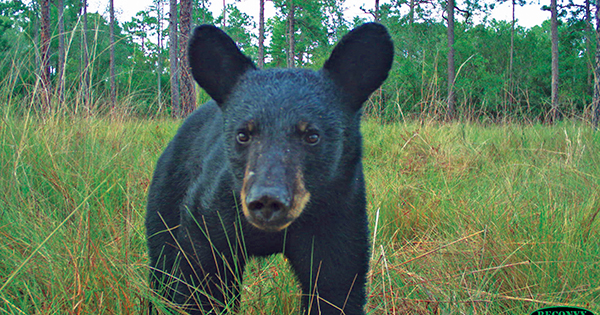
In his time operating a wildlife camera on his property, Greg Clarkson has seen all manner of wildlife come and go.
“We’ve had bears, raccoons, possums, rabbits, squirrels, grey foxes …” Clarkson ticked off all the kinds of animals his camera has picked up. “We had a bobcat come through about a month ago. That was pretty cool. [We’ve also had] some coyotes and we’ve seen deer in the yard, but we haven’t captured a deer on the camera yet. I don’t know why, especially when they hang out in our yard.”
As a wildlife photographer and Macon County resident, Clarkson has photographed all manner of wildlife, both with a handheld camera and his trailcam. After researchers from Western Carolina University took an interest in some weasels living around his land, Clarkson became intrigued as to what other types of critters might be roaming the area.
“I started using a trail cam in earnest this past summer, after the Highlands Biological Station put 4 trail cams around our yard to capture the weasels that I first captured with my Canon camera,” said Clarkson. The fact that they captured so many critters around our yards excited and motivated me into putting one of my own out there. Although their trail cams did not capture the weasels as we all had hoped, they did capture the bobcat and deer...but no bear. Needless to say, I was quite motivated then after their captures - especially with the bobcat … I had been hearing the bobcat at night, and during the day calling for her young.”
Since setting up his own trail cam near a bird feeder on his property, Clarkson has been capturing wildlife photos left and right. Some of the shots themselves are fascinating: one group of photos captured just last month shows a tense staredown between a bobcat and a possum; others feature groups of foraging raccoons and grey foxes just feet from camera eye. In capturing so many compelling images, Clarkson believes the camera’s location in a high-traffic area for wildlife helps.
“It’s kind of amazing,” said Clarkson. “Our house is down low right by a wooded area, and we’re blessed - there’s a couple of creeks nearby, and there’s stuff all over the place out there.”
While Clarkson has had no shortage of wildlife pass in front of his camera’s lens, he is far from the only person who has captured candid shots with a wildlife camera. From 2016 to 2019, North Carolina was home to a project called Candid Critters, a massive statewide effort to compile data and photographs from trailcams in all 100 North Carolina Counties. A joint effort between several state agencies, NC State University, and more than 500 citizen-scientists around the state, the project’s organizers sought to better study the range and behavior habits of the state’s native species.
“[We had] two original objectives,” said Monica Lasky, a former Zoology student at NC State who worked on the project. “We wanted to engage North Carolina citizens in science. We worked with people of all ages, backgrounds, and experience to help us study the wildlife of their state through camera trapping. We also wanted to collect wildlife data that will be useful for management and conservation questions proposed by the NC Wildlife Resources Commission and other organizations.”
In its three years of collecting data and photographs, Candid Critters collected more than 2 million photographs and 120,000 records from more than 4,000 camera traps from across the state. So wide was the project’s net in fact that it ranks as the largest trail camera citizen-science project in history and stands as an unprecedented resource for North Carolina biologists. Between academic pursuits like those of Candid Critters and people like Greg Clarkson learning what animals they share their yards with, trail cameras are tailor-made for Western North Carolina.
“A lot of hunters will use trail cameras to get a sense of what, say, deer or other species that they want to hunt are in the area,” said Falyn Owens, extension wildlife biologist with the NC Wildlife Resources Commission. “They might be able to get a couple of photos of a few different deer that pass through their hunting area. Then when they go out to hunt, they have an idea of what they might actually see so they can be prepared on what they actually want to harvest. [It goes] all the way to somebody in the middle of Raleigh who has a nice backyard, they can put up a trail camera just to see what wildlife pass through their yards and learn what’s in our area. People see all sorts of things, and a lot of times people are really surprised what shows up.”
In her role with the NCWRC, Owens takes calls from residents across North Carolina reporting animal sightings and asking for help in identifying wildlife from the pictures.
Interestingly, in recent years the agency has received more and more photos of armadillos - an animal not native to North Carolina but whose habitat has been growing steadily over the past few decades. As a result the shelled mammals are a perfect example of the value trail cameras can have.
“It’s one of those Christmas gifts that I haven’t yet bought for myself, but one of these days, I will and set it up in my own backyard,” said Owens. “I probably won’t be too surprised just because as a wildlife biologist that does this on a day to day basis, I know that wildlife is out here. But the typical person who lives in suburban Raleigh like I do would probably be very surprised at the foxes, coyotes, raccoons, possums, and animals that are pretty common.”