
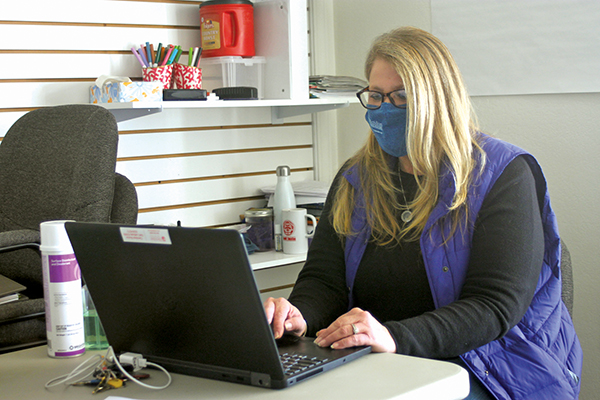
Press photo/Will Woolever - Meridian Behavioral Health Macon County director Candace Burton.
Will Woolever
sports@thefranklinpress.com
When the COVID-19 pandemic hit Franklin last March, the economic shutdown that followed affected some organizations more than others. While virtually everyone was touched by the pandemic in some way, social distancing requirements left essential groups like Meridian Behavioral Health scrambling to provide their services.
“People that have never been involved in our services have started coming through the door and reporting increased depression and increased anxiety,” said Candace Burton, Meridian’s Macon County director. “We’ve recognized that isolation, while it is a symptom of depression, can also be a trigger for depression for folks that may not have ever dealt with depression before.”
In Meridian’s role providing mental health and substance abuse services to youth and adults in Western North Carolina, 2020 was a busy year. In the nine months since the pandemic began, Burton said the nonprofit organization has seen a spike in both new clients and crises by existing clients. This increase in demand has been compounded by efforts to stop the virus’s spread.
“For us, we’ve always maintained our face-to-face support services, but we did have to prioritize,” said Burton. “Since COVID, we’ve really had to utilize all options we can to support someone virtually over the telephone, but also recognizing that there are just going to be some situations where we really can’t get around it and we’ve got to be able to support face to face. … It really has gotten down to: ‘Is it essential? Is it really necessary?’”
Since the start of the pandemic, Meridian has moved many of its regular in-person classes and counselor-client meetings to phone calls or virtual mediums like Zoom. Burton said the virtual meetings have given Meridian more flexibility as to where and when they can check in with clients and hopes to adopt some elements of the virtual meetings permanently. Given Meridian’s experienced peer support specialists, the more they can check in with clients, the better.
Peer support specialists
“I’ve been in sustained recovery for 15 years,” said specialist Chad Cagle. “I actually started out by receiving services at Meridian, and that’s when I was introduced to peer support through an intensive outpatient substance abuse program. In doing that, I just saw the impact that a peer can have, especially with people in early recovery, because it gave me hope. I could sit there and see someone in front of me, that had similar challenges in me. And now, you know, had a successful life.”
After a long battle with addiction to multiple drugs, Cagle is himself a success story for what a peer support program can do. As former victims of addiction themselves, Meridian’s peer support specialists are more qualified than most clinical staff in understanding the problems clients face. The leader of a community-based team of peers, Cagle and his team help clients with everything from securing food and shelter (many of Meridian’s clients are homeless or struggling to get by) to offering a simple word of support. While he and his fellow specialists are an invaluable resource to both Meridian and its clients, Cagle will tell you his clients do the heavy lifting.
“I’ve worked at Meridian now for 12 years, and I think there’s countless people who have kind of been in my similar position,” he said. “I’ve worked with people who have been homeless and had struggles with substance use, to be able to now have their own home, be able to maintain a job and become what people say would be a productive member of society. It’s just been amazing. I don’t think it’s necessarily anything that I’ve done as much as it is just walking with people along their recovery journey and supporting them.”
With their experience having been through substance abuse themselves, Meridian’s peer support specialists are uniquely qualified to offer support to those battling addiction. In addition to helping Meridian’s clients, though, peer support personnel also got creative during the pandemic.
“Through COVID, we’ve been able to get some financial help to allow us to provide more community service,” said Burton. “During the summer, we had our COVID Cares program, and we had a counselor that was doing window visits at the nursing home. We had some other staff that wanted to do maintenance on the Appalachian Trail. We had staff that requested ‘Could I go walk dogs at the shelter?’ or ‘Can I help this person keep their grass mowed or clean some trash out?’ … We were able to do a lot of neat things over the summer while we were still supporting our clients to be able to serve our community.”
In addition to the CARES program, Meridian offers a variety of services to help improve clients’ quality of life. Through financial support and employment coaching for clients, and mental health workshops for the community at large, Burton said she and her staff are just happy to help their clients reach their potential.
“We do this because we can watch this transformation happening,” she said. “We can watch this person light up as they are moving through recovery,” she said. “It’s not about ‘look what we did,’ it’s about what we believe in. We believe this is possible, and we see it all the time. Our stories are just all over the place with people that come to us, and they haven’t been sober in 40 years. We just get to be a part of that path.”
Meridian Behavioral Health provides services regardless of insurance status or financial situation. For more information, call 828-631-3973 or visit Meridian’s office at 674 Highlands Road between 8:30 a.m. and 5 p.m. Monday through Friday.