
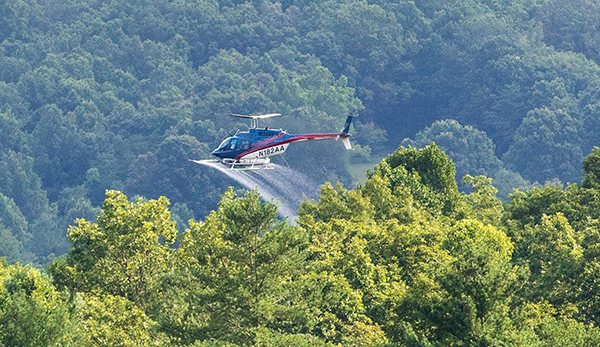
In the face of mounting criticism, Duke Energy has halted the spraying of herbicides in Western North Carolina.
Doug Woodward, who lives in the Oak Grove community, said that neither he nor his neighbors were notified in advance of the spraying.
“The first many of us knew of the operation was when the helicopter began releasing a cloud of mist over fields, roads and creeks in our valley,” he said.
“We’re going to reach out directly to property owners who will be impacted by this work,” said Duke Energy spokeswoman Meghan Miles. “We will not restart the program until we send those direct communications.”
About 3,000 acres were earmarked for spraying on rights-of-way maintained by Duke Energy Carolinas across its coverage area, including Western North Carolina, and Upstate South Carolina.
“While trees are part of the natural beauty of the region, they are also a leading cause of power outages and power quality issues,” Miles said. “Vegetation near power lines can also present a potential safety threat for utility crews and the public. Managing vegetation along power lines and in rights-of-way is an effective way to improve reliability for our customers who depend on us.”
Spraying is necessary because ground crews can’t reach some areas, Miles said.
“We’re really focused on areas that are rugged and really difficult for crews to access,” she said. “Trees and vegetation near power lines are the leading cause of power outages.”
The aerial herbicide program began as a pilot in 2017.
“We work to avoid neighborhoods, schools and community gathering spaces, as well as field workers and domesticated animals,” Miles said. “We review each site to evaluate potential obstacles and hazards before any herbicide applications are conducted.”
Angela Faye Martin, who lives in Cowee, is concerned about the impact of spraying.
While herbicides may be necessary to control the tallest trees that may encroach on power lines, spraying also affects “mid-story” vegetation such as dogwoods, Martin said.
“They can do better,” she said. “It’s not rocket science. It’s like killing all the bugs in the world just to kill one ant. It’s heavy-handed, it’s lazy. It’s cost-effective, but it’s a really grotesque way to approach this.”
Duke uses a chemical called Trycera, the active ingredient of which is triclopyr, according to Miles.
“Other herbicides in the mix include Krenite, Escort and Method,” she said. “Product mixes used at each application site address different vegetation species at the specific location, making the application as effective as possible. The blend/mix is very diluted at the point of application and is predominantly water [about 90 percent).”
All the herbicide chemicals are tested and approved by the EPA, she added.
“Our team works to minimize the impact to customers and our communities while also balancing the importance of reliably meeting our customers’ energy needs now and in the future.