
After a harsh history, hope for a better place
Barbara McRae
mcbarbara@frontier.com
The year 1941 was a tough one, especially for a young black boy in the Jim Crow South who was hoping to make his mark on the world. With the Great Depression hanging on and the nation teetering on the brink of war, it was a time of sweeping change and uncertainty.
This was the year that Eddie Ray’s parents sent him north, hoping he would find opportunities there that did not exist on his home ground. He was 15 years old.
Ray remembers his father, Andrew Madison Ray, leaving him at the Franklin bus station with this bit of advice: “Remember, whenever you need a helping hand, look at the two below your elbows before you call me.”
“I felt that was cold,” Ray says. “But I came to see that he was right.”
It cannot have been easy for his parents, especially his mother, Grace, whom Ray sees as the brave one, kicking her chick out of the nest before she knew he
could fly. But Grace saw strengths and talents in her youngest son, which she knew would languish in his hometown.
She was an uneducated woman, going no further in school than fourth or fifth grade, Ray recalls. “But, she always, always talked about … ‘You are important, you are intelligent, don’t let anybody determine who you are and what you can do but you. Especially when you know they don’t love you, when you know they don’t care for you.’”
“I’ve never forgotten that,” he says.
The lessons of his youth stood him in good stead as he worked his way to the top of the music industry. He made friends along the way with some of the most renowned musicians and music producers of our time and earned a reputation as a “pioneer music man.”
In his youth, Ray did not experience some of the common humiliations of Jim Crow, such as having to sit in the back of the bus. (“There wasn’t a bus.”) He feels that Franklin was a kinder place for a black child to grow up than some of the places he visited. The lack of opportunity he experienced here wasn’t necessarily because of racial relationships, he notes. But, there was no future here for meaningful work.
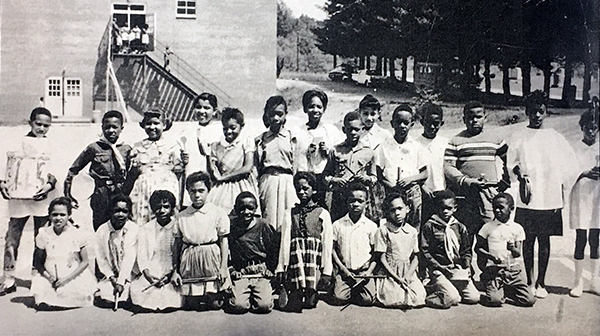
“I was born in the Jim Crow era. Everything was second class, especially in the South. That was also true in Franklin.” Where it manifested itself most powerfully was in the schools.
“The most difficult thing was primarily trying to get an education. It was out of reach for all black kids.”
And yet, none of this left him embittered. His mother made sure of that.
“We were never taught to hate anybody. I never heard conversations about hating white people.”
Legacies of slavery
The system Eddie Ray faced in Franklin was born of a complex and harsh history, beginning when the county was settled in 1820. Within 10 years of settlement, 5,333 people had moved in and established 811 households. Enslaved persons made up 5 percent of the population (274) and lived in 13 percent of the households (107).
The formation of Jackson County, which carved out part of Macon in 1851, reduced the number of slave owners in Macon to 85, while the number of those in slavery doubled between 1830 and 1860.
Though a small minority, mountain masters represented the most prominent group of residents in terms of wealth, influence, power and education. Historian John Inscoe, whose seminal work, “Mountain Masters, Slavery, and the Sectional Crisis in Western North Carolina,” was the first detailed study of this group, coined the term “Mountain Gentry” to describe them.
As Inscoe’s work makes clear, this was not the plantation South.
Geography made it impossible to cultivate enormous fields of cotton, rice or tobacco — crops that inspired low country planters to amass huge slave holdings.
Instead of monoculture, wealthy mountain masters like Dillard Love, William Angel, Thomas Shepherd and Jesse Siler depended on diverse crops and pursued other entrepreneurial avenues to build wealth. Commercial crops included apples, tobacco, wheat and other grains, sweet potatoes and garden vegetables.
Much of the early economy was based on cattle. Animal husbandry depended on putting cattle, sheep and pigs out to pasture in the mountains, where they could fatten on rich crops of chestnuts. Someone had to stay with them, to ensure their safety. Someone had to shepherd them during the long drive to market in Athens or Augusta, where the owner or a trusted deputy handled business arrangements.
These important tasks, including the business side, often fell to the household’s slaves, who were given considerable freedom and responsibility. Though they weren’t allowed to master reading, black people were permitted to learn arithmetic so that they could handle these kinds of chores. Other chores in the house or on the farm usually meant white and black members of the household working side by side, all of them developing a large repertoire of the skills required to survive – and thrive – on a mountain farm.
Beacons of freedom
One aspect of Macon County’s early settlement set it apart from other counties in the region: the arrival of a significant population of Free Persons of Color (FPOC). By 1860, 18 percent of black residents in the county were free, compared with just 8 percent statewide. Among them were some who arrived in the first wave of settlement, obtained land grants and became active in the community.
Fearing the presence of a growing FPOC population, North Carolina leaders passed a series of draconian measures to drive them from the state. For example, free black people were not allowed to enroll in the public-school system that was established in 1840. It was forbidden to teach black people, enslaved or free, to read. Marriage between free and enslaved black people was forbidden, as was marriage between whites and free blacks. In addition, the state made emancipation illegal.
Macon County is a long way from Raleigh. Locals tended to ignore – or perhaps were genuinely ignorant of – these restrictions. For example, in 1850, 12 of the 36 free black children here were enrolled in school, despite the law.
Hopes dashed by
Jim Crow
The Civil War and its aftermath of freedom brought hope to Macon County’s black residents, but with that blossoming of hope came chaos and new challenges.
It was a time of vast upheaval. Newly freed slaves traveled in search of opportunity in one of the great migrations of American history. For some, their path took them through Macon County, where they typically found a welcome in the homes of other black people. The households described in the 1870 Census dramatically reflect this phenomenon.
Despite some of the horrors of this period – rumors, for example, that newly freed slaves were carrying smallpox with them as they traveled — hopeful signs emerged.
Some former slave owners made efforts to help the black folk who had been part of their families. Assistance included gifts of land, economic aid, help resettling and personal care. Some white families took in orphaned black children or elderly former servants.
William Addington, a former slave owner and CSA captain, helped members of the black community establish an AME Zion Church and school on land he gave them.
A Yankee philanthropist, George Peabody, established a fund to provide educational opportunities for children in the South. He was especially concerned for the fate of black children. Two Peabody schools, created through his generosity, opened in Macon County — one for black children, in Cowee.
These individual efforts were not enough to halt other movements, such as the growth of the Ku Klux Klan and a new emphasis on racial separation.
Counties were required to operate separate schools for black children. It was an onerous burden for small governments in a time of economic malaise, with the entire educational system in ruin. It was not a good time for education, for children of any race.
The brightest chapter for black children in this grim era was St. Cyprian’s School, which was established in 1877. Those lucky enough to be able to attend received a rigorous education, were drilled in common academic subjects and learned vocational skills.
Jim Crow’s slow demise
With the establishment of Jim Crow laws, the black community seemed doomed to perpetual second-class citizenship. Although the 15th Amendment, in 1870, forbade denying any male citizen the right to vote based on “race, color, or previous condition of servitude,” the states found ways to introduce difficulties: poll taxes and literacy tests. It was nearly a century before the Voting Rights Act of 1965 made those requirements illegal.
The 1960s brought other needed reforms as well. The segregated school system that made it impossible for young Eddie Ray to get a decent education in the 1930s finally ended here, peacefully, in 1963.
Relearning history
History, they say, belongs to those who write it. For most of the past 200 years, in this region, those writers have been white. That changed in 2015, with the publication of Ann Miller Woodford’s richly illustrated book, “When All God’s Children Get Together.” The book focuses on the real lives of real black people, their personal stories, their families and homes, their spiritual lives, the role of music in their lives, their athleticism, patriotism, work experiences, and their interactions, painful or positive, with the larger society of which they are a part.
Woodford grew up in Andrews, but her mother was from Franklin and she has many ties to Macon County. One thing her book makes clear is how regionally focused the black community of WNC has always been. The small size of the population has promoted strong ties among the people, who frequently travel long distances for church meetings, family reunions, funerals and celebrations of all kinds.
Woodford’s book spawned a movement as communities throughout the region began to recognize the unique heritage it documented. She participated in traveling exhibits and presentations to groups large and small, black and white. She spoke to academic audiences and small rural community clubs, white churches and even the Sons of Confederate Veterans.
“It is a white world out there,” she says, noting that less than 1 percent of the population in the region is black.
Given the numbers, it isn’t easy for a white person, however determined, to get to know the black community. Historically, it has been easier for black people to understand whites. Many worked in service jobs in white homes, where they were largely invisible but observant retainers.
If you want to bridge the gap between the races, be prepared for discomfort, Woodford says. Opening herself to others in this way has brought her some difficult moments. For example, a friend told her, “My family had slaves, but they were good to them.”
The suggestion that slavery had its benign side was painful. Woodford reminded her friend that, by definition “a slave is someone who works without wages and doesn’t have anything.” Slaves were used without regard for their humanity.
Speaking out hasn’t always been easy for her. At 73, Woodford sees herself as being “more straightforward than ever before” as part of the conversation we must be willing to embrace, even when it hurts.
“To tear down these walls, you have to go through pain sometimes,” she says.
Tone of protest sparks hope
Both Woodford, at 73, and Ray, at 93, have positive feelings about the unrest occurring in the country now.
“I believe we’re going to a better place,” Woodford says. She is buoyed by the spirit of the recent peaceful protests in the region. She points to Bryson City, where the first attempt in the state to integrate public schools faced opposition and failure in 1955, but where 200 people gathered recently for a peaceful Black Lives Matter protest.
Herman Thomas, whose father led the failed desegregation effort in Swain County, speaks of it as planting a seed that later flourished. Woodford quotes him in her book: “I knew all along that the spirit of the people of Bryson City was fundamentally good.” She sees the same goodness in people throughout the region.
For Ray, the Black Lives Matter movement has the potential to become the most effective of the many similar efforts he has witnessed in his long life. “So many young white kids are involved,” he explains.
“Even though we’re going through a helluva time now with the virus and this, I think it’s going to come out good,” he says.