
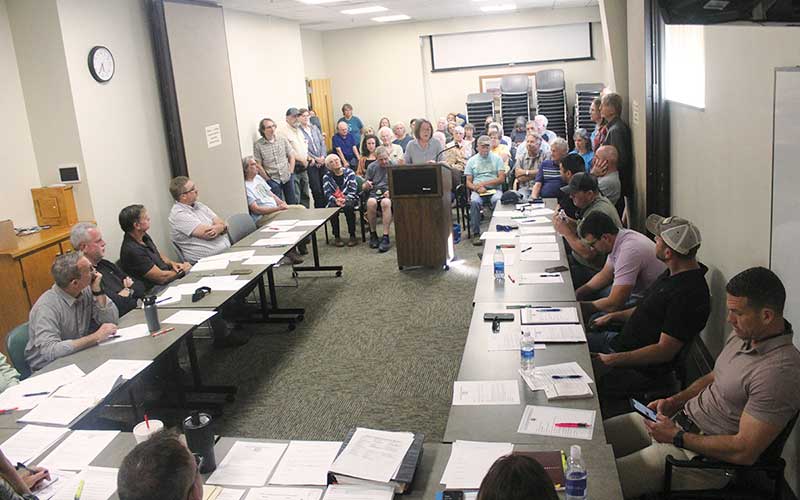
Local residents flooded the Macon County Planning Board’s May 2 meeting with requests for the board to protect or even strengthen the section of county’s floodplain ordinance that bars fill dirt from being used.
In total, 24 people spoke in just under 80 minutes. All but one spoke against having fill dirt in the floodplain.
At the end of the meeting, after the 10 planning board members present gave their thoughts, the board voted to table any action for further discussion. Nine voted “aye” while Marty Kimsey abstained.
At the March Planning Board meeting, Commissioner Josh Young requested that the board look at relaxing the rule barring outside fill dirt from being used in a floodplain. Young said he felt the rule was an extra burden on Macon County citizens, with the request from a local farmer who wanted to build an access road. The board canceled its April meeting due to a lack of quorum.
County Planning Board meetings often have few or no spectators, but this one filled the meeting room at the Macon County Public Health Center, with more in the hallway waiting for their turn to speak or to listen.
The public speaks
Many public speakers talked about the diversity of life in the Little Tennessee River and the need to protect it, arguing that fill dirt eventually will get into the river and divert floodwaters downstream, harming neighboring properties and houses through faster currents.
The speakers were landowners, conservationists, former planning board members, and in many cases, multiple-generation Macon County residents who spoke on the area’s scenic beauty.
Starting the public comments, Jason Love brought up the Iroquois’ “Seven Generation Sustainability” principle, saying our decisions should have the next seven generations in mind.
Doug Woodward said adding fill is contrary to the function of a floodplain. Aquatic biologist Bill McLarney, a landowner in the Little Tennessee River floodplain, said we should do all we can to maintain the river and feels lowering the protections is akin to “shut up and join the herd” and “choosing between mediocrity and excellence.”
Lewis Penland, a former Planning Board member and contractor, asked for a subcommittee to look at the issue and said he’s seen berms turn into giant steep banks due to erosion. Ricks Carson, who lives on the Cullasaja River said you can’t undo harm to rivers. Don Reis said he was a 35-year union laborer developing former farmlands before moving to Macon County and said he’s not proud of that work.
“You’re blessed with one of the most gorgeous places in the United States,” Reis said. “I don’t want to paddle down the river and look at the back of businesses.”
Susan Ervin, another former Planning Board member, said her parents regretted building their house on a floodplain before the county implemented the current ordinance. Nathan Pannell spoke on how the Cherokee took care of the land and equated the Little Tennessee River area to the Garden of Eden.
Kenneth Pannell said from a business standpoint working for the phone company, they had service go out from equipment above the floodplain during Hurricane Ivan and asked the planning board to leave the current ordinance alone. Karen Hawk said as a Highlands resident, she understands how everyone else in Macon lives downstream and would feel the impact of what they do. Hawk mentioned seeing what water could do from the 2004 Peek’s Creek mudslide and debris flow that killed four people.
Sara Johnson of Otto spoke on the biodiversity in the Little Tennessee River and how diverting from current floodplain regulations could cause flood insurance rates to increase.
Kenneth McCaskill of N.C. Farm Bureau said he was the local director when the county passed floodplain protection ordinances and wants to strengthen those instead of allowing fill. McCaskill said he didn’t want to lose farmlands for “shortsighted people trying to make a profit,” and said the state Farm Bureau board endorses the current fill dirt restrictions. McCaskill said developers call asking about his land on the Little Tennessee regularly.
Michelle Ruigrok said people can be innovative and creative without using outside fill. Jordan Smith, executive director of Mainspring Conservation Trust, said they typically don’t weigh in on policy but said their entire board, past board members, staffers and investors were against allowing fill in the floodplain. Smith said he drives through two counties that allow fill dirt in floodplains and sees the results.
“The Tuckaseegee now runs red with every rain event,” Smith said.
Ken Brown, Jackson County Planning Board member, said they admire the Little Tennessee River’s protections and urged the Macon board to leave their floodplain ordinances as it is. Angela Faye Martin, co-founder of Alarka Expeditions, said developers destroyed her North Georgia childhood forest and she was hurt having to defend the Little Tennessee River. Martin said she spoke for herself and as a proxy for her competitor Jerry Anselmo of Great Smokey Mountain Fish Camp & Safaris.
Stan Polanski said he was proud of the foresight to protect the river. Alton Reynolds asked if it would be fair to put one person’s desire to fill in a floodplain over a neighbor’s desire to have a home. Scott Baste said he paddles down Tessentee Creek and said it’s hard because of all the fill dirt.
Ed Haight said he supported the current ordinance and Tom Young said it’s easy to mess up the environment.
David Culpepper, Franklin Town Council member, was the lone speaker for allowing any fill into the floodplain, calling the current ordinance “a poison pill.” Culpepper talked about a developer who bought the Tyler’s Motel property and wanted to open an RV park but got denied a permit because of the floodplain ordinance. Culpepper said the man went bankrupt and lost the property, which is still in disrepair. Culpepper also said landowners want small additions such as small culverts and access roads, claiming the ordinance isn’t fair for those who want those changes. Culpepper also owns property along the river.
The last speaker, Heather Johnson, pointed out none of those farmers or landowners he referenced showed up to speak.
The Planning Board discussion
After public comment, planning board chair Jean Owen allowed each board member to speak. Lee Walters said he wants to address some parts of the ordinance, including finding ways to alleviate cost burdens for property owners and allow the use of materials already in the floodplain. Ben Laseter said the ordinance does a lot of good, and he doesn’t want to jeopardize what they have and wanted more technical and legal advice.
Larry Lackey complimented Culpepper and said he wanted to “blow the dust off” the ordinance while avoiding giving “carte blanche” to developers. Kimsey said if it were up to him, he’d have a county-wide referendum and feels like a relaxation or fill dirt rules would pass.
Franklin Planning Director Justin Setser said as a firefighter, they have a list of homes they know flood every heavy rain and didn’t want to add more houses to the list. Setser said he liked the idea of offsetting fill.
Mark Berry said there were a lot of good points and believes in being a good neighbor. Berry said fill dirt shouldn’t be completely restricted but wanted more information before deciding. Barry Breeden said the passion behind some of the arguments made him think and he would love to take a field trip.
Ben Ledford said the smaller fill projects need to be looked at and wanted more time to research. Highlands Planning Director Michael Mathis said the comments changed his opinion on how he would vote and maybe look at a no adverse impact study requirement for fill dirt applicants. Luke Jakushev said that was a heck of a meeting for his first and said he’s not jumping to conclusions. The meeting was Jakushev and Kimsey’s first since their appointment by the county commissioners.
Owen said she felt some aspects of the ordinance needed to be tweaked but mirrored others in wanting more information.
Lackey asked about the makeup of a potential subcommittee and who could be on it. The consensus was that those questions needed to be answered by the county attorney.
“We need more knowledge before a decision is made,” Owen said.
The Planning Board didn’t take up any other issues besides having the members sign an updated standard of conduct. Jakushev and Kimsey briefly introduced themselves at the start of the meeting as they were the new board members.
Conflict of interest?
In their public comments, Ervin and Martin spoke about a commissioner with a potential conflict of interest. While not giving specifics during public comments, Martin later confirmed they were talking about Young.
On March 7, Steele NC, LLC, finalized the purchase of three adjacent tracts of land along Georgia Road north of the intersection of Coweeta Church Road, a combined 5.04 acres, for $150,000 total. The flat properties all border the Little Tennessee River and are in the floodplain. Steele NC, LLC, was formed Sept. 5, 2023, with Young as the registered agent, according to the business registration on file with the N.C. Secretary of State.
When asked about the properties, Young said he’s been pursuing those parcels for 15 years and said relaxing the fill dirt rules is separate.
“It’s a principled interest for me. Numerous farmers and numerous landowners are trying to fill their land and all I want to do is follow state guidelines, nothing more and nothing less,” Young said.
Young said he’s always advocated for less government control, less government restrictions and people’s property rights and this fill dirt issue falls in line with his beliefs.
Young says the purchase timing was “probably terrible” given he first proposed the fill dirt changes to the planning board on March 7, the same day he closed on the three parcels. Young added that he would be willing to deed restrict those parcels as a show of good faith.
“I don’t want anyone to change the rules for me,” Young said.
Young said he intended the fill dirt discussion on the planning board to be healthy, but from what he heard, he feels the meeting got “Derailed by a certain interest group that flooded it with people who are very emotional.”