
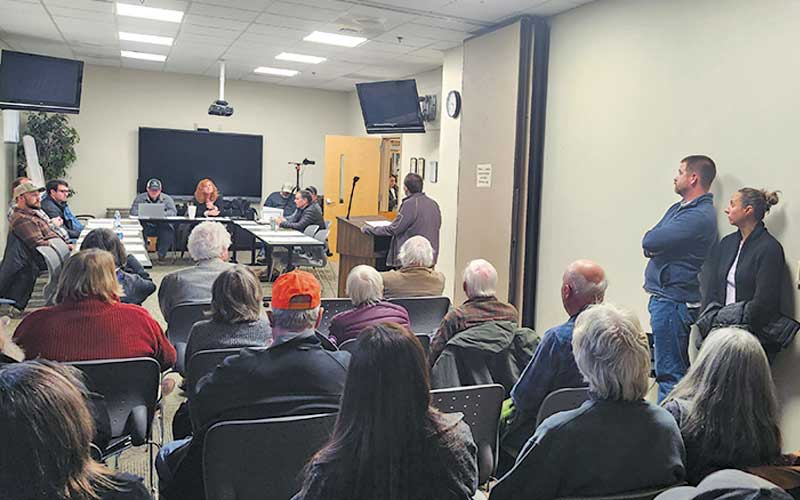
By a 5-2 vote, the Macon County Planning Board rejected recommending a controversial floodplain fill proposal during its Jan. 2 meeting.
The motion by Highlands Town Planner Michael Mathis specifically mentioned the “no adverse impact” parts of the ordinance. Later in the discussion, Mathis amended his motion to recommend “procedural changes” to the Flood Damage Prevention Ordinance that don’t have to do with changing the ordinance requirements.
Voting to reject the proposed ordinance changes were Mathis, Ben Ledford, Lee Walters, Luke Jakushev and Jean Owen. Voting “nay” was Marty Kimsey and Mark Berry. Not in attendance were Larry Lackey, Justin Setser and Ben Laseter. According to Macon County Planner Caleb Gibson, Barry Breeden is no longer on the Planning Board due to being sworn in as a county commissioner.
The Planning Board is an advisory board and makes recommendations to the Macon County Board of Commissioners. In turn, the commissioners can vote however they please on an ordinance change.
Currently, Macon County does not allow any outside fill in a floodplain. The proposed amendment would allow 25% of a floodplain acre to be filled and allow more if an applicant can get a Certification of No Adverse Impact signed by a licensed civil engineer.
The 25% proposal by former County Planner Joe Allen came after a committee of Commissioners Josh Young and Danny Antoine and Planning Board members Larry Lackey and Barry Breeden held one meeting in May 2024 to make sure the proposed changes met the minimum state guidelines.
Mathis said one of his reasons for voting to deny the no-adverse-impact section was that FEMA and the N.C. Department of Emergency Management are currently updating their maps for flood prevention. Another was after reading the Water Quality Advisory Committee’s report, which unanimously recommended against the proposed changes.
Kimsey raised a point of order, saying that the commissioners never voted to send the Flood Damage Prevention Ordinance changes to the planning board. Thus, Kimsey argued, it would be out of order to even take up the proposed ordinance changes, especially with the state and FEMA working on its maps.
Walters countered Kimsey’s point, saying the commissioners had directed the Planning Board.
The commissioners never had any formal vote to send any of the proposed ordinances to the Planning Board, rather just coming to a consensus. Owen, re-appointed as board chair at the start of the meeting, said the commissioners made their wishes clear at the start of its September 2024 meeting to have the Planning Board look at this and the Watershed Protection Ordinance changes proposed. The Planning Board recommended the changes to the Watershed Protection Ordinance by a 4-3 vote in October 2024.
Kimsey said he’s been getting calls from property owners who want to change the ordinance, but don’t want to go to meetings and “get their name drug in the mud…they don’t want to be in the newspaper.” Kimsey dismissed the speakers against the floodplain changes by citing the Fifth Amendment of the U.S. Constitution.
“If you’re too restrictive, if all you can do is you own a piece of property and you can grow grass or trees on it, you’re basically taking property without due process and just compensation,” Kimsey said, later adding “There’s 35,000 people in this county, not 50.”
Eventually, Kimsey withdrew his point of order at Owen’s request. Owen said she didn’t want to rule on the point of order without the county attorney, who was not at the meeting.
Walters said he was disappointed the commissioners’ request to look over the Flood Damage Prevention Ordinance wasn’t broader than voting on one set of proposed changes.
“We were told to work directly with the [Water Quality Advisory Committee] and come up with something. And you guys made a nice presentation that I think…we could have woven improvements and your suggestions and come up with something solid,” Walters said. “But it was crickets as far as I’m concerned from the county commissioners. No direction whatsoever.”
Young, who has pushed for the floodplain changes, was not in attendance on Jan. 2.
Lake Emory Dam study punted to commissioners
Acknowledging how huge a change it would be and with no opinions formed, the Planning Board voted unanimously to send the topic of studying the effects of removing the Lake Emory Dam back to the county commissioners.
The motion came from Owen, who said as a Planning Board, they can’t pay for a comprehensive study.
“I do know that there are years of toxins built up on it,” Owen said. “And I just think that in my opinion, this needs to go back to the commissioners, and they need to order a comprehensive study.”
Lake Emory holds untold tons of sediment and byproducts from decades of urbanization and riverside businesses. The Town of Franklin built Lake Emory Dam in 1925, creating Lake Emory in the Little Tennessee River. Duke Energy owned the dam and lake from 1933 until 2019 when Northbrook Carolina Hydro II LLC bought the dam and the 179.83 acres of Lake Emory/Little Tennessee River for $35,000.
Kimsey said that he has an open mind and wished to go back 100 years and not build the dam in the first place, but noted it still produces electricity. Walters said it would be great to restore the river and there are issues with leaving it the way it is.
The assessed value of the land and dam is $320,600 as of December 2022, with the land and lake being described as a “wasteland” in the tax bill.
Northbrook Carolina Hydro II LLC is a subsidiary of Northbrook Energy based in Scottsdale, Arizona.
Now-former-Commissioner Paul Higdon made the request for the planning board to look at the effects of removing the dam. Higdon argued removing the dam would make the Little Tennessee River more free-flowing and a great recreational asset.
Public comment against floodplain fill
Eight members of the public spoke to the Planning Board on Jan. 2, all of whom were against the proposed ordinance changes. The seating in the meeting room at the Macon County Health Department was filled with more people standing along the walls or in the hallway.
Narelle Kirkland said nature finds the easiest path to destruction and hopes the Planning Board doesn’t want to put people at risk.
Callie Moore of MountainTrue said there could be limited amounts of fill for parking and not the wholesale changes suggested. Moore noted every speaker in favor of the ordinance changes in recent months had issues with not being able to fill in for parking or vehicular access.
Bill McLarney said he heard from Josh Young that the commissioners will table the floodplain discussion indefinitely. McLarney said the Lake Emory Dam discussion is very complicated and offered his services for such a study.
Kenneth McCaskill of the Macon County Farm Bureau reiterated that his board is opposed to filling in the floodplain, saying it can damage and eliminate farmland, which is already decreasing in North Carolina. McCaskill also said that filling in the floodplain can lead to costly emergency situations after heavy rain, and that state minimum regulations are not one size fits all.
Angela Faye Martin spoke on the Little Tennessee River’s biodiversity, saying ecology was more important than real estate value.
Nathan Pannell decried meeting in a “cramped room” right after a holiday, saying it stifles public involvement. He said a third party should investigate how these ordinances were brought up, or everyone involved should resign.
Gwynn Lindler spoke on how Hurricane Helene impacted the Eastern Hellbender population and how the proposed regulations won’t help that species.
Sarah Johnson said Helene taught us people should give the rivers some space and Macon County should have stricter floodplain regulations than the state. On the Lake Emory Dam, Johnson said it’s wise to leave it as is until there’s a good plan, noting removal could lead to polluted sediment washing downstream into Needmore game lands.
“The old timers used to say, ‘never drink out of the stream that don’t have a salamander in it,’” Johnson said, explaining how Franklin has a great drinking water resource that Helene almost damaged.