
Three days of focus groups and meetings with students, teachers and community members in Nantahala, Highlands and Franklin kickstarted the Macon County Schools strategic planning process last week.
Human Restorative Project, a nonprofit hired by MCS to conduct the surveys, held focus groups in Nantahala on March 4, Highlands on March 5, and Franklin on March 6. Each day followed a pattern of meeting with students and teachers during the school day, and then community focus groups after school.
Human Restorative Project’s Chris McNutt, co-founder and executive director, and Nick Covington, creative director, conducted the focus groups, which they recorded.
During the Franklin community focus group, McNutt and Covington shared some of what they found out.
“When we ask kids, “Hey, how would rate your experience on a scale of one to five, a lot of them say like a three or a four,”” Covington said. “The conversation then comes, “How do you we get that three to a four….or get a four to a five.”
Covington said no student gave a one, but they did have some who rated their school experience at a two. Students at all three schools spoke of a want for more hands-on experiences, Covington explained.
Another point heard during the discussions was the lack of a systemic approach to K-12 expectations for collaborative learning. One parent said her kids deal with at least one teacher leaving a year, many going to other schools, specifically to high school classrooms. Another parent said going from elementary school to a middle grades school for only two years is tough because you can’t develop the same relationships, equating it to “leaving a big, warm hug” of elementary schools.
McNutt said a highlight they noticed was love for the teachers.
“The kids tell us “school’s OK, but I really like my teachers,” McNutt said. “The kids told us 90% of their teachers are awesome…but school is just OK.”
McNutt later said one teacher told them the teacher-specific focus group was the first time they’d been able to sit with fellow faculty due to constant demands put on them.
Another highlight was concern about students’ exposure to different perspectives.
“A teacher shared with us she feels like a mother duck when they go to events because when you take kids out of the community and put them in big groups, all the groups just follow that teacher around and they’re scared to interact with other people,” McNutt said. “Being a small, familiar community has its assets but also has its drawbacks. And one of the drawbacks is “what happens when I go to a community that’s different than my own.”
McNutt said one Nantahala student told them their only exposure to people of different cultures was through the tourism industry.
The last highlight the facilitators noted was kids craving hands-on experiences, followed by a discussion of how to facilitate and fund those experiences.
McNutt suggested MCS be active in telling the stories of needing funding for programs through social media.
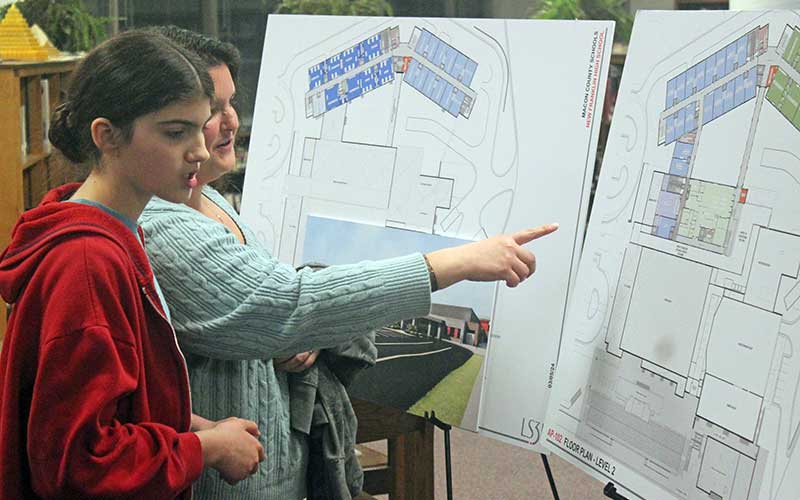
While not specifically discussed during the Franklin community meeting, Emily Kite with LS3P was on hand with Franklin High School renderings. Kite told attendees that LS3P will soon complete the construction documents.
Afterward, McNutt said they will “spend the next few weeks diving into what we learned from students, what we learned from teachers…etc., and compiling that into a report.”
McNutt said they work with a constructive communications process developed by MIT to synthesize the findings. McNutt said after that process, Human Restorative Project will give the findings to Open Way Learning, a local nonprofit, who will meet with district leaders over multiple weeks and months.
Macon County Schools has a one-page stakeholder survey that goes along with the focus groups online at tinyurl.com/MaconCSSurvey.