
Jake Browning
reporter@thefranklinpress.com
Monday night’s installment of Cowee School’s Where We Live speaker series provided a glimpse into the lives of the women who helped make Macon County what it is today in a lecture titled “It Happened in the Graveyard ... Beginnings of a Women’s History Trail.”
Marty Greeble, vice president of the Folk Heritage Association and a co-leader of the Women’s History Trail, presented the lecture.
After giving a brief history of the Women’s History Trail (WHT) and what motivated its leaders to establish it, Greeble turned her attention to the cemetery at First United Methodist Church, where many of the women who are recognized on the trail are buried.
Greeble talked about Eloise Potts, the first female mayor of Franklin, Ruby Dowdle Beshears, who opened Franklin’s first bed and breakfast, Arrah Belle Wilson Johnson, the first female publisher and editor of The Franklin Press, and many more women who contributed to Macon County’s early development in schools, salons, libraries, factories and beyond.
“It’s a very fascinating graveyard,” Greeble said. “You can go through the graveyard and pick up hints and tips and see how people are related and try to build a history.”
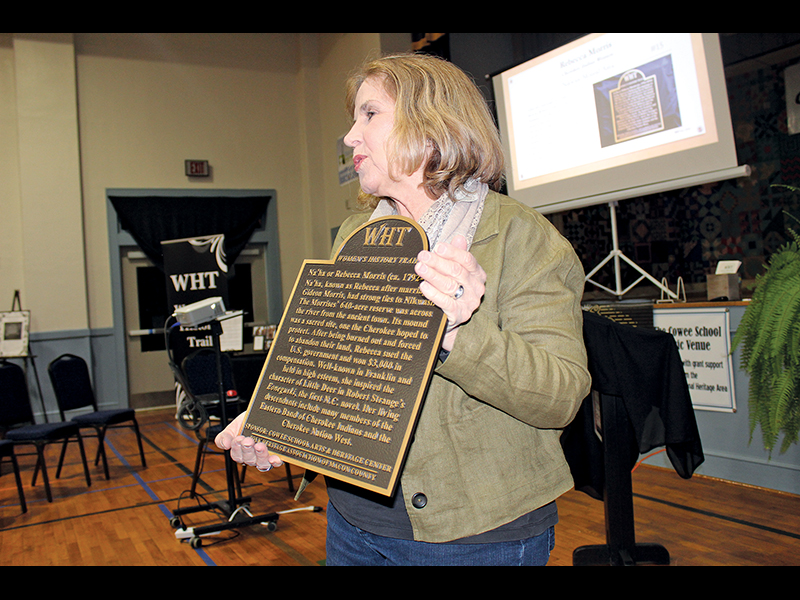
Greeble also discussed what the near future will be like for the Women’s History Trail. The next plaque on the trail will be dedicated to Rebecca Na’Ha Morris, who sued the U.S. government after her people were burned off their land in the area of the Nikwasi Mound. Greeble showed off the plaque for the attendees and said it will be installed soon on the kiosk being developed by Nikwasi Initiative for Nikwasi Mound.
The Women’s History Trail has commissioned Academy- and Emmy-award winning sculptor Wesley Wofford to install a statue of Morris, an African American woman known only as Sally, and Harriet Timoxena Siler Sloan. All three women lived on the same tract of land along the Little Tennessee River at different points in Franklin’s history.
Mary Polanski, another leader of the trail, said that Wofford’s clout as an artist and the stories of the three depicted women will be an asset to Macon County’s historical tourism in a couple of years.
“We’ve looked at what he’s projected, and it will take about two years,” Polanski said. “That’s a generous timeline for this artist. There will be people who come to Macon County just to see this statue.”
Cowee School Arts and Heritage Center chairman Bob McCollum continues to be impressed by the turnout at every Where We Live event and appreciates the interest that his neighbors show in staying educated about local history.
“We were excited about this series from the beginning, but I never expected it to be as well-received as it has been,” McCollum said. “We’re happy that this is something that we can continue to do with the community’s support.”
Where We Live will take a break next month while Cowee School members prepare for the Balsam Bee and Cowee Christmas. The series will resume on Monday, Jan. 20 with a presentation by Stacy Guffey on mountain dialects.