
Schools look at ways to offer more vocational career paths
At a recent meeting of the Macon County Planning Board, residents of the Carson community had the chance to share their most pressing social concerns with the board members.
Some of their biggest issues were familiar, like poor internet reliability. One surprise point of contention, however, was vocational education for students who want to pursue a trade.
Carson Community Club president Brenda Elliott brought up the topic when the meeting’s focus shifted to education. Referencing vocational schools in more urban areas of the state, she mentioned that more technical curriculums save a lot of money and time for students interested in carpentry, auto repair, electrical maintenance, culinary professions, cosmetology and even nursing.
Because these are jobs that are needed just about everywhere, Elliott also feels that encouraging students to pursue these educational pathways will help keep them living and working in Macon County.
“We need these kids to stay here,” Elliott said. “If they can make a living here, let’s help them go to work. Let’s go for this.”
Macon County Schools superintendent Chris Baldwin says that he also values teaching students technical skills and affording them more opportunities to advance in whatever fields they choose. However, he sees that as a two-way street. He feels it’s the schools’ place to provide the students with information, not to tell them how to use it.
“Our mission is to help students develop career goals and prepare them to be successful in the field of their choosing,” Baldwin said. “Certainly, trade school is an excellent option for students, but we steer away from pushing students in a certain direction. Students need to be prepared for a variety of jobs.”
Baldwin also pointed out that Macon Early College already provides a great option for students looking to earn professional certificates and two-year degrees while working on their high school diploma. This program only accommodates a small percentage of all Macon County students right now, but Baldwin is open to expanding it as student interest grows.
“MEC and SCC are currently able to offer a good variety of opportunities for our students,” he said. “We would like to offer additional courses. Students must show enough interest in these courses in order for them to be financially viable.”
Macon County Schools career and technical education director Todd Gibbs said that Franklin High School offers 11 vocational pathways for students interested in earning their technical degrees in drafting, family sciences, business and more. These students work closely with SCC, but their credits are transferable to many institutions. While there isn’t a robust CTE focused scholarship program, the school system saves these students a lot of money on their early classes and can help connect them with internships and apprenticeships for after graduation.
“When they’re taking a course that’s worth future credit in a high school class, it’s like they’re getting a scholarship,” Gibbs said.
Finances are a critical part of the equation. Recent reports place the cost of the average bachelor’s degree at around $127,000, while an average vocational degree or certificate costs closer to $33,000. Even without factoring in how these degrees affect earning power, the upfront costs of a four-year college are prohibitive to many students, and the excessive burden of student loan interest doesn’t help.
Tyler Goode, SCC’s director of public relations, said the college is a good option for anyone looking to learn new professional skills at a competitive price. The programs they offer cater to aspiring real estate agents, forest rangers, emergency service professionals, welders, construction workers, casino dealers and more.
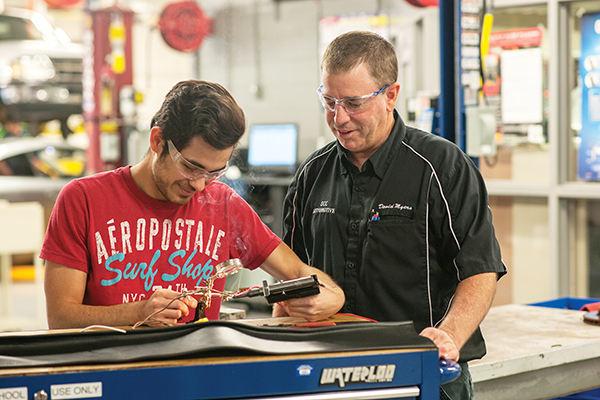
David Myers, automotive systems technology program coordinator and instructor at SCC, said vocational education at the high school level is extremely efficient for many students. His program works in tandem with Franklin High School and students who take all coursework available to them can get halfway to an automotive systems technology degree by the time they finish high school.
With that kind of background, Myers said, it doesn’t take long to begin a fruitful and fulfilling career.
“There is great money and high demand for this field,” Myers said. “I am regularly placing students all the time. You can always find a job with skilled labor.”
For more information on classes available through SCC, go online to southwesterncc.edu.