
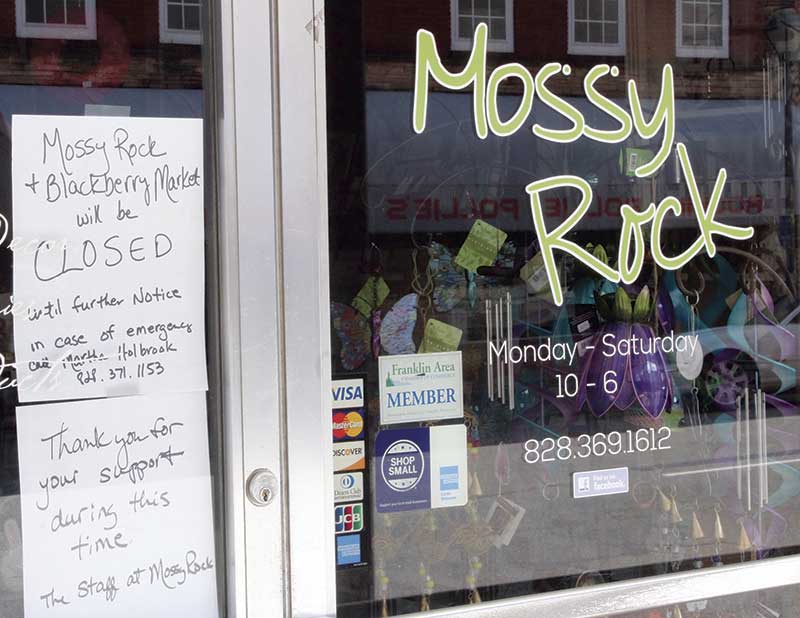
The impact of the coronavirus and measures to combat it have already taken a heavy toll on some Macon County businesses, with many retail shops and hospitality operations shut down.
“We’re just getting into the season where they really make their money,” said Tommy Jenkins, director of the Macon County Economic Development Council. “It’s going to really hurt, especially not knowing how long it’s going to last. There’s no way to plan.
“We’re in uncharted territory.”
Local manufacturers have been relatively unaffected.
“As of yet, our industry is considered to be an essential infrastructure industry,” said Chris Norton, plant manager at the Beasley Flooring plant in Franklin. “So far we haven’t seen impact on either end, in incoming lumber or in outgoing sales. We expect we might see an impact on our sales end.”
Beasley human relations manager Len Cody said the company has taken measures to protect its employees.
“One of main things we’re doing a lot more cleaning, to try to maintain a healthy environment and protect the health of our employees,” he said.
Jenkins still finds room for optimism.
“If we could come out of this thing fairly quickly, there would still be time for the economy to recover during our main season, during our tourist season,” he said. “There’s still going to be a lot of small business that are going to need some sort of assistance.”
Various sources of assistance are already available.
The N.C. Rural Center and the Golden Leaf Foundation launched the N.C. Rural Center Rapid Recovery program with $15 million in funding for businesses that have suffered economic losses as a result of the coronavirus.
That’s the fastest I’ve ever seen such a response,” Jenkins. “They ran through $15 million in 48 hours.”
Jobless claims have soared. In the past two weeks, approximately 270,000 claims have been filed, with most of them related to COVID-19, Gov. Roy Cooper said on March 29.
For comparison, the state received about 7,500 claims in the first two weeks of March, before the order was issued.
What’s most concerning to Jenkins are the unknowns.
“We don’t have is a definitive picture of what is coming down the pike for federal assistance,” he said. “My main fear is that the federal assistance will not benefit the small businesses in rural areas. Hopefully the feds and the state will be able to see that and give extra effort in rural areas.”
Business owners can apply to the N.C. Department of Revenue to have their status as non-essential reviewed.
“If [businesses] feel they are excluded from the list of COVID-19 Essential Businesses and Operations but believe that they may be essential, then they have the opportunity to make a request to the Department of Revenue to be included as a COVID-19 Essential Business or Operation,” according to the NCDOR. “A business that has made a request to the Department to be included as a COVID-19 Essential Business or Operation may continue to operate until that request is acted upon.”
Business owners can make that request online at ncdor.gov/home/ncdor-actions-covid-19/covid-19-essential-businesses.
The Small Business Administration is offering low-interest federal disaster loans for working capital to North Carolina small businesses suffering substantial economic injury as a result of the Coronavirus (COVID-19), according to SBA administrator Jovita Carranza.
The governor’s proclamation declaration makes SBA assistance available in the entire state of North Carolina, according to the SBA.
“Small businesses, private non-profit organizations of any size, small agricultural cooperatives and small aquaculture enterprises that have been financially impacted as a direct result of the Coronavirus (COVID-19) since Jan. 31, 2020, may qualify for Economic Injury Disaster Loans of up to $2 million to help meet financial obligations and operating expenses which could have been met had the disaster not occurred,” said Carranza.
Eligibility for Economic Injury Disaster Loans is based on the financial impact of the Coronavirus (COVID-19). The interest rate is 3.75 percent for small businesses. Applicants may apply online, receive additional disaster assistance information and download applications at disasterloan.sba.gov/ela. The deadline to apply is Economic Injury Disaster Loan is Dec. 18.
Here is a list businesses deemed “essential” in Gov. Cooper’s stay-at-home order:
• Restaurants that provide take-out, drive-through or delivery
• Grocery stores
• ABC stores and beer and wine stores
• Doctors and other healthcare providers
• Pharmacies
• Hardware stores
• Post offices
• Office supply stores
• Gas stations and convenience stores
• Veterinarians and pet supply stores
• Hotels, airlines, buses, taxis, and rideshare services
• Places of worship
• Child care providers (that are following the required NCDHHS procedures)
• Food, beverage production and agriculture