
The Macon County Board of Education heard a presentation from the digital curriculum provider EVERFI about an opportunity to expand access to mental health resources in Macon County Schools during their meeting on Monday night.
EVERFI’s Mental Wellness Basics program consists of four 15-minute online lessons targeted at students in grades 8-10. The lessons cover subjects like identifying risk factors for mental health problems, coming up with strategies to cope with negative thoughts and developing empathy to reduce the stigma that often comes with asking for help. Thanks to sponsorship from HCA Healthcare and Angel Medical Center, the school system could implement this curriculum for free and deploy it in whatever setting they decide is most appropriate.
“They’re typically placed in a health class or advisory setting,” said Aaron Harris of EVERFI. “It just depends on what works best for any individual district or building.”
In addition to mental wellness, EVERFI also offers education in STEM fields, finance, drug safety, digital wellness and workplace ethics, among other subjects. Macon County Schools STEM coordinator Jennifer Love said the company has a strong reputation for providing high quality content. While the school system hasn’t contracted with them before, receiving support from them for free could be a major opportunity.
“It is very well-respected,” Love said. “I know other school systems in the region use EVERFI and it is a very well-respected program.”
Student mental health was turning into a hot button issue even before 2020 because of the impact the rise of social media has had on the way children communicate. Once the pandemic began and hit kids with virtual schooling, quarantines, masking mandates, irregular schedules and a bevy of other status quo changes that still haven’t completely gone away, many began to see student mental health as a full-blown crisis. Even at the federal level, leaders are singling out mental health as a top priority for schools.
“Epidemiological data now shows alarming rates of behavioral health needs among school-age youth, with significant increases in the number experiencing moderate to severe anxiety and depression,” reads a White House press release from October detailing the federal government’s approach to student mental health resources. “Even more concerning, suicide remains the second leading cause of death among young people between the ages of 10 and 24. Mental health emergencies among young people have increased across the board. In 2020, there was a 24% increase in emergency room visits for mental health reasons for children ages 5 through 11, and more than a 30% increase in visits for those between 12 and 17 years old.”
The state government is also focusing on mental health. Last November, the North Carolina State Board of Education adopted a new set of comprehensive standards for school systems to tailor mental health plans to their students in the form of the School-Based Mental Health Policy.
Last May, Gov. Roy Cooper allotted $5 million to the University of North Carolina system specifically for mental health concerns, reiterating that even postsecondary students are facing unique challenges.
“According to UNC, eight in 10 students say their mental health has been negatively impacted by the pandemic,” reads a May release from the governor’s office.
“National data reinforces the urgent need to supply campus communities with the training, resources and expertise to better support students, staff and faculty.”
The school board decided to take some more time to consider the deal before accepting it, but EVERFI has their attention. Mental health and suicide prevention have come up frequently in recent School Board meetings as Macon County parents worry about how their children have suffered during the pandemic.
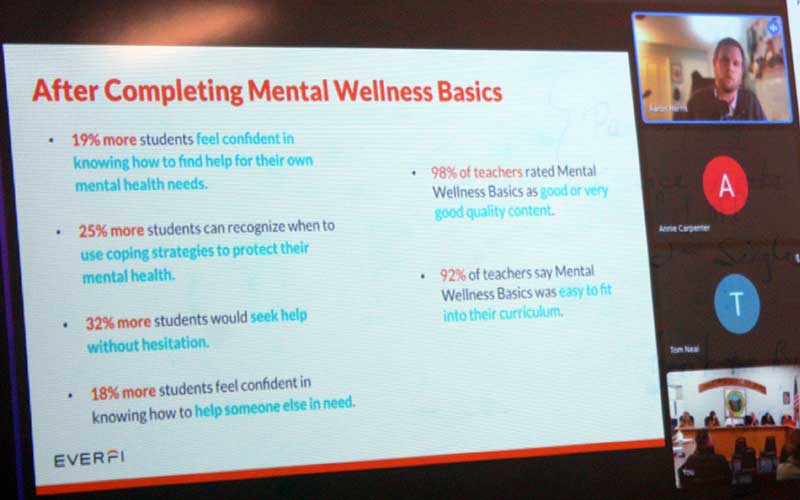
EVERFI claims that among students who have taken their Mental Wellness Basics training, 19% more said they felt confident handling their own mental health needs after the class than before it, 18% more said they felt confident helping someone else and 32% more said they were willing to seek help without hesitation – all numbers that could potentially make a life-saving difference.
“It’s certainly something I think could be helpful,” board member Hillary Wilkes said.
One piece of news that will be good for many Macon County Schools families and their mental health – the first month of the board’s mask optional policy was largely successful. In revoking the requirement to wear face coverings in school buildings at their last meeting, the board bet that any increase in quarantines and positive cases would be small at this point in the pandemic, and the data so far seems to back up their bet.
At the time of the meeting, there were 97 students and four staff members in the school system who were out due to quarantine or a positive case, and while those numbers have fluctuated throughout the month, there were 111 students and 10 staff members out on Oct. 15, so Nov. 15 was actually a little better.
“We did see a slight increase in the number of students in quarantine, which was anticipated, and we did see just a slight uptick in the number of student positive cases,” Superintendent Chris Baldwin said. “However, none of the student positive cases that we’ve seen in schools since the last board meeting have been traced to in-school exposures… the question is how much things have changed since our last meeting, and the answer is very little.”
The Macon County Board of Education will have a special called meeting on Monday, Nov. 22 at 5:30 p.m. to discuss how to use the last of their Elementary and Secondary School Emergency Relief (ESSER) funding.