
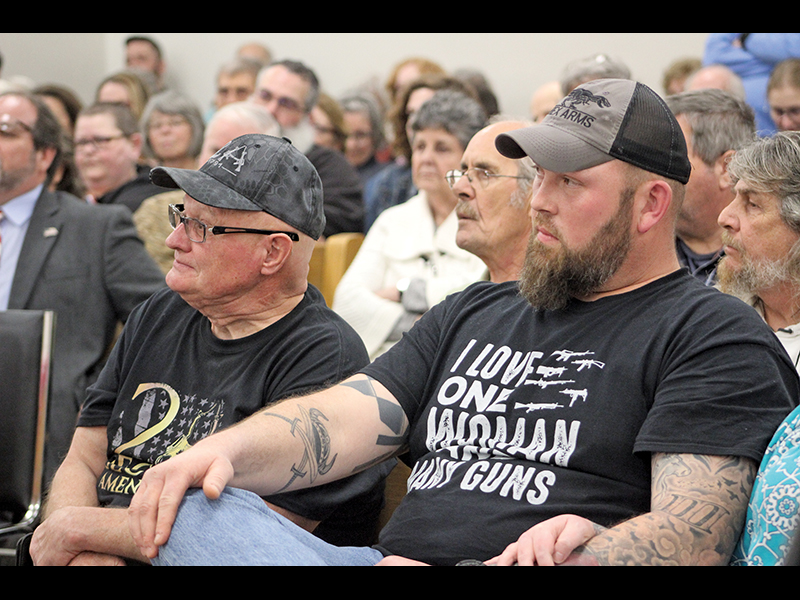
Some county residents are impatiently waiting for a decision on whether or not Macon County will become a Second Amendment Sanctuary.
More than 400 local governments in 20 states have adopted resolutions to become Second Amendment sanctuaries, resolving to protect gun owners’ rights regardless of laws passed by state and federal governments. The concept has gained popularity in 2020 following the rise of a sweeping gun control agenda in Virginia’s new state legislature. Text varies by resolution, but no resolution serves as actual policy and instead serves as a symbolic commitment to upholding gun rights.
“All this would be doing, if the commissioners adopt it, is firmly saying that the county will stand up for the Second Amendment whatever else happens in the federal government or the state government,” Macon County Sheriff Robert Holland said.
In Macon County, Donnie Holden has become the face of the drive for a resolution. Holden has been drafting a resolution to put in front of the Macon County Board of Commissioners over the last few weeks and has gotten hundreds of signatures on petitions to adopt that resolution. At the commissioners’ Feb. 11 meeting, he reiterated his stance that absolute rights to gun ownership are essential to maintaining a free country.
“This resolution will be a symbol,” Holden said. “That’s what this thing is to the federal government and to the state government. It’s a symbol that the people believe they are free, and we’re going to hold to that.”
A large crowd of supporters for the movement joined Holden in addressing the commissioners. Each of them had their own reasons for supporting it, but most cited the absolute sovereignty of the Constitution and the necessity of self-defense.
Dave Hurd, for example, argued that the types of guns available to private citizens should not be influenced by what they need to hunt or fend off standard home invaders when the Second Amendment was conceived of in the midst of a rebellion against a federal government.
“I don’t need 30 rounds of ammunition to hunt with, but the Founding Fathers did not write the Second Amendment because the deer were coming,” Hurd said.
Opponents make their case
When Holden proposed a resolution at the January 2019 commissioners meeting, most of the crowd was seemed to be in favor of it. This month, however, detractors of the idea made their voices heard. Susan Ervin spoke on behalf of a group of women, many of whom she said were uncomfortable attending the meeting under such tense conditions. She made the case that gun violence disproportionately affects women and children, particularly in dangerous home situations.
“Among 23 high-income countries, 92 percent of women killed by guns are in the United States,” Ervin said. “Many of these are the result of domestic violence. Seventeen million children in the U.S. live with unlocked, loaded guns in the home. Eighty-nine percent of shooting deaths of children occur in the home.”
Henry Horton said that determining what is constitutional is not up to local authorities.
“I’ve been reading the resolution,” Horton said. “It does state that if a law is unconstitutional, the county would not support it, but the county is not an authority on determining constitutionality. That’s the courts.”
Frustration with county
As of Feb. 18, the wording of the resolution is still up in the air. By the time of their most recent meeting, the commissioners had seen several different drafts of the resolution, not all of them from Holden. Supporters of a sanctuary were frustrated to learn that the commissioners weren’t prepared to vote, and some even went as far as to say the commissioners were breaking a promise by not voting immediately.
“I’m asking the board to take up this resolution for a vote like you promised you would do in the January meeting,” Chris Browning said. “It’s on video. We’ve all went back and watched it. It was a promise.”
The commissioners assured citizens that they would vote as soon as they were all on the same page about what draft of what resolution they were voting for. Commissioner Paul Higdon, who describes himself as a firm supporter of Second Amendment sanctuaries, said he still wouldn’t have voted for the first draft of the resolution he saw because of the undue pressure its wording put on the sheriff’s office, a problem he said Holden has since corrected.
“The Macon County sheriff was mentioned five or six times,” Higdon said. “I don’t think it’s my role as an individual commissioner or as a body to resolve to coerce another elected official to perform or not perform a certain function.”
Holland, who spoke in favor of sanctuaries, also urged the commissioners to be cautious and supporters to be patient as the gears of local government turn.
While there’s still no certainty on when the commissioners will vote on a sanctuary resolution or what exact wording that resolution will have when it’s voted on, board chairman Jim Tate expressed his appreciation for the way that this issue has mobilized Macon County citizens to speak up and take an active role in the way that their county is run.
“It warms my heart,” Tate said. “I like to see so much interest in what’s happening in Macon County, and I kind of wish everybody would be here every month when we meet and show an interest in what we’re doing.”