
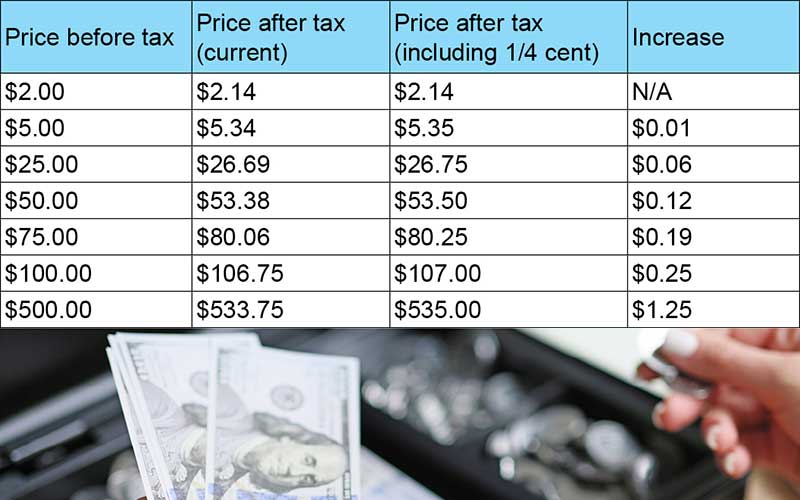
The quarter-cent sales tax committee continued its work in January, seeking to get a resolution passed by county commissioners and develop educational materials for candidates and voters in the upcoming election.
The Macon County quarter-cent sales tax committee, a loose and informal collection of citizens and public officials, started working on a plan to sway voters to pass a ballot measure to raise the county’s sales tax by a quarter of a cent per dollar spent.
The increase would raise the current 6.75% sales tax to 7%. This would add a cent in sales tax to every fourth dollar spent (starting with $3, raising the total price of such a purchase from $3.20 to $3.21) and consumers would have to spend $400 before spending an extra dollar in sales tax. The increase would not apply to gas and unprepared foods.
The committee includes County Commissioner Gary Shields, Macon County Democratic Party Chair Betsy Baste, county Human Resources Analyst Nina Parrott, Eric Haggart of the Tourism Development Committee and other locals and business owners looking to see the measure enacted.
At the Jan. 6 meeting County Manager Warren Cabe, Macon County Board of Education Chair Jim Breedlove and Macon GOP Chair Patti Trick also attended.
The Macon County Board of Commissioners voted in November to place a measure on the 2026 general election ballot for Macon County voters to approve or discard the quarter-cent increase. While commissioners cannot legally earmark the funds to go to any specific purpose, they can specify where they intend to use those funds. The November vote made no such specification, so the committee is seeking a resolution from county commissioners signaling a desire to spend those funds on capital improvement projects, a list of projects presented to commissioners each year as a part of the budgetary process.
Capital improvement projects, large investments in improving county property, were funded at $2,224,711 in the 2025-26 budget and included flooring replacements for county patrol offices, a new elevator and surveillance system at the detention center, new cages for animal control, and technology and facility improvements to both Macon County Schools and Southwestern Community College. Many more projects were proposed but not funded by the current budget.
Shields believes this strategy will allow an advocacy plan in favor of the ballot measure to take a “shotgun” approach and use a collection of different projects to attract the support of many different citizens. During previous attempts to pass the ballot measure Shields pushed for the funds to go primarily toward the public school system, which he now believes may have been a mistake.
“It just didn’t resonate with what we were doing and what it was going to be used for,” Breedlove said. “That’s why I like the shotgun approach, but we’ve got to convey to folks this money’s going to be used to better the county and it’s not going to cost you as much as it would with a [property] tax increase.”
Cabe said the additional estimated $2.3 million that would be raised from the quarter-cent increase would allow the county to accomplish twice as much while keeping the property tax rate the same.
Education
Breedlove and Baste said the term “capital improvement projects” would need to be dropped to aid in marketing the measure to those unfamiliar with the government terminology.
The committee also agreed candidates in the upcoming primary elections, at least for county commissioner, would need to be educated on what exactly the tax measure is and what it does to help prevent candidates from accidently spreading or buying into misinformation. Shields said this process will have to begin after the resolution is voted on in February.
Trick said she was victim to the spread of misinformation during the previous attempt to pass the measure in 2024, stressing the importance of answering detailed questions people may have, such as what kinds of foods count as prepared or unprepared.
“The people I heard the misinformation from in the last go around, these were things that were brought up,” she said.
Breedlove said he encountered people giving misinformation while at the polls when he ran for reelection and wondered whether that might have been enough to swing voters against the measure. “We’re going to have to have some boots on the ground,” he continued. “With people who are knowledgeable, that have the information.”
According to a brief plan Shields developed, the group will begin planning an educational marketing campaign in April to begin educating county voters ahead of the election in November. Cabe said for this marketing plan, county money could potentially be used to educate the populace, but those materials could not advocate for or against the measure.