
A new plan to connect people with local food is taking root along the Little Tennessee River.
“Our emphasis is working with local farms, so our mission is two-fold in that we want to support local farmers and we also want to help address food insecurity in our region by helping channel farm fresh food to folks in need, keeping local local,” said Cara-Lee Langston, project manager for Franklin Farm Hub, a nonprofit educational farm and food hub.
Food hubs aggregate, distribute, store and market fresh food. The local group is a collective of farmers, entrepreneurs, business owners, environmentalists, naturalists and philanthropists.
Langston previously worked with the Food Bank of Northeast Georgia when they started a food hub nearly 10 years ago. She helped to develop their nutrition and culinary education programming and administered the SNAP program for their region.
“As a farmer and an educator, I feel very called to this. I’m very passionate about this project,” Langston said. “It has great potential for creating positive environmental, health and economic outcomes for our community.”
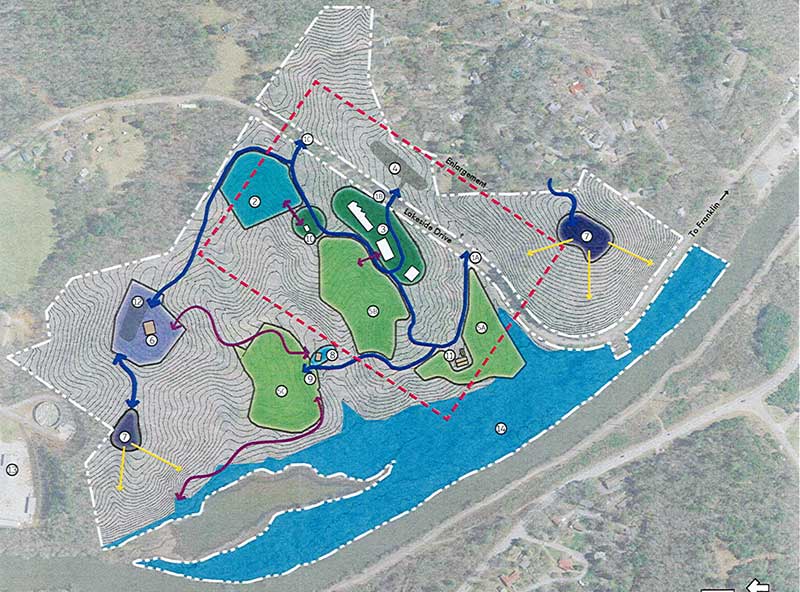
Langston said they are in the early planning and development stages, but they were fortunate to recently acquire 94 acres along the Little Tennessee River and Lakeside Drive.
Biscuits for Everyone LLC purchased the property from the Duncan family and will lease it to the Farm Hub. Langston said some of the property has not been farmed in about 20 years so there is a lot of work to do to reclaim the land.
“The land itself has rich cultural and historical significance to the area. It was once part of the Gideon Morris reservation,” Langston said. Morris was a white man who was married to a Cherokee woman, Na-Ka “Rebecca” Morris, who is depicted in the Sowing the Seeds of the Future sculpture in East Franklin. They had a 640-acre tract of land along the river but were burned out of their home and forced to give up the land.
“It historically has been used for organic agriculture. It’s also been used for mica mining. So, it’s a really interesting place,” Langston said. “And there are some really unique conservation features on the property.”
Langston said while there are numerous food hubs across the region, this one will be unique because it will be located on an actual farm rather than in a commercial or retail space.
“We want to be able to engage folks in educational experiences on the property that connect people with food and farming and nature,” she said.
Langston said they are assessing the feasibility of the land and have been in talks with the Town of Franklin and Macon County. She presented information to the Town Council at their Aug. 4 meeting. “All the feedback has been so positive, so I feel really great about the reception that we’re receiving for this project.”
Farm incubator
In addition to providing fresh food for people, the organization wants to support farmers and their businesses. “We want to help support them in helping them find new markets and we want to help provide land access to growers in need.”
She said the farmer incubator program will offer low-cost leases of farm plots. In addition to land, the program would offer access to mechanical tools, a packing house, cold storage and technical assistance. They are still working on a fee schedule.
“We welcome all types of growers for the farm incubator program,” Langston said. They hope to launch the incubator program in spring 2026.
In addition to local growers, Langston said some of their partners include the local Cooperative Extension office, the USDA, the Southwestern Community College Small Business Development Center, Organic Growers School, Appalachian Sustainable Agriculture Project, Macon County Public Health and the Eastern Band of Cherokee Indians.
Langston said the farm hub will also offer an educational center for farmers wanting to expand their knowledge but also those just getting started. They also hope to have a certified kitchen to help launch small food businesses.
“There will be opportunities for experiential learning for all ages, for our community to come out and learn about subjects related to food and farming and also conservation. Because of the nature of the property, we all feel strongly about taking good care of the land.”
She said they also want to rework some of the trails on the property and offer public access. “We’d love to work with groups that are wanting to focus on mental health and well-being to invite participants of those programs to come and spend time in nature,” Langston said.
Feeding the community
Ultimately they want to grow food at the farm and collect food from other producers for charitable distribution.
“That is our priority,” Langston said. “We will also be looking to create opportunities for folks who can and are able to purchase food from the food hub. That will come later. Our priority right now is to focus on charitable distribution.”
She said the food distribution could occur through pop up markets outside restaurants or other businesses that want to help support local food access. “Local food access and food insecurity go hand-in-hand and hopefully folks realize the value of farmland preservation too.”
Currently the Franklin Farm Hub offers a Produce Purchase Guarantee Program through the Macon County Farmers Market. When the market closes each week, the Hub purchases leftover produce, up to $100 per vendor up to $1,000 per week. That means 30 weeks of local, farm fresh food gets delivered to local agencies that help feed the community.
“That has been an amazing incentive for the farmers and food producers involved in that program to attend the market,” Langston said. “It’s just a beautiful relationship between the farm hub and the market that we hope to see grow.”
This year they have delivered food to CareNet, REACH, Smoky Mountain Harm Reduction, Vecinos and Highlands Food Pantry. Langston said she is also connecting with local food pantries such as those at churches.
Get involved
Like most nonprofits, the Franklin Food Hub can use support from the community in the form of volunteers and donations.
“There will be lots of opportunities,” Langston said. “From conservation to trail related work, to agriculture related work to packing food boxes. Helping sort food. We really want to ensure a high-quality standard. And, at our education center as well. We hope to offer cooking classes, nature walks, and all sorts of educational activities that folks can volunteer to help with in various ways.”
For information, visit franklinfarmhub.org.