
The new executive director of Mainspring Conservation Trust plans to stay the course after the retirement of current director Sharon Taylor, but that doesn’t mean the organization is standing still.
Jordan Smith, who joined Mainspring in 2016 as land conservation director, will officially take the reins on March 1.
A native of the North Carolina mountains, Smith earned a degree in wildlife management from Auburn University.
“I’m from the mountains, grew up in Jackson and Swain counties,” Smith said. “I was gone from this area for about 15 years and decided I wanted to come back and raise my family here.”
Smith gives Taylor and founding director Paul Carlson and Sharon Taylor credit for developing relationships with landowners over the years.
“That’s why important projects walk through our door,” he said. “We closed one project this year that was about 13 years in the making.”
Don’t expect big changes at Mainspring anytime soon.
“I certainly have big shoes to fill with Sharon’s absence,” Smith said. “A lot of folks ask me what my plan is, what am I going to change? The answer is, nothing, really. As far as change, the organization is strong and we have excellent, dedicated staff. To come in and make sweeping changes would be a huge mistake.”
Mapping Mainspring’s future
Staying the course is the mandate for the short term, but Smith and Mainspring have been busy planning for the future of conservation in the far west.
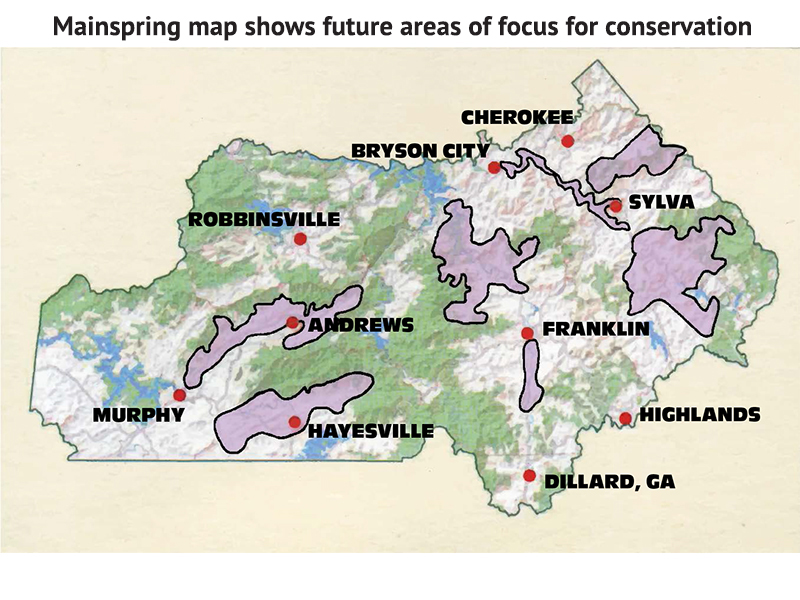
At the heart of those plans is a map identifying seven areas of focus in the region – Western Plott Balsams, Upper Tuckasegee, Lower Tuckasegee, Upper Little Tennessee, Nantahala to Cowee, Valley River and Hiwassee River.
Smith and the Mainspring staff created the map by overlaying data gleaned from experts in terrestrial ecology, aquatic systems, cultural resources, recreational resources, and agriculture. In all, there were 65 layers of data used in creating the map.
“Because we have a finite amount of resources and staff and funding, we have to pick the conservation projects that are going to have the most impact,” said Molly Phillips, Mainspring’s communications coordinator. “This really has helped get our focus more finite and made us able to be more strategic.”
Cultural considerations
Cultural heritage is always a consideration when considering a conservation project, Smith said.
“Everything that we do has a cultural heritage components by default, because of where we live,” he said.
The planned cultural corridor is a centerpiece of those efforts.
“As we do our day to day work, we’re looking at that in light of promoting and hoping to establish this cultural corridor that essentially runs from here to Cherokee. We have to pay respect and recognize that every piece of land that we work on had some important and some significant to the Cherokee or even people before the Cherokee.”
The Nikwasi Mound is one of the focal points of the cultural corridor, and Mainspring will continue to work with the Nikwasi Initiative in that effort.
“We’re proud to be a part of the Nikwasi Initiative and continue to be supportive of their work. I fee like it’s progressing. There are some kiosks going up like the kiosks we put up at our Cowee view site.”
Expect similar cultural heritage kiosks in the coming months.
“You’ll start to see those up and down the corridor,” Smith said. “We’re getting permission for one at Nikwasi, then one at Cowee School.”
The kiosk to be placed at Nikwasi mound is currently under construction, he said.
Another focus for 2020 will be selling properties, Smith said.
“We’re going to divest ourselves of some properties,” he said. “We’re not long-term owners of land, so a lot of times our model can be to purchase something, conserve it and then turn around and divest of that property. A lot of times that can be viewed negatively as flipping land or development land, but it’s certainly not. It’s just a tool that we use to conserve property.”
Finances
Private fundraising remains a critical component of Mainspring’s finances.
“The majority of our staff salaries come from private fundraising,” Smith said. “I think that’s probably a misconception that’s out there. Most of the time when we get a grant, that money is going into the dirt and into the resource.”
After Taylor’s retirement, Mainspring will operate with a staff of 11. Annual salaries and benefits total about $725,000, according to Phillips. The annual operating budget is $1.5 million
Taylor recently helped launch an endowment to provide a cushion for operating expenses.
“This is a big step, and it shows our maturity and our plan to be here a long time,” Phillips said.