
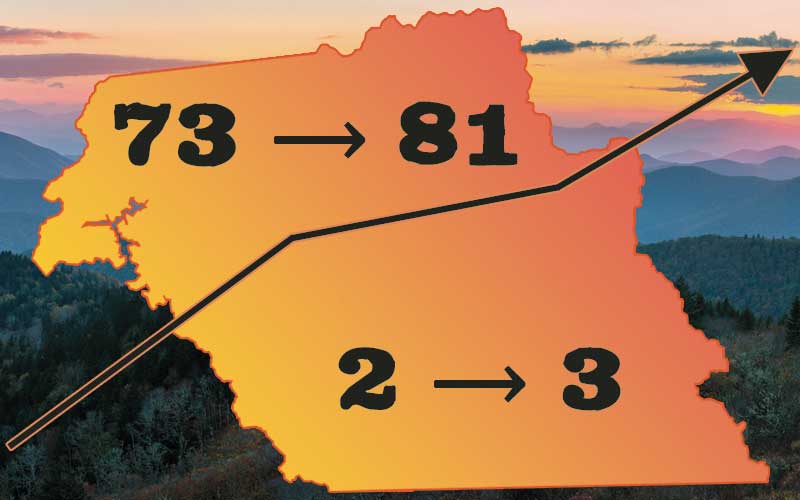
Many counties in Western North Carolina dropped in the state’s 2026 economic distress rankings after fallout from Helene left them in dire straits. Macon County showed progress, jumping from 73 to 81 and from Tier Two to Tier Three.
County tier designations, established each year by the N.C. Department of Commerce, measure North Carolina’s 100 counties according to average unemployment rate, median household income, percentage growth in population and adjusted property tax base per capita to determine a 1-100 ranking for economic distress. The counties are then sorted into three tiers which determine the county’s applicability for certain state programs and funding opportunities.
The first 40 counties become Tier One and are applicable for the most opportunities. Counties 41-80 comprise Tier Two and are applicable for fewer opportunities. The remaining 20 counties are in Tier Three. A press release detailing the new rankings noted Helene’s impact on unemployment in western North Carolina and said the government shutdown impacted the unemployment data it was able to collect from September 2025.
For 2026, 18 counties will change tiers, with Beaufort, Camden, Davie, Graham, Macon, Montgomery, Randolph, Stanly and Surry counties moving up to Tier Two or Three. Buncombe, Burke, Granville, Haywood, Henderson, Jones, Madison, Pasquotank and Yancey Counties moved down to Tier One or Two.
In 2024, Macon County dropped from rank 79 to 75, then to rank 73 in 2025. DOC’s 2026 rankings place the county at 81, just past the Tier Three threshold. Macon will be the only county in Tier Three west of Lincoln County.
Macon County’s 4.4% population growth rate and 3.43% unemployment rate are both 74th in the state. The county’s median household income of $58,765 puts it in the bottom half of the state at rank 45, but the county sails above most of the state with its ranking of 95 with a tax base per capita of $341,118.
At the Dec. 9 Board of Commissioners meeting, County Manager Warren Cabe said there will not be much impact to the county from the tier shift.
“It could affect some economic development-type grants as far as cost share, the eligibility,” Cabe said. “They actually give points if you’re a Tier One county, but as far as Tier Two or Tier Three it doesn’t really penalize you. So at this point, I’ve been asked what the effects are for us and there’s not a lot at this moment, but we’ll certainly keep an eye on that and see what that does to us in the future.”
Cabe told The Franklin Press, “I do think it says a lot for Macon County that our median income appears to be increasing and people are still interested in moving and working here. In that respect, I believe it shows that Macon County is still thriving and is in fact improving as we are the only Tier Three county in Western North Carolina.”
Macon County Schools Superintendent Josh Lynch also said the tier change would not directly change the school system’s eligibility for most state or federal education grants.
“Many funding opportunities are based on student needs, program requirements or statewide formulas rather than county tier status. However, many private grants that we apply for are based on need in terms of tier status. Therefore, moving tiers can definitely impact our eligibility and consideration based on need regarding economic factors.”
As an example, Lynch pointed to the N.C. Needs-Based Public School Capital Fund, which prioritizes Tier One and then Tier Two counties for higher consideration, and said the school system would continue monitoring the new designation and how the change affects is competitiveness “while actively pursuing all available resources to support our students and schools.”