
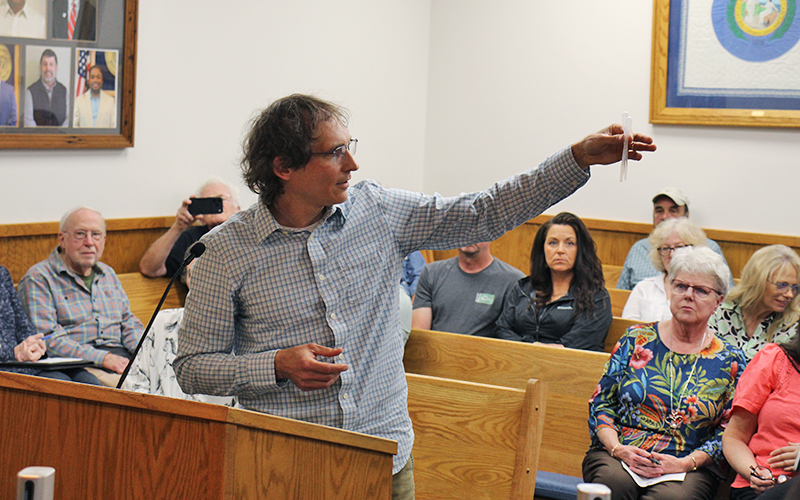
Jason Love of the Water Quality Advisory Committee would like to see water treated as a precious resource rather than taking it for granted.
The committee was formed in 2024 at the direction of then-Macon County Board of Commissioners Chair Gary Shields to advise commissioners on water quality and an ongoing conversation at the time about proposed changes to floodplain ordinances. Love serves on the committee and is a researcher at the Highlands Biological Station.
At the commissioners’ March 10 meeting, Love said sometimes, “Water is simply an afterthought. It’s in the background, makes pretty pictures. But what it should be is treated as a core asset of the county. Last month, it was reported the world has entered an era of global water bankruptcy, where human consumption is outstripping what nature can replace. So about four million people are living in areas where it’s not going to take just a couple months of good rain to get them out of this situation. It’s going to take decades, maybe hundreds of years.”
“Compared to most parts of the world we’re in pretty good shape in large part because 46% of the county is forested … national park,” he said. “That’s why we have such clean water for the most part.”
However, Love went on to outline a list of concerns that may threaten clean water access now or moving forward.
First he listed high levels of E. coli in the waterways, in particular around Franklin testing sites. The bacteria can cause diarrhea and incontinence in the most extreme cases to those infected.
“For the past few years, MountainTrue has monitored E. coli levels following standard protocols, and last summer, from May to August, they selected 15 days during that time span and sampled several areas,” Love said.
Data for these tests are recorded at theswimguide.org, where users can see data from Macon County and surrounding test sites. Sites at Cartoogechaye Creek at the Rec Park and the Little Tennessee at Tassee shelter failed every time. The Little Tennessee at Iotla Bridge failed 13 times, the Little Tennessee at Queen Branch failed eight times and the Panther Branch access failed four times.
The high concentrations of bacteria could come from different sources, including faulty septic systems, wildlife and livestock. Love said while tests could be used to determine the source of the waste, they are expensive at $135 per sample taken, though the county may be interested in identifying specific sources. After determining where and which sources the waste is coming from, the county or a local nonprofit could begin working with local farmers or homeowners to help clean up the water.
Industrial use restrictions
Love said data centers, especially those used for AI, use large amounts of energy and produce noise pollution, but also use a lot of water. “On the order of 300,000 to five million gallons per day. That’s as much as a small town uses,” he said.
He approved of the county’s 2023 vote to restrict “cryptocurrency mining facilities or any other similar server-based computer facilities” as a form of high-impact land use. High-impact land use businesses can only run from 6 a.m. to 10 p.m., a measure Love feels will effectively discourage data centers from scouting Macon County as a location for now.
“But it is still something to keep our eye on,” Love said. “There’s going to be more pressure to build these centers in Macon County.”
Trash in waterways
Lastly, Love discussed physical trash, mainly plastics. He said students from UNC Chapel Hill went into Macon County rivers and collected an estimated 620 pieces of trash per mile of the Cullasaja, about 1,600 pieces of trash per quarter mile in Cartoogechaye Creek and over 1,900 pieces of trash per quarter mile in the Little Tennessee past Franklin.
Some of this trash was “legacy trash” like bumpers and Mason jar lids, but much of it was modern. Love said 25-35% of trash collected was plastic ranging from bags to bottles to textiles.
“Overall, our results show that we probably need to do a better job managing the trash. It’s not surprising that most of the trash was found in the Little Tennessee in the Otto area because that section of river follows [Highway] 441,” he said.
Education is key
In an interview with The Press after the March meeting, Love advocated for education to ensure people are responsibly using resources, disposing of trash and taking care of their neighbors and the environment.
“When I was growing up in the ‘70s you had, it seemed like, a bunch of ads. You had the [ad] with the owl; ‘give a hoot, don’t pollute.’ I don’t see that much anymore,” Love said. “Just remind people that it is an issue and it’s important to realize that pollution, that this trash is not only unsightly but … that plastic can degrade and release some of those chemicals into the environment.”
He went on to say his goal at the meeting was both to remind commissioners and members of the public of the importance of and threats to clean water, but it was also to ensure people know and understand the committee was made to give advice on water quality in the hopes their advice may be relied upon.
“If water is treated as a core asset, if water is treated as precious, then you build policies around that asset to protect that asset. I don’t have any specific policies, but again if we have that core asset that is precious, then policies will follow,” Love said.
Microplastic research
At the Highlands Biological Station Love is also researching microplastics in rainwater using, in part, data collected at the Coweeta Hydrologic Laboratory. Microplastics are tiny pollutants that have the capacity to inflict different ailments on wildlife, and while the health effects on their accumulation in the human body have not been clearly identified, a 2023 report in the National Library of Medicine recommends protecting human health by preventing and managing the pollutants.
Love’s research identified microplastics primarily from synthesized clothing and fabric can end up in the atmosphere, falling with rainwater and resulting in higher concentrations in areas that experience higher rates of rainfall, including Highlands, Coweeta Lab and Waynesville where data was collected. He said a 74% increase in microplastics was measured in eight years from 2016 to 2024.
“There’s no fancy technology that we can put in streams to suck up these microplastics. I mean they’re microscopic. It’s just not practical or feasible,” Love said. “We’re going to have to really slow down the production of plastics. The U.N. has a global plastic treaty that they’re trying to sign to get countries to reduce the use of plastics, particularly single-use plastic … in general, really thinking about plastic production. But that goes against our model of growing the economy.”
Between these two pieces of research, Love said he was pleased access to clean water resources appeared to be a bipartisan middle ground. He noted that last year, as the U.S. Army Corps of Engineers contractors were removing “legacy wood” from waterways as a part of Helene remediation, he was pleased to see advocates from across the political spectrum come together to advocate for natural resources.
“We’re 70% water … it runs the world, so we need to make sure we steward it properly,” Love said.