
Blooming hops set off a journey of discovery
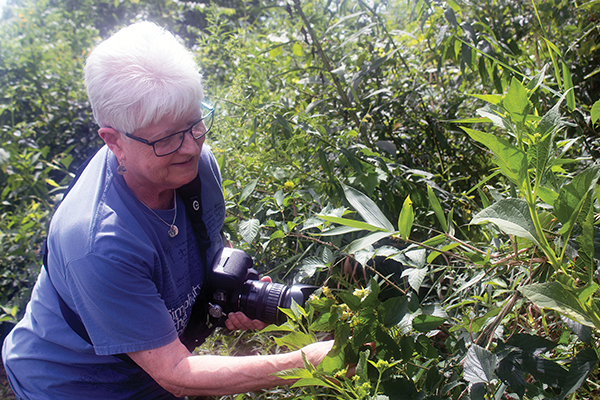
Barbara McRae
bmcrae60@gmail.com.
The Greenway section known as the Old Airport Trail evokes memories of aviation’s early, adventure-filled days, but its history goes back much, much farther.
The recent discovery of blooming hop vines brought some of that history to life for members of Friends of the Greenway (FROG) and the Women’s History Trail. The groups have found evidence that hops were grown here in the 19th century. As the plant is known to be particularly long-lived, these vines could be growing from the original rhizomes. (Note: Technically, they are bines, not vines, as they have no tendrils.)
For FROG secretary Rita St. Clair, the discovery opens exciting new possibilities for the Greenway. She had already been tossing around ideas for stations that would lead visitors on journeys of discovery while they walk. In the case of the hops, that could involve cultivating some of the now-wild vines in a small hopfield or hop garden like those the early settlers might have had, with appropriate educational signage.
“There are more than 150 species of native plants along here,” she said. “It is exciting to know that we also have surviving heritage plants.” She wonders what else might be found here.
Hops are best known for their contributions to beer. Early people made other uses of the plant, including many applications in herbal medicines, but beer was the object of settlers who brought cultivated hop varieties with them to the colonies as early as 1629. Benjamin Franklin is said to have endorsed the beverage in his inimitable style, saying, “Beer is living proof that God loves us and wants to see us happy.”
Hops were also used to make yeast, which could not be purchased at your typical country store. If you wanted to have “light bread,” you had to make your own. First, though, you had to make your own yeast.
Among the household papers of Timoxena Siler Sloan were handwritten recipes for “hops yeast,” dating probably to the 1870s. Here’s one way to do it, as she did:
Boil a quart of hops in a gallon of water for a half-hour, then strain it off into a tin vessel, first putting in a single handful of dry corn meal. Let it cool, then stir in equal portions of wheat and rye flour to make a consistency of batter. Add one gill of molasses and, if you wish, a teaspoon of soda. Allow this mixture to stand in a warm place until it rises – about four hours. Add enough corn meal to make it stiff, then spread the substance on a smooth board to dry in the shade.
Not only do the recipes shed light on Timoxena’s complicated domestic duties, but they make it clear that she had access to hops.
Timoxena and her husband, Billy Sloan, lived on a 320-acre farm in East Franklin that was once part of the Gideon and Rebecca (Na-ha) Morris reserve. The Morrises lost the land during the turbulent early settlement period; it was then claimed by Gen. Thomas Love. Jesse Siler acquired it after the Loves moved to Tennessee. He gave half of the land to his daughter Timoxena when she and Billy married in 1856.
The Sloans – and Timoxena’s father before them – farmed the rich bottomland where the first Macon County airport later stood, and where people now stroll, or run, or bicycle on Franklin’s popular Greenway.
Tim (as her husband Billy called her) continued to farm with the help of her children after Billy’s death in 1875.
The little notes she left show that she grew apples, probably cultivating trees that had originally been nurtured by the Cherokee of old Nikwasi. In the years after Billy’s death, she used fresh and dried apples to pay off her debt to an Anderson, South Carolina supply house.
For yeast and beer?
The vines still growing along the river tell us that she also raised hops – probably in much greater quantities than she would have needed for yeast alone.
Did she brew beer as well? The jury is out on that. No evidence has emerged about early beer-making in this area, but the tradition came to the frontier with early German settlers, and the surviving hop vines raise some interesting speculation. And, Timoxena was of German descent. Indeed, the hops on the Old Airport Trail could date to her father’s ownership and cultivation of the farm, from 1836-1856.
For the Women’s History Trail, the discovery of hop plants still growing on Timoxena Siler Sloan’s farm adds richness to the life story of this notable Macon County woman.
“It’s exciting to think that Timoxena may have harvested hops from these same plants. It’s like a living link to the past,” said Mary Polanski, one of three co-leaders of the Trail.
Timoxena is one of three women – White, Black and Cherokee – who will be featured in a monumental bronze sculpture commissioned by WHT. The women played significant but little-heralded roles in the region’s early history, and their lives intertwined in fascinating ways. The sculpture will be located near the river and Nikwasi Mound – not far from where the hop vines are blooming.
“We see the women in the sculpture as strong individuals, but also, symbolically, as matriarchal figures – mothers of those who live here now. As such, we owe them a great debt for their struggles, their courage, and the moving examples of their lives. Our object is to bring them and other women in our history out of the shadows and give them the honor and recognition they deserve,” Polanski said.
“It’s also fun to discover so many interesting things about them as we continue our explorations of their lives. Can’t you see Timoxena in her yard, about this time of the year, boiling hops over an open fire?” she added. “These were real, living women.”
Rebecca (Na-ha) Morris, a Cherokee, and Salley, an enslaved African American whom the Morrises sold to Jesse Siler in 1821, are the other two women to be represented in the bronze. WHT has commissioned Wesley Wofford, a sculptor living in Cashiers, to create this monumental work.
Barbara McRae can be reached at bmcrae60@gmail.com