
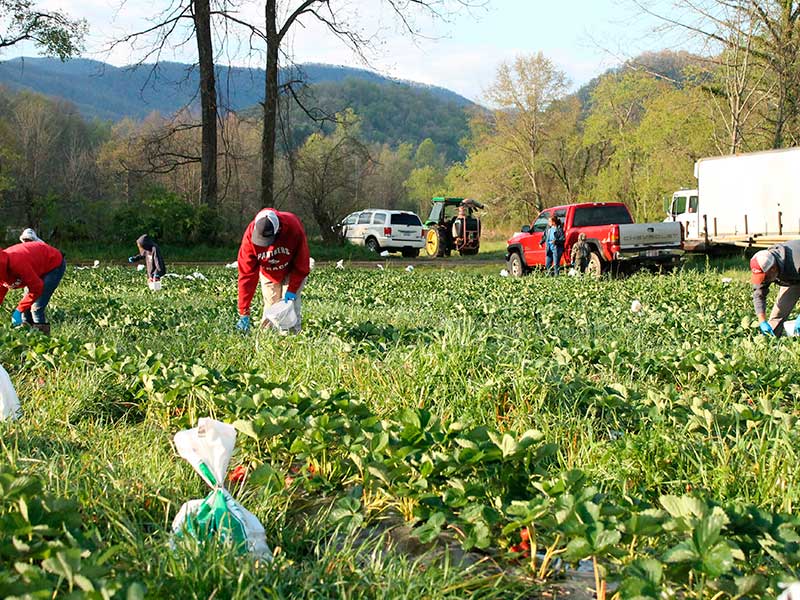
Joe Deal, along with his wife, sons and daughters, plucked fresh strawberries Tuesday morning after a brief rain shower subsided.
Each took a row, plucking the good berries and placing them in baskets, while discarding the bad ones.
Demand for the berries could be high, or it could be low.
“We don’t know exactly what to expect with all this COVID-19 stuff, whether it will be a mad dash to get what we got or we’ll have to get out there and work to try and sell them,” said Deal, who runs Deal Farms.
Life right now, particularly for local farmers, is full of uncertainty. While some farms have lost business because of restaurants being closed, the majority of local farmers aren’t reporting financial hardships – at least not yet anyway.
Farmers are staying positive. They’re evolving their business models and making necessary changes to help financially as the pandemic continues. This includes selling directly to customers, particularly utilizing online sales.
While some farms relied on restaurant sales, the timing of this pandemic comes when most vegetables have yet to be planted. Produce such as squash, cucumbers, green beans, sweet corn, potatoes, tomatoes and peppers won’t be ready until late summer or early fall.
CSAs (community-supported agriculture) remain popular, where consumers pay for a weekly haul from a farm during the growing season. Most farms have already filled their CSA quota for the season.
The local farmer’s market is still operating Saturday mornings at its downtown location. Farmer’s markets were deemed essential business, and some prefer it over shopping at a grocery store because it’s outside and social distancing guidelines are easier to adhere to. Plus, they know they’re getting locally produced products.
“I think there’s a safety measure in it, both from a food sourcing point of view if they know it’s something we’ve grown,” said Joe Carringer, who operates Carrington Farms along with his wife, Belinda. “The second part is they’re able to feel safe in terms on not having to get into a crowded store.”
While the timing is good for produce, there’s really no such thing for those who have livestock.
Tom Ort, manager at Tellico Trout Farm, spoke last week while looking out the window at 160,000 pounds of fish that he isn’t sure what to do with.
“I have found myself professionally in some really hard spots in the past 30-some years,” Ort said. “But nothing like this where we just don’t have any control.”
Tellico Trout Farm’s business is very heavily based on long-term fish sales. It’s biggest months: March, April and May.
Half of Ort’s market dried up to nothing. As for the other half, he’s completed two trips when normally by this time he’d have completed six.
“My sales are significantly impacted,” Ort said. “I’m not even sure I see a pathway out of it at this point.”
The fish are being fed four days a week. Ort could feed them every day, but it would be similar to stomping on the gas pedal towards a cliff.
Ort has looked into alternative routes. On Wednesdays, he and an employee bring a couple hundred pounds of fish to Dowdle Mountain and sell them directly to customers from 12-6 p.m.
“That keeps us very busy for a day and it’s a service to our community,” Ort said. “But that’s not any sort of answer for keeping this farm going.”
Ort and the owner of Tellico Trout Farm, Michael Macke, filled out paperwork to apply for the Paycheck Protection Program. But that program ran out of money last week.
The problem is the whole country is shut down, Ort said. He’s good friends with pretty much everybody who buys trout on the East Coast, but this is a very challenging position – and he knows he’s not alone.
“This problem is bigger than me right now,” Ort said. “We’ll keep chipping away at it until we get it.”
Multiple programs exist to assist farmers in times of need.
EmPOWERing Mountain Food Systems (EMFS) is a three-year cooperative extension project funded by NC State and the Appalachian Regional Commission.
EMFS works with farmers in seven counties in the region, supplying funding for equipment, and providing education for grants and loans.
Laura D. Lauffer, project director, said some farmers in Macon County have reached out to them. They want to continue to spread the word about services they offer so they can help others.
“We are here to work with farmers through this challenging period,” she said, “and we want to continue to be a resource.”
Appalachian Sustainable Agriculture Project, a nonprofit based in Asheville, is another program that is working with farmers.
ASAP surveyed farmers in March, compiling a report that outlined how farmers are dealing with the pandemic.
Charlie Jackson, executive director, said ASAP provides a variety of services, such as offering programs related to education, financial relief and access to grants.
Deal said selling direct to the consumer versus wholesale bodes well for local farmers.
“If we were reliant on selling to restaurants right now, I would be real concerned,” he said.
“We do a lot more direct to consumer. I’m optimistic that it’s an opportunity for us to grow our sales and business this year. More folks are eating from home and cooking from home. We’ve got a fresh, direct local product for people to consume.”
Whether it’s safety concerns, financial concerns or a shift in thinking, people are indeed making more meals at home. While many still flock to the grocery stores and load up their shopping carts, some folks are more eager than ever to purchase locally grown foods.
Hannah and Alan Edwards, owners of farm-to-table restaurant Yonder, have long been outspoken about how people should stop eating processed foods and support local farms. Of course, they heard the backlash about food being “too expensive.”
“Now all of a sudden you don’t hear anybody talking about that,” Hannah Edwards said. “People are flocking to the farmer’s market to spend that extra dollar on a farmer’s piece of vegetable, or leafy green, or spring onion, or handmade soap, or fresh-baked bread, and fresh eggs. And they’re flocking to our online market (eatrealfoodinc.com) to get these specialty goods you can’t find anywhere else.”
Winding Stair Farms has already fulfilled its 30-member CSA for the year. However, like Deal Farms, it has a retail store/produce stand (located at the nursery off Highlands Road) to sell produce grown on the farm, plus free-range chicken eggs and duck eggs.
A new retail center is being built, with the hope to expand products for sale from others in Macon County and Western North Carolina.
Katie Doe, farm manager, said the farm and nursery have undergone changes during the pandemic, but she remains positive.
“Farmers are extremely creative people,” Doe said. “They’re resilient and good at solving problems. That’s kind of what the whole game is like growing food. So I think we’re all gonna be OK.”
Deal said these are unchartered waters for farmers. He hopes one good thing to come out of the pandemic is folks are realizing the importance of local farms and what they’re eating.
“Most of us farmers are optimists,” Deal said. “We try to see the good in the bad situations and make the most of it.”