
The Macon County Health Department’s community health plan report card is online, tracking local progress toward addressing the county’s biggest public health priorities.
The annual Community Health Improvement Plan (CHIP) is the 2025 counterpart for the annual Community Health Assessment (CHA). The CHIP scorecard is posted online and will be periodically updated as additional information comes in. The CHA identified three priorities for addressing the county’s public health needs: mental health, housing and food insecurity.
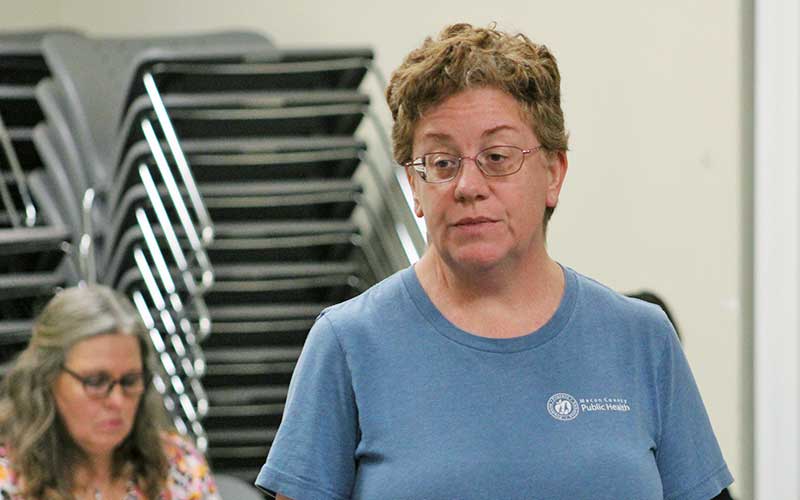
“The Community Health Assessment lets us know what we need to work on within the community and the Community Health Improvement Plan … is after I’ve gotten with community partners and we’re kind of on the path of addressing issues,” said Jennifer Germain, the health department’s community health programs coordinator, at the Sept. 23 Board of Health meeting.
Mental health
Mental health covers a range of issues including drug abuse and suicide and is in the process of being addressed by multiple community groups including the Macon County Behavioral Health Task Force – comprised of government, nonprofit and medical groups discussing ways to address public mental health needs – and similar public health nonprofits and community organizations.
The CHIP identified a series of challenges to meeting community needs. These include a shortage of mental health professionals and limited crisis services, disparities in access to services between Franklin and Highlands, and a lack of funding as COVID-19-era grants phase out.
According to the CHIP, the task force has made some progress on identifying gaps in local mental health coverage and tracking opioid addiction in the county, especially fentanyl-related overdoses.
“The … task force has made meaningful strides in 2025, particularly in expanding mental health support within public schools,” the document read. “At their April 17 meeting, the Task Force focused on the urgent need for increased funding and personnel to bolster school-based behavioral health services … The emphasis on school mental health suggests a strategic pivot toward early intervention and youth-centered care. This aligns with broader statewide efforts, including North Carolina’s $835 million investment in behavioral health infrastructure and Medicaid expansion.”
Germain pointed out the school system is currently working on providing telehealth services to provide virtual counseling for students. No Wrong Door and other agencies have been working on reducing the suicide rate, which Germain said is high in Macon County. Macon County has one of the highest suicide rates for veterans in North Carolina, according to the CHIP.
Also outlined in the document is the “View From Here WNC” social media campaign, which seeks to connect residents with health resources. The campaign is prioritizing mental health, substance use, nutrition and vaccination as ways to improve local health.
Affordable housing
The CHIP says access to affordable housing improves public health outcomes by ensuring individuals have safe, healthy places to stay and freeing up funding for healthcare, nutrition or savings which would otherwise go to steep mortgage or rent payments.
The Highlands Coalition for Workforce Housing was identified as a local initiative making progress by creating opportunities for middle-income workers such as teachers, healthcare staff, first responders and service industry employees. Excessively high rent and housing costs and a shortage of housing stock has driven working class Highlanders out of the market, according to the report. Progress has been made in community engagement and the coalition is developing a strategy for securing land, funding and beginning constructions on affordable units.
The Macon County Housing Department was identified as making progress toward improving housing access and quality for low- and middle-income residents through its improvement and weatherization programs. These programs can help certain residents with mold and moisture control, pest management and handicap accessibility.
Discover Church and No Wrong Door recently built three apartments, which are currently all occupied, to serve as transitional housing for community members.
Nutrition
According to Germain, food insecurity is the priority the county is closest to resolving, however, she said the county’s abundant small food banks are a band-aid, not a solution.
Among those organizations taking steps to address the inequity are the Macon Food Council, comprised of local nonprofit representatives and community members who are looking for ways to improve nutrition access in the county. The Franklin Farm Hub supports local farmers and distributers to make fresh, healthy food easier to access.
“The cool thing about the Franklin Farm Hub,” Germain said, “they are building a cool little place for farmers to gather to process their meats, to process their vegetables and store food and have a commercial kitchen for educating people … it’s still in the early stages, but I’m so glad that’s coming along.”
The Macon County Farmer’s Market has been utilizing the federal Supplemental Nutrition Assistance Program (SNAP) to help local shoppers access fresh and healthy food. The double SNAP program, provided in Macon County through grant funding, doubles SNAP funds spent at the market, ensuring more nutritious (but often more expensive) local produce would be more accessible to those shoppers while also providing stable income to small farmers. The CHIP projects $6,000 in double SNAP incentives by the end of the year.
Farmer’s market manager Devon Dupuis said the market was forced to temporarily pause the double SNAP program in August when demand outstripped the grant money that had been awarded for the market to offer the program. Dupuis said the program would continue in 2026.
Other challenges
At the federal level, SNAP and Medicaid cuts recently passed in the federal budget will impact the administration of both programs and lead to individuals and families using each program being cut loose and worsening local access to medical care and nutrition. The U.S. Department of Agriculture also recently stated it would no longer conduct its annual Household Food Security Reports, which were a source of data for marking progress toward eliminating food insecurity. Germain said the Health Department would have to rely on the data collected through any state or local reports.
At the state level, the Healthy Opportunities Pilots (HOP), which seeks to provide food and housing support, has seen no temporary or permanent funding this year. The offices administering HOP funds have closed, cutting off another source of funding for the southwestern tip of the state.
Germain said the 2025 CHIP is pending approval from the state, but once it does the report card will be published online and hard copies will be made available at the Macon County Public Library. More data will be added to the CHIP report card as it is collected.