
On Sept. 22, the Macon County Board of Education banned cell phones during school hours. On Oct. 20, it changed its mind.
In a 3-2 vote during the school board’s October meeting, board members Melissa Evans, Hilary Wilkes and Jim Breedlove voted to overturn the board’s September decision to ban phones from the moment school starts to the moment it ends. Diedre Breeden and Stephanie Laseter voted to keep the bell-to-bell policy approved in September.
The new policy will still ban wireless devices during instructional time but will allow them during lunch or transitions between classes. Schools will have the ability to build stricter policies, such as Macon Middle School, Macon Early College and Bartram Academy, which all have variations on a total ban.
Comments from students
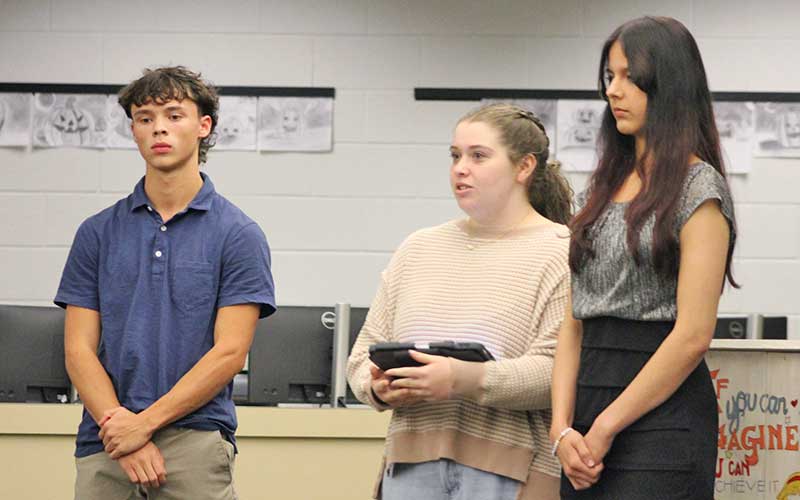
The decision followed a public comment period in which representatives of the Franklin High School Student Leadership Team advocated against the bell-to-bell ban and for a reversal to a ban during instructional time only.
“We completely understand that during instructional time, teachers and students should not be on their phones,” said Reid Laseter, the son of Stephanie Laseter. “We do like the first policy that was put in place that allowed us to be on our phones during breaks and lunch times that kind of treated us as adults.”
Reid Laseter said high school should be treated as a step closer to college, with the freedom and responsibility – and respect – expected of a group close to adulthood. By shifting from a ban during instructional time to a total ban, the board took those opportunities away from students. Laseter also shared the results of student/teacher surveys the group sent out, which found 81.8% of teachers and 99.2% of students were in favor of the old policy.
Samantha Wilson said, “A lot of students have responsibilities outside of school. We’re contacting colleges, and phones are very accessible. Most places of work and college operate during business hours which is during school, and it would be really chaotic if students constantly had to go to the office to get in contact with people.”
“One of our group members that couldn’t be here today made the point that if she’s at school and her job tries to contact her, they probably won’t call the high school directly and she doesn’t know when she needs to go there,” Wilson continued. “So, she may not know if she has to cover someone else’s shift or if she’s not working that day.”
The decision
In September, the bell-to-bell ban was implemented with another 3-2 vote in which Breeden, Laseter and Evans voted yes and Wilkes and Breedlove voted no.
At the October meeting Evans said she had been “on the fence” about the decision previously, but had since spoken more with teachers, principals and students.
“I do feel that every school has a different dynamic,” she said, “I have really changed my mind about Franklin High School … I think the policy of giving the principals some room to wiggle in this – I am absolutely against using phones during instructional time as I said at the very beginning – but I feel like these kids need just a few minutes, at least a few minutes a day to make these texts, to make these calls.”
Evans also reflected on her own daughter being a mom during her senior year of high school, and said she would need to be in frequent, available contact with her child’s caretakers even during school hours to be a responsible parent.
Wilkes agreed different schools and administrations had different needs and should be left to develop their own policies. She encouraged parents who would like to see a total ban at their schools to approach the school to advocate for the policy.
“I felt and still feel that it’s our job to empower our administration and our superintendent,” she said, “and they’re the ones running the schools and I really did try to hear what the administration was saying … I feel very strongly that it is a gift, as Diedre said at our last meeting. It is a gift to give kids space and time to be kids and talk to each other. I don’t know that’s, from a structure standpoint, what we’re necessarily here to have to do.”
Laseter and Breeden both said they had encountered overwhelmingly positive response from parents regarding the ban, and still supported the decision.
Laseter said, “I am still in favor of our current policy, bell-to-bell, myself because I heard from two parents who wished that we would reverse. I heard from, I think, 33 parents who said they were fully supportive and thanked us, so I’m going on that.”
Breeden agreed every negative response had been tempered by at least three positive responses from both present and former teachers and students. She argued keeping a total ban on devices would also give students chances to develop a sense of responsibility.