
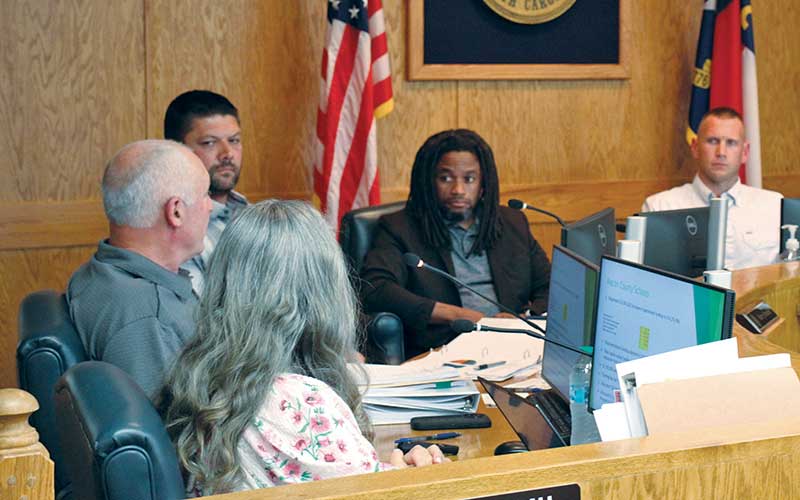
The proposed 2026-27 Macon County budget keeps the tax rate at 27 cents per $100 valuation but leaves out more than $7 million in asks from county departments.
Macon County Manager Warren Cabe started the budget discussion on May 12 by highlighting some of the 2025-26 accomplishments: construction progress on the new Franklin High School, repairs and a roof replacement at the Macon County Public Library and Detention Center, improvements at the Greenway, renovations at the tennis courts, and finding $3.8 million in grant funding to offset project costs.
In the coming year he said the county intends to complete the construction of pickleball courts at the Rec Park, complete construction of a new Carson Convenience Center, replace the Arthur Drake (Suli Marsh) Boardwalk at the Greenway, address space needs for county offices and resurface the Southwestern Community College driving track to allow the college to hold commercial driver license classes among other projects.
The proposed 2026-27 budget of $68,045,008 maintains the county’s 27-cent tax rate, which has not changed since 2023. As of June 2024 Macon County had the lowest tax rate of any county in North Carolina, but in 2025 Carteret and Dare counties, lowered their rates to .22 and .26, respectively following tax revaluations.
Projected revenues place property tax collections at $37,054,763 (54% of the budget), sales tax at $14,416,536 (21%), intergovernmental revenues at $8,561,757 (13%) and service fees at $5,065,752 (7%). Miscellaneous revenues are projected at $1,796,200 (3%) and $1,150,000 (2%) appropriated from fund balance to cover capital improvement costs for Macon County Schools.
Total property values are estimated to come in at $13,696,273,048 between land and vehicles, up $290,268,915 from 2025. This would produce a total tax levy of $36,442,764. Revenues are slightly higher than those from 2025-26 due to an increase in the property tax base and an increase in the amount of service fees collected.
Cabe said requests from nearly every department were higher than in 2025 as costs rise, resulting in $7,683,085 in department requests being left out of the budget recommendation.
Distributed by function, general government expenses were listed at 15%, public safety at 30%, human services at 20%, and education at 21%. Recreation was listed at 5%, economic and physical development at 1%, transportation at 2%, debt service at 3% and non-departmental expenses at 3%.
Employees
“We tried to take care of all our existing employees,” Cabe said. “We took into consideration the economy as far as the cost of living, we also tried to do a fix to hopefully make some corrections to some inconsistencies that have happened over the years, and we looked at the lower [salary] grades to make sure they were adjusted directly and were making a decent wage for the duty they’re producing for us.”
Conducting an internal pay study was one of Cabe's priorities in 2025. He said the results of the study show standardized positions, employees without specialized training who can easily transfer between employers, are compensated close to entry market comparables (similar government positions). Public safety positions – law enforcement and EMT personnel – are compensated on average 7.5% below comparable positions. Specialized positions, like public health jobs where employees need specific credentials and cannot be easily replaced, were compensated on average 3.25% below comparable positions.
He said the study revealed compensating experience is “essential, especially for public safety recruitment.”
Though the pay scale is set to remain the same, the study resulted in step adjustments for some employees. According to Cabe, employees more than three steps down from their correct place on the scale were raised to three steps below that spot. He used the example of a 15-year employee at step 9 being moved up to step 12. Cabe said full-time positions in “lower pay grades that had entry salaries below an identified standard were adjusted to proper grade at that level.
Overall, workers will receive a 2% cost of living increase, down from the 3% adjustment they received in 2025. Health insurance rates will remain the same and county contributions to the N.C. retirement system will increase.
Macon County Schools
The Macon County Board of Education requested $14,275,956.20 in local contributions for the 2026-27 year. School officials say the $14 million represents the minimum amount the school would need to cover cuts in state and federal funding without cutting positions. The number was a nearly $2 million increase from the $12,377,295.68 requested in 2025.
The system received a total of $9,816,628 in operational expenses from the county for 2025-26, leaving it with a $1.7 million shortfall. MCS dipped into its fund balance to cover some of the additional expenses. Though the balance was once built up to $3,752,381 through management of ESSER funds during the COVID-19 pandemic, the system has had to repeatedly dip into the fund since then.
The school system also sent a $15,570,817.19 “top priorities” budget reflective of the minimum operating costs plus $1.29 million to cover positions or projects MCS believes it needs now or will need in the future to improve the quality of education it provides. These asks included arts and exceptional children teachers, a counselor, Career and Technical Education internships and free lunches for Franklin High and Highlands schools.
Cabe’s recommended budget places total operational funding for the schools at $10,731,569, with an additional $1,150,000 appropriated for capital improvement expenses, which is less than the $1.5 million MCS expects to encounter in 2026-27 to repair equipment and improve facilities.
The budget proposal calculates total funding for Macon County Schools at $13,441,182, a number it arrives at by listing $418,040 to cover the school nurse program and $1,141,573 for the school resource officer program as educational expenses. These programs were previously listed as human services and law enforcement programs. The budget states this change was made “in an effort to clarify our total educational expenditures as a percentage of our overall budget.” With that $1.5 million shift, education expenses as a percentage of the overall county budget increased from 18.2% to 21%.
Cabe said a 2.53-cent tax increase would be required to fund the full $14 million requested from Macon County Schools.
The Macon County Board of Commissioners will convene on May 21 at 9 a.m. on the third floor of the Macon County Courthouse for a budget work session.
Look for more coverage related to the county's budget in the May 27 edition of The Franklin Press.