
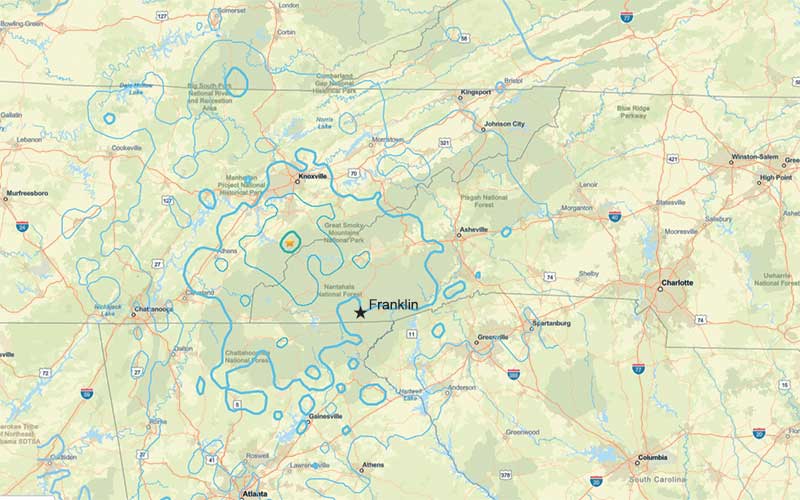
A magnitude 4.1 earthquake near Greenback, Tennessee, rattled the weekend as homes throughout Western North Carolina felt the shaking. The earthquake, which occurred at 9:04 a.m. on Saturday, May 10, alarmed many locals in Macon and its surrounding counties.
A flurry of activity on social media followed the quake, with Franklin residents and folks in the surrounding area expressing surprise at the rare event. It also prompted calls to 911 from people looking to confirm what they had just experienced or inform first responders of what had happened. May 10 saw 79 calls between 9 and 11 a.m. By comparison, Saturday, May 3, saw 37 calls over that same period.
Todd Seagle, Macon County 911 supervisor, said callers were likely trying to be helpful, but urged locals not to call unless the quake had caused injuries or structural damage to their properties. Seagle said no injuries had been reported.
The United States Geological Survey estimated Macon County saw shaking characteristic of a magnitude 3-4 earthquake, which is to say light or weak shaking with no damage. The earthquake occurred 15.5 miles below the surface, there is a 9% chance of a small aftershock though the end of the week, and it is estimated that there will be no fatalities and little economic loss as a result of the initial quake as of 10 a.m. on May 13.
According to USGS, quakes in the Eastern Tennessee Seismic Zone are less frequent than those in the Western United States but are felt over a larger area. The ancient fault lines of the Appalachians also frustrate attempts to identify the specific faults responsible for earthquakes, the Survey said.
Earthquakes are more frequent in Tennessee, especially in and around Knoxville. Only a handful of earthquakes have impacted Western North Carolina in the last 10 years, of which Saturday’s was the most serious. Three quakes have landed in and around Macon County in that time, with one originating in Cherokee, one near Bryson City and one about halfway between Franklin and Dillsboro. All three were around magnitude 2.5, according to USGS.
State Farm agent Amy Manshack said her office had received several calls from concerned locals Saturday. Only one called to report some very minor damage from the earthquake, but most were simply curious about what damages their insurance might cover. Manshack said because Macon County has a lot of second homes, it is entirely possible that more damages will be noticed as people come back to the county for the summer.
Manshack said earthquake insurance is offered by State Farm, and likely most other homeowner insurance providers. She recommended that homeowners get in touch with their providers to learn more about what is offered, how it works and what the likelihood of using it might be.
However, Manshack noted serious earthquakes in this part of the world are exceedingly rare, and the peace of mind provided by additional coverage might not be worth the accompanying premiums or deductibles that extra policies would bring for some customers.
Manshack advised people to be on the lookout for weaknesses in their homes’ structures that could put them at risk for damages from another earthquake or aftershock, including sagging crawl spaces or unanchored structures. Inside the home, homeowners can protect against damages by securing breakable objects like glasses and mirrors as well as heavy appliances to prevent them from falling or obstructing an escape route.
After experiencing an earthquake, residents should be on the lookout for potential gas leaks, broken glass, loose plaster, walls, ceilings or stairwells that could have suffered earthquake damage. It would also help to prepare an evacuation route in the event of an aftershock.
Manshack said that insurance is always changing, so it is always worth it to contact providers and review coverage.