
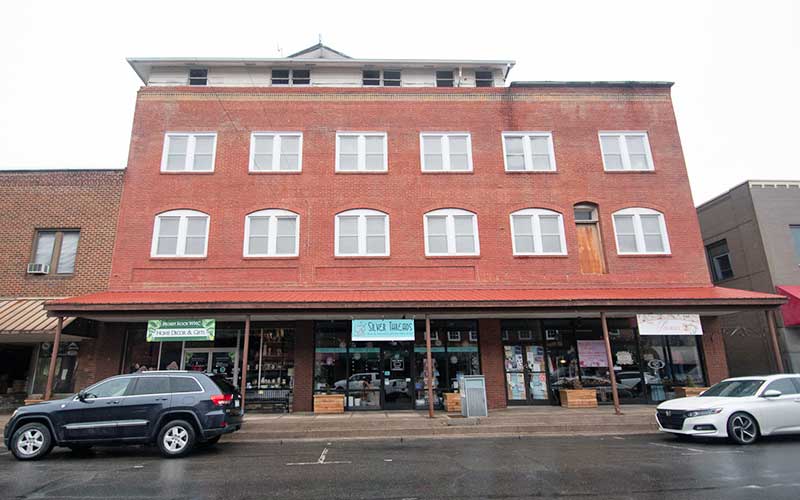
The Town of Franklin has received a long-awaited approval that could spur improvements along Main Street.
The N.C. Historic Preservation Office approved Franklin’s request for historic district designation on Feb. 13.
“It feels good,” Town Planner Justin Setser said about the approval after waiting for several years. “It took a long time – longer than I wanted. It was stressful and nerve-wracking.”
Setser said they got the ball rolling in after a plan was presented in 2022 to restore the old Scott Griffin Hotel on Main Street to include 20 rooms and a rooftop restaurant.
“As we were going into the hotel project, we saw that we need this [historic district] to offset the potential funding that the project would need to make it feasible.”
One of the hurdles was that so many of the buildings along Main Street had changed over the years and very few still look like they did historically. “That changed the character of downtown,” Setser said.
During the application process Setser said they found that Franklin had participated in the TVA “Townlift” program, which was designed to help small towns revitalize their business districts and improve urban design. Some of the property owners had received funding through the program to update their building facades at the time.
Setser found a copy of the plan from 1969 in his office. “Finding that was a lifesaver,” he said. Because the Townlift program was federally funded, it could not be used against the town’s historic district application. “I think that’s what saved us in being able to get a historic downtown.”
Setser said the district will now have to be approved at the national level, but that is basically a formality.
Downtown Franklin Historic District
The district encompasses 8.85 acres of the Main Street area from Patton Avenue at the top of Town Hill to just beyond Macon Avenue on West Main Street. Some of the historic structures are the old jail (ca. 1896) on Phillips Street that now houses the Gem & Mineral Museum, the Johnston-Porter Building (ca. 1887) on West Main, the former post office built in 1935 (now the 911 and Veterans Affairs building), the Macon County Courthouse, and the former Western Auto building on Palmer Street built in 1926. The Pendergrass Building, a general store built in 1904 that now houses the Macon County Historical Museum, is already on the National Register of Historic Place.
The district includes 29 buildings or sites that are considered contributing, meaning they add to the historic, architectural or cultural significance of the district. An additional eight non-contributing buildings are in the district.
The historic district designation will make it possible for property owners of the contributing buildings to qualify for tax credits when making improvements to their buildings. Setser said the tax credits could pay up to 30% of the project.
“That could really help on some of these projects and getting some of these projects done. It’s another tool,” Setser said.
“I’m grateful for all who worked so hard to get the designation,” said Janet Greene, whose family owns the Scott Griffin building. “The historic district means the remodeling effort could receive tax credits that make the project more affordable.”
Setser said once the district gets approval at the federal level they will start again looking for investors interested in the hotel project. He described it as an “evolving process” that could take several years or maybe not at all. “But it’s a possibility again,” he said.
Setser said another property owner had told him it was just too cost prohibitive to work on their building, but being eligible for the tax credits could help. The town’s comprehensive plan recommends creating apartments, or other uses, in the upper floors of the buildings along Main Street.
Setser said this is not the type of historic preservation district that comes with restrictions about changes owners can make on their buildings. It’s more about the tax credit program. He said there could be stipulations for owners applying for the tax credits. He did caution that owners of the contributing buildings should be mindful of the changes they make. If they alter the building so much that it becomes non-contributing it might not qualify for the tax credits.
Setser said they have held a couple of meetings with the property owners, and some were concerned about their property taxes going up. He said the historic designation will not make taxes go up.
“If your tax goes up, it’s because you made improvements. You got tax credits and you made $2 million worth of improvements,” he said. “It’s not a taxable district or anything like that. It’s just another tool in the toolbox.”
He said there could be some economic benefits as some people like to travel to visit historic districts.
Main Street redesign
Economic development and the Main Street redesign project were topics of discussion at the Franklin Town Council’s retreat held Feb. 20 and 21 at Fontana Village Resort.
The town has advertised for Request for Proposals for the project. Mayor Stacy Guffey said the next step would be approving the contract. Town Manager Amie Owens said it will be a long process and that they likely would not have a design plan until fall. The town plans to have sessions for the public to give input on ideas for Main Street redesign.
Some of the issues discussed during the retreat included speed enforcement, parking, beautification, incentives for developing the second floors, rejoining the state’s Main Street program, widening the sidewalks, and a possible reduction to one lane.
“I want us to be careful,” said Vice Mayor Michael Lewis. “If we’re going to do this redesign, I would ask that we be very careful about any money we spend on Main Street as it stands.”
He said anything they do now may not end up fitting in with the concept that is approved for the redesign. “I’m not saying ‘don’t’, I’m just saying let’s just try to be mindful.”
There was a discussion about possibly purchasing speed cameras. Town Attorney John Henning said according to state law, fines collected through ticketing must go to the local school district. The town would not benefit financially from the fines.
It was also mentioned that some of the proposed changes to Main Street could help slow drivers. Council member Rita Salain said more enforcement and police presence would be helpful and she would like to see a monthly report on how many tickets are issued.
Note: These were ideas discussed at the retreat – no official action was taken. The council members identified items the town may want to work on, and budget for, in the coming years. Look for more coverage from the Town Council retreat in next week’s edition of The Franklin Press.