
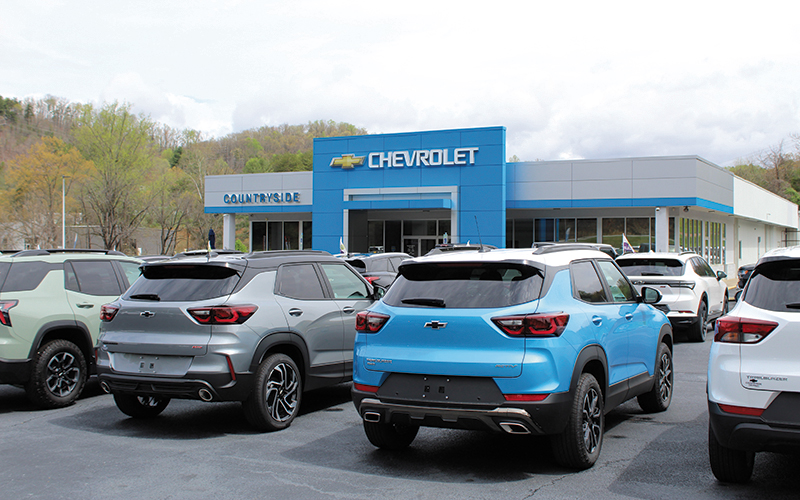
As worldwide markets reel from President Donald Trump’s broad application of tariffs, which include a 25% tariff on automobiles and auto parts from Canada and Mexico, local car dealers appear to be taking their cues from corporate, implementing sales and deals or awaiting further advice on how the companies will respond.
In addition to the broad “reciprocal tariffs” the White House announced on Wednesday, April 2, the president placed 25% tariffs on all imported automobiles as well as agricultural products, electronics and machinery, textiles and apparel, steel, aluminum and chemicals. These import taxes usually lead to price increases for consumers as importing companies pass the tariff costs along to consumers, though the exact amounts by which prices will increase is currently unknown as many of these tariffs compound costs through the production chain.
For the time being, leaders at Franklin’s car dealerships are having mixed responses to the news. Though Countryside Chevrolet, Franklin Ford and Andean Chrysler Dodge Jeep RAM sell vehicles of U.S. car companies, many of their vehicles are assembled overseas — and parts for all vehicles rely on a global supply chain.
Kevin Sinden, general manager at Countryside Chevrolet, said the tariff announcements were so new that on the local level they had not yet received any insight into what exactly the economic impact would look like for them. He said the “big three” (General Motors, Ford and Stellantis) were working on a plan of action, and that it would not be disseminated for at least a week.
“We don’t know how it’s going to affect us yet,” Sinden said. “It’s not been addressed.”
Sinden did say that consumers would not feel the effects of the tariffs just yet, because the dealership has plenty of stock in place. Even incremental price increases will likely not be seen for some time.
Though there is no “cut and dry” list of vehicles made at Mexican or Canadian plants, Sinden said that most of the 2500 trucks are Canadian and most smaller SUVs are made in Mexico. The manager said he foresees a shift to reliance on pre-owned or aging vehicles, and that Countryside Chevrolet might shift to selling more pre-owned vehicles than it does currently.
Hammond Rauers, owner of Franklin Ford alongside his brother Bryan Rauers, said Ford appears to be using the announcement as an opportunity to push for more sales, with its “From America, For America Pricing” where customers will receive employee pricing when purchasing or leasing new vehicles. Rauers said approximately 80% of Ford vehicles sold in the U.S. were assembled on American soil, and the entire F150 series is assembled in the U.S., likely placing Ford in a better position to respond to tariffs than its competitors.
The Rauers brothers also own the Franklin Kubota Tractors, which Rauers said sells more new vehicles than Franklin Ford does. The tractor company also heavily relies on domestic manufacturing despite being a Japanese company, and most of the product sold is assembled in Gainesville, Georgia.
One concern, however, is vehicle parts, Rauers said. Parts come from all over the world, and it is currently unknown how taxed parts will affect overall construction and assembly costs. Rauers said he observed similar trends during the COVID-19 pandemic and expects to see a bump in new vehicle sales as consumers purchase more used vehicles and dry out the market, forcing others to purchase new cars instead.
In general, Rauers struck a more casual tone about the tariff news, opting to focus instead on things the dealership is able to control, like its local business and relationship with employees and customers.
“It’s all just supply/demand. We’re truly looking at it as an opportunity for business,” Rauers said.
Ralph Fugett, Andean general manager, said Stellantis has joined Ford in offering employee pricing through its “Freedom of Choice” pricing program, making its current stock as cheap as ever, and that Andean has more stock than its local competitors. With more than 200 vehicles in inventory purchased before the tariffs were levied, Fugett believes Andean to be in an excellent position to make the tariff announcement into an opportunity.
That is, if the tariffs hold, a possibility that Fugett expressed doubt over. Fugett believes that the current market response to the tariff announcements is a bit of an overreaction, and that Trump will make deals with various foreign nations that will result in the tariffs being lessened or lifted entirely. He said he has also seen a strong sales weekend at the Franklin dealership.
But for those who are concerned that the tariffs will be long-term, Fugett said that now would be the best time to buy a new car rather than later. If Chrysler were to increase the cost of a vehicle by $3,000, Fugett said, he would have to raise prices in response.
Though Fugett said it was possible that buyers could shift to a greater reliance on older or pre-owned vehicles, he said it was just one possible response among many — one of which was a rush by consumers to purchase more American-made automobiles.
Stellantis drew headlines when, in response to auto tariff announcements, it declared a temporary stop to production in Canadian and Mexican plants, which will result in temporary layoffs to 900 domestic employees, according to a report from the Associated Press. Fugett however, said local dealerships are able to operate independently from the automaker, and that Andean will not necessarily copy the corporate response.