
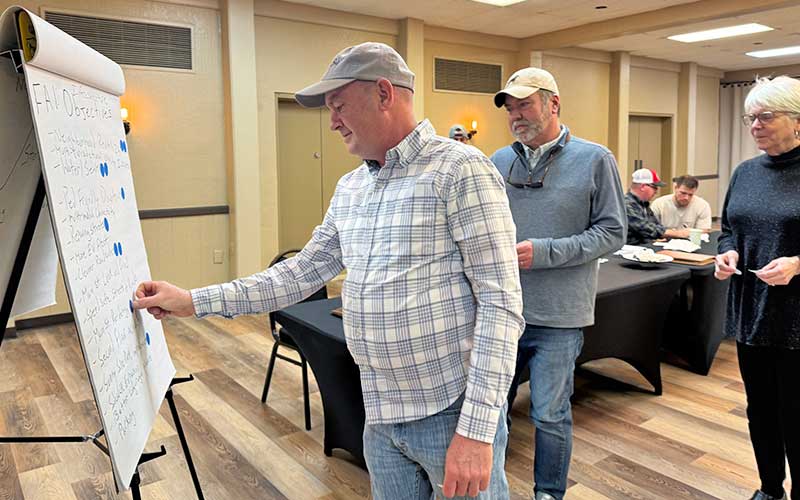
Economic development and revitalizing town infrastructure were the top two priorities to come out of the Franklin Town Council’s annual retreat held Feb. 20 and 21 at Fontana Village Resort.
The council then took its first action related to those items at the March 2 board meeting.
The retreat began the evening of Feb. 20 with council members prioritizing a list of 10 focus/goal areas provided by the N.C. League of Municipalities.
That list included a safe, vibrant and healthy community; organizational excellence; economic development; tourism and cultural resources; safe, reliable and sustainable utility services; revitalized town infrastructure; environmental character; economic health; connected, engaged and diverse community; transportation.
With each council member and the mayor given two blue dots to “vote” with, they ranked their priorities. Economic development and revitalized town infrastructure were the top two focus areas, followed by tourism and cultural resources; safe, vibrant and healthy community; and economic health.
Within the infrastructure and economic development categories the council members then listed action steps they would like to take in the coming years and prioritized those actions.
The ideas presented at retreat were for discussion purposes and no official action was taken on any of them at the retreat. The purpose of the retreat is to help the council identify areas they want to work on and any items that would need to be budgeted in the coming years’ budgets.
Infrastructure objectives
The morning of Feb. 21, the council began discussing neighborhood revitalization and Main Street redesign, which were the top two priorities under infrastructure objectives.
The Main Street redesign process is already in its initial phases as the town advertised for Requests For Qualifications in November. At the March 2 Town Council meeting, Town Manager Amie Owens said they received nine proposals and interviewed four candidates. Of those two were selected to work together with John R. McAdams Company serving as the prime consultant and Toole Engineering as the subconsultant.
The two firms worked together to develop a scope of service for Phase 1. The council approved a $98,856 budget amendment from the general fund balance for the first task order through June 30. The fee for the second task order will be submitted prior to the new budget year beginning July 1.
As the planned repaving of Main Street in 2028 is key to the redesign, Kristy Carter from McAdams said they will start collecting the data that NC Department of Transportation will need from the town by October in order to advertise for bids. That information will also help them better determine what happens in Phase 2 and the cost.
Carter pointed out that one of the most expensive parts of the first task order is community engagement at $42,630.
“Mayor Guffey and Vice Mayor Lewis communicated they want this to be a community driven plan and vision,” Carter said. “There does need to be a vision.” She said they will hold meetings with town leaders, business owners and the public at large to give their input.
“The reason we want to do it is to make it a place where residents want to come and hang out and enjoy themselves,” Lewis said.
“This is not going to be some paint and trashcans,” he continued. “It’s going to be big. This is going to be transformative, and the community really needs to be involved in it.”
Neighborhood revitalization
During the retreat the council talked about the following ideas to revitalize neighborhoods.
• Recreational opportunities such as continued development of Sunnyside Park and Little Tennessee Greenway connections other than the parks.
• Council member Joe Collins asked if there was an inventory of houses or dwellings that don’t meet the minimum housing requirements and the process for condemning those. Related to that, council member Rita Salain asked what they could do to increase the effectiveness of code enforcement for houses and businesses and if some of the codes needed to be rewritten.
Salain commended Code Enforcement Officer Angela Green for the job she has been doing. “I want to make sure she has the resources she needs to continue doing a great job.”
Town Attorney John Henning cautioned that when it comes to property rights “there’s only so much you can do.”
It was suggested being proactive in rezoning or restricting uses in areas where there are problems so that when a certain situation ends the property can no longer be used in that way. “In other words, you’re not running somebody off; you’re just saying once that one’s gone, that’s it,” said Vice Mayor Mike Lewis.
“If you look at places where you don’t have problems and you look at places where you do, it’s because it’s probably zoned differently to a degree or a different classification,” Lewis said. “There’s a reason places are problems and other places aren’t.”
• Collins said the lower part of the Sunnyside property in East Franklin would be a good location for condo-type housing.
However, Russ Harris, from Southwestern Commission, who was leading the retreat, said the location of the property near Lander Tubular might make it ineligible for the state’s Low Income Housing Tax Credit program. Private developers not needing the tax credits could develop the property.
• Council member Robbie Tompa suggested the council look at criteria for selecting neighborhoods they want to focus on revitalizing.
Other suggested items listed as infrastructure objectives included continued water/sewer improvements, a pedestrian friendly downtown, repaving streets, cleaner roadsides, the look and flow of Main Street, speed safe streets and roads, second floor activation, Sunnyside Park improvements, multi-jurisdictional utility issues, more electric vehicles in the town fleet, sidewalk expansion (not just repairing current sidewalks), parking, and better long-range planning.
Economic development objectives
The council identified the top two priorities for economic development as establishing a revolving loan fund and focusing on the growth of businesses with a stake in the future of Franklin.
To budget for a revolving loan program, it was suggested the town look for examples of other local governments that offer a revolving loan fund to get ideas on how much is offered, how the loans are used, and what businesses would be eligible.
Several ideas for encouraging business growth (BRE – Business Retention and Expansion) were discussed including a consumer education campaign.
Mayor Stacy Guffey said many people don’t realize how shopping local benefits not only the businesses but the overall local economy and the long-term investment in the town.
In addition to the consumer campaign, council members said it would be helpful to let business owners know what services and programs are available through Southwestern Commission, Southwestern Community College, or other organizations to help small businesses succeed.
During the March 2 Town Council meeting, the board approved a resolution and Memorandum of Understanding with the N.C. Main Street & Rural Development Center to assist the town in creating an economic development plan.
“We want to be here to help you vision and to help you imagine what can be for your downtown spaces,” said Allison Smith from the N.C. Department of Commerce.
Smith outlined the free services they can provide, which will also benefit the town’s application in 2027 to reenter the state’s Main Street program.
Smith said the economic development plan is meant to be usable, not to sit on a shelf, and that it would be grounded in reality with awareness of who will be implementing the plan.
“We believe in incremental transformation,” she said. “Small projects have snowball effects.”
In following up on a discussion from the retreat, during the council meeting on Monday, Lewis presented a proposal to rebrand three areas of town to assist with marketing, events, overall promotion of businesses and properties in those areas.
Lewis said some business owners in other areas of town have said it seems most of the town’s focus is on Main Street.
“They’re part of this too,” he said. “It sort of gives them an opportunity to come up their own identity.”
He proposed the Main Street area at the top of Town Hill would be called Uptown, with the surrounding areas called East Downtown Franklin and West Downtown Franklin.
“This is just a way to facilitate more activity in those districts,” said Guffey.
No vote was taken as Lewis asked Town Manager Amie Owens to post the proposal on the town’s website to see what kind of feedback they get before talking about it again next month. He encouraged anyone that wants to talk about the proposal to sign up to speak during the public comment period at the April 6 meeting.
Some other economic development topics discussed included improving cooperation among businesses, zoning regarding nuisance uses (such as data centers), researching the ideal retail mix (such as the need for more places to shop for clothing), workforce housing, co-working space, improved access to childcare, availability of downtown properties, natural environment/recreation, cooperation between the Tourism Development Authority and the Tourism Development Committee/Chamber of Commerce, and establishing a subcommittee with representatives from Franklin, Highlands and Macon County to discuss and address economic development issues.
In closing the retreat, Guffey thanked the council for being proactive and “making things happen for Franklin.”