
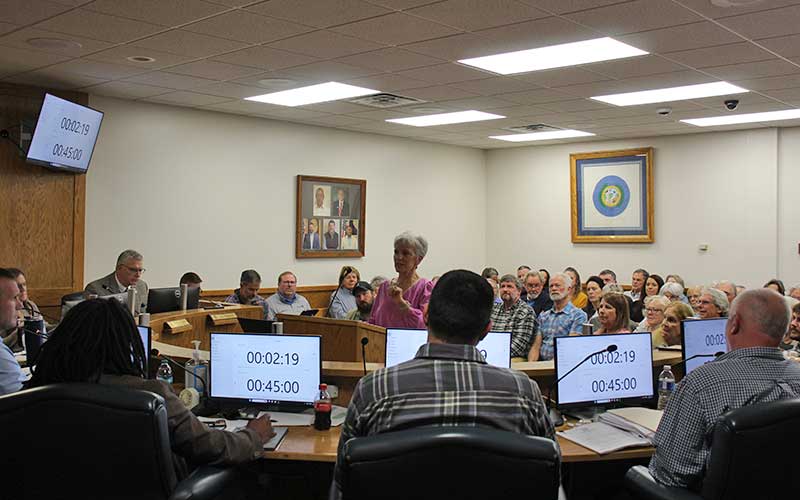
Thirteen speakers showed up for the Macon County Board of Commissioners meeting on Feb. 10 to voice opposition to a proposed new election structure for the board.
Commissioners have been discussing redistricting since their Dec. 9 meeting, reigniting an effort from 2023 to restructure the board. Ultimately no vote took place on Feb. 10 regarding the proposal.
Commissioners voted 4-1 in December to approve a resolution to request permission from the General Assembly to begin a redistricting process. Commissioner Josh Young voted against the measure, saying he wanted to ensure a public hearing was held before the vote. The issue came up again in January after state lawmakers requested a specific plan to vote on instead, and commissioners voted to hold a public hearing on Feb. 10 on a plan to establish three districts with equal populations with one commissioner from each district and two at-large seats.
The plan is effectively the same as the plan approved in 2023 in a 3-2 vote with then-commissioners Paul Higdon, John Shearl and Danny Antoine voting in favor and Josh Young and Gary Shields voting against.
Current system
Five Macon County commissioners are selected from three districts. District 1 includes Highlands, Ellijay, Flats and Sugarfork. One commissioner is elected from District 1 every four years to represent 6,090 people.
District 2 includes Iotla, Millshoal, Union, Smithbridge and the three Franklin districts. Three commissioners are elected from District 2 with at least one election held every two years due to staggered four-year terms to represent 17,113 people.
District 3 is made up of Cowee, Burningtown, Cartoogechaye and Nantahala. One commissioner is elected every four years to represent 6,068 people.
Commissioner John Shearl has said at multiple meetings the current system is unfair to Districts 1 and 3 because people from those districts can only run every four years, compared to District 2’s elections every two years. He said the proposed change would allow for people from each district to run each election cycle and potentially give voters a chance to vote on a candidate from their district each election.
Public hearing
The public hearing included 13 speakers, all of which opposed the plan presented at the February meeting. Most speakers urged commissioners to take their time and avoid rushing into approving a drastic change, including Joanne Roesner, Amy Patterson, Tom Young, Mary Williams, Linda Tyler, Jim Tate, Jeff Weller, John Muir and Patrick Taylor.
Roesner said, “This is not an emergency and it is not an absolute necessity to send it to the assembly short session in March. The urgency is artificial and appears to reflect candidate concerns and personal agendas.” She said more options need to be considered than the single option on the agenda and suggested a ballot referendum.
Patterson said the current system is reflective of Macon County’s population center in and around Franklin. She said she would like to see more districts and district-only voting, so that she, a Highlander, would only vote for the Highlands district.
Tom Young suggested organizing an event at the Carpenter building to educate residents on different options and taking in public input, asking commissioners not to decide right away. Mary Williams said she was concerned at-large districts could result in some commissioners being unaware of the issues affecting each district. Tyler advocated for a ballot referendum to allow voters to weigh in on a new election structure.
Tate said, “I personally don’t think the route that’s being proposed tonight is the best route. I think there are some other options, and I don’t know that it’s better than what we have right now … let’s get it right.”
Scott Baste said he was not in favor of at-large commissioners at all, adding he would not be opposed to there being five full districts in the county.
“Why would I want to vote for Highlands? Why do I care about the Highlands commissioner? They have their own concerns … why should a Highlands commissioner be able to run countywide … it doesn’t make sense to me,” Baste said.
Lisa Walker was disappointed the original December decision was made without public input and said if a problem exists the public needs to be a part of finding the solution.
Frieda Bennett said the decision was too rushed and any newly drawn districts would need to be redrawn after the 2030 census anyway.
“Voters must pick their politicians, politicians must not pick their voters,” she said.
Caleb Brown said, “I think everybody’s here because we want transparency in our local government. We want transparency in our state government … trying to pass this resolution without the input of your constituents is questionable at best and shady at worst and I think that’s what happened. I appreciate that y’all ultimately decided to hold this hearing this evening and I think that it’s important.”
Brown said redrawing the districts to hold equal populations would shrink District 2 and dilute Highlanders’ votes by adding voters to District 1 that currently live in Franklin. He said the same would happen in District Three.
“The most effective way to resolve this issue is to develop that true electoral system that we talked about where you vote for a representative from your district to represent you on the county commissioner board,” Brown said.
Commissioner response
County attorney Eric Ridenour clarified that if the commissioners wanted to determine the board’s structure via referendum, it could only choose from four options:
A: All commissioners would be elected at large.
B: One district must exist per commissioner and only members of that district can run and vote for the seat, both in the primary and the general elections.
C: Only voters from each district can vote on candidates representing their districts in the primary, but the entire county can vote on each candidate in the general election.
D: Candidates must reside in their districts, but the entire county can vote on each candidate in both the primary and general elections.
If the county wants to implement any other structure, it must be voted on in a local bill at the General Assembly.
Shearl said he wanted to correct some misunderstandings about the proposal.
“This makeup of this board was done in 1978, and as far as I know there’s never been a population study in this county as to where the growth is. So you have 37,000 people living in this county. Every single person of that 37,000 should have the equal representation and equal opportunity. At this time, you have three people at District Two. You have one in [district] 1 and one in [district] 3. Where’s the fairness in that?” he said. “I’m trying to bring fairness.”
Shearl reiterated the proposal would increase opportunities for people to run for office and could potentially lead to three of the five commissioners being from Highlands or Nantahala.
“District 1 and District 3 has everything to gain and nothing to lose. District 2 will have one representative on this board, as the law says that it should have,” he said.
Shearl also said the board is pressed for time to implement the plan, saying the current system is unfair and the proposal must be voted on by the General Assembly.
Commissioner Danny Antoine thanked those for coming to speak at the hearing and said he believes it is unfair how District 2 candidates can run every two years to the other districts’ four, but liked the speakers’ suggestions taking more time or putting the decision up to a referendum. He said because the system has been around for so long, the commissioners need to take their time to find a solution. He said he does not believe any of the commissioners have a hidden agenda on this issue.
Commissioner Barry Breeden said he felt it was important to address the problem and the current system is not perfect, but said it was important to make sure people understand what the county is trying to do and showcase all the options.
Commissioner Chair Josh Young said he believes things need to be recalibrated and would like to see a study that compares Macon County to other surrounding counties in the area to see all the options lined up on paper.
“Let’s do it entirely, and it may come back that this is the best method. It may come up that what John has is the best method, but I feel like I’ve yet to see, in writing, a visual, what this is going to look like, how it’s going to affect me,” he said.
“That’s my ultimate goal,” Shearl said. “There’s a conversation piece to recognize where this county is and moving this county forward to be fair for every citizen.”