
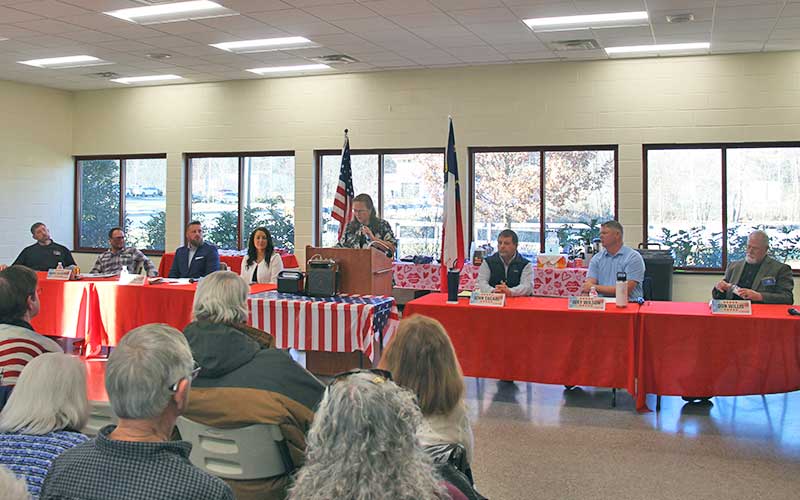
This is part one of coverage from the forum with county commissioner candidates held Feb. 7. Part two will be published Feb. 18.
In the lead up to early voting starting this week, the seven county commissioner candidates talked policies and credentials at a forum presented by the Macon County Republican Party on Saturday at the Robert Carpenter Community Building.
Incumbent John Shearl, Don Willis and Joey Wilson are vying for the single District 1 seat to represent Highlands, Ellijay, Flats and Sugarfork. David Culpepper, Dylan Castle, Kellie Burns and Nick Lofthouse are running for two open District 2 seats to represent Iotla, Millshoal, Union, Smithbridge and Franklin. District 2 incumbents Gary Shields and Danny Antoine did not run for re-election.
Republican Party chair Patti Trick opened the forum with questions asked by moderator Keith Blaine, chair of the Jackson County Republican Party. Each candidate was given two minutes to answer each question as well as a chance to make a 30-second rebuttal.
What do you see as the fiscal consequences when county departments request funds outside the standard annual budget cycle?
Willis said it was important for commissioners to work within the confines of their budgets, and when departments come with requests outside of the standard budget commissioners have to decide which requests are the most important and will have the biggest impact on taxpayers.
Wilson said it was impossible to plan for everything, but the county has contingency funds for additional funding requests. He said he would like the county to explore opportunities for outside revenue to help cover more county expenses.
“We do need to be responsible in our departments,” he said. “If my construction job runs over budget I have to explain to the customer why that happened and I have to do everything that I can do to keep that from happening.”
Shearl said, “Four years ago my sign said low taxes, period … this county has been ran outside that budget for decades and I have fought every step of the way to live inside that budget just like every household has to do.”
“We have not spent any money outside the budget this year,” he continued. “We’ve actually put just a little bit of money back into undesignated fund balance, even after this adopted budget.”
Shearl later used a 30-second rebuttal to note contingency funds are a budgeted item.
Castle said, “If a county commission board were to say ‘yes’ every time an unexpected expense comes up then it sets a tone. So where do we draw the line? It creates a slippery slope. My immediate response would be that.”
He said absolutes are dangerous and would prefer to examine the needs of extra budgetary requests on an case-by-case basis.
Culpepper said, “It should definitely not be the norm to step outside of the budget. That being said, there are certain circumstances in which we can get a better product by doing that. I can think of a few examples – from the town, anyway – where there were some great opportunities for radios or fire equipment, some police issues where we were able to use some money outside of our budget to match some grant funding opportunities … That being said, there’s a lot of time spent on that budget process and it’s important that we try to stick as closely as possible to that.”
“When a department head comes before the board and asks for more money I think we all need to give them some grace and recognize they’re not doing it because they want more money, they’re doing it because they see a need or they want to address an issue,” Culpepper continued.
Lofthouse said, “Working [with the] county budget for a long time now at the Sheriff’s Office … sometimes those needs come up and we have to have those things that we need at a certain time. So we also have to replace things on a certain cycle that they need to be replaced. Just because a department head comes to us and says ‘Hey, I need to replace this hole in the roof’ or ‘I need to replace this or that’ it’s not an immediate no. We need to have that conversation.”
He added the commissioners need to ask questions to determine which requests are most needed but noted sometimes saying no pushes needs off to the next budget cycle and makes the requests more expensive.
Burns said she would like to establish a “philanthropist initiative” to search for donations to invest in county resources like schools or healthcare. She used Highlands as an example, saying the hospital and civic center were built through philanthropy. “Those people had money and donated it to make those things happen. We should have a foundation set aside with funds for discretionary things … it’s kind of like grants.”
What do you plan to do about the population growth regarding the housing industry, employment of families?
Shearl said, “I believe in capitalism. I also believe in private property rights, and so you’re talking about an issue that you’re trying to tell people they can’t come here. Back in the day, we had manufacturing in this country. Many places that people worked and raised their families and supported their families and thanks to Bill Clinton, back in the ’90s, there was the [North American Free Trade Agreement] and all of our plants and manufacturing and everything else left us.”
Shearl said he was grateful for new families coming to the county because, as a contractor, their migration paid for his home and children’s college.
Willis said there is not enough affordable housing in Macon County, a problem that is driving young families to move away or look over Macon County as an option.
He said, “John’s right. We lost industry in the ’80s and ’90s and when we lost that we lost a higher income … The average home costs about $300,000. How can anybody afford that on $16 an hour or $18 an hour? I don’t know how they do it. We need to think outside the box, we need to start marketing, we need to start filling some of these shopping centers that are open. We need to promote business.”
“I agree,” Wilson said. “This one, I think, is going to be pretty level across the board.”
He said housing stock has not increased with population growth, causing inflation, and the county needs to attract more jobs to increase income.
Lofthouse said, “Affordable housing in Macon County is pretty complicated, being that 50% or a little bit over is national forest … it locks us in on how much land we have, how many houses we can build.”
He said the county needs to preserve that natural beauty but look for ways to lower prices by reducing the price of building houses.
Burns said a creative solution may be building retirement communities to give seniors who are willing to sell their homes someplace comfortable to live.
“If you could get somebody to develop an area that is suitable for them and their needs that would open up a huge faction of the housing market,” she said. “On the job front, you wouldn’t believe how much people make doing remote jobs from home. It would blow your mind. They cross my desk and I get to see it. I think we need to work with SCC (Southwestern Community College), Franklin High School and Western Carolina University and start training our children to do that and find jobs that they can work here in Macon County remotely.”
Castle said, “I will not advocate for a county-funded, county-built, county-maintained sort of housing solution … philosophically, I cannot get on board with that.”
He said he agreed with Burns’ remote work plan and wanted to look for more ways to incentivize Macon County as a location for remote work. He said he would like to incentivize the private sector.
Culpepper said the most immediate solution was for the county to get out of developers’ way, specifically mentioning a housing study from Transylvania County. He said the term “nimby” (not in my backyard) appeared in the study and he wanted to make sure property owners were able to build without interference from neighbors.
“The solution’s more housing stock,” he said. “If you build medium-range houses, mid-range housing stock, that opens up lower income housing stock as people move up the property ladder. We need to make it easier.”
He also lauded a North Carolina house bill that allows people to build a home with lumber harvested from the landowners’ property.
A collection of rebuttals followed.
Shearl said affordable housing was “not a government issue” but “a private sector issue” and “if people can make money they’ll come here and build, but we have nothing to offer.”
Willis said he would like to find a way to incentivize short-term rentals into becoming long-term rentals to increase available stock.
Burns said Macon County is already an attractive place for builders with fewer regulations than its neighboring counties.
Culpepper said deed restrictions make development harder than it needs to be and said again he believed more housing stock was the answer.
Lofthouse responded to Shearl’s rebuttal, saying “I just heard something … ‘we don’t’ have anything to do here’ and I just wanted to say that we do. Our outside recreation is a huge draw for us”
“We should be boosting our community up and talking about the good things that we have and that’s what we need to do,” he continued. “When people on our boards are saying that’s not what we need, that’s not what we want here, what message does that send to everybody?”