
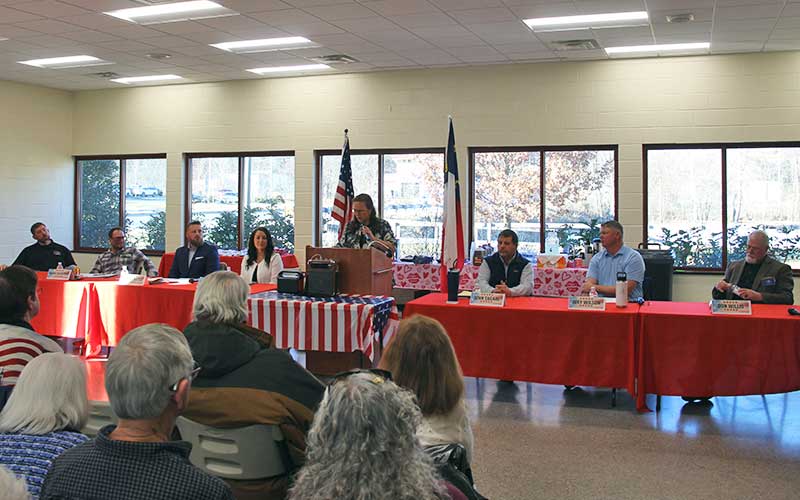
This is part two of the coverage from the forum with the candidates for the Macon County Board of Commissioners held on Feb. 7. The first part was published on Feb. 11.
To fund raises for high-performing employees, would you support a hiring freeze on non-essential vacancies, or do you believe all current positions must be maintained?
Joey Wilson said, “I think any successful government, any successful business, is successful because of the employees … I don’t know in the entire Macon County where we have excess, where we have high performers, but I can figure that out within a month.”
He said the county will have to retain essential positions and provide competitive pay for those providing all county services.
“Maybe we can raise the income of Macon County so we can spread that around to the people that deserve it,” he said.
John Shearl said the county’s most recent pay study in 2019 failed to provide for all county employees. He is categorically opposed to a unilateral pay increase for county employees, saying employees who go above and beyond “can’t be recognized because they’re on this pay scale.”
“I’ve never in my business life ever went across the board and gave all my employees raises. They earn it,” he said. “I wish there was a way that they could really get recognized, because they are wonderful employees.”
Don Willis said he was a Macon County employee for 35 years and has seen four or five pay studies.
“The problem is we don’t adhere to it,” he said. “When we have these studies done, a lot of times, we kind of dilute it a bit because we can’t really afford it. But if we’re going to keep these quality employees, you have to give them a competitive wage.”
Dylan Castle said he had heard from the county manager the county was not overstaffed, in spite of a common misconception, and most county employees are “wearing multiple hats.”
“If you have people that already their heart is to serve the fellow citizens of Macon County and then their pay needs to be addressed and they’re wearing multiple hats and pulling multiple roles, not always getting paid for those additional roles and then we say ‘Oh, by the way, those people that help supplement and support you … they’re not going to exist’ … what’s going to happen? Who’s going to pick up the slack? I know it’s not essential, but those are still services.”
“I’m going to treat my employees well,” Castle said. “This new generation does not focus so much on benefits; they look at the take home pay and we need to think about that.”
David Culpepper said attrition can be a benefit for the county but said there is no easy solution. He said some employees are worth more and deserve recognition.
“I think the focus is a lot of time on the upper level positions, but it’s our foot soldiers that I think get the worst end of the stick,” he said. “It’s our bus drivers, our jailers, teacher assistants, the people that I guess they’re considered unqualified jobs. They’re the ones that probably need the most attention in this matter.”
Nick Lofthouse said the 2019 pay study was only implemented on phase one, with the county failing to move on to other phases.
“County employees are still wanting to know where’s step two, where’s step three. Years down the road we’re looking at paying for another pay study. If we’re going to keep doing pay studies and keep wasting money, let’s at least give it to the employees,” he said.
Lofthouse added county positions were created for a reason and freezing them without understanding why they were created would cause more problems. He also said the county needs to boost pay to help with retention and it is losing money training employees who then leave to pursue better-paying jobs.
Kellie Burns said she would like to start an initiative to incentivize employees to find waste, saying, “You make them part of the solution.” Under this initiative Burns said the county could give a bonus for finding a certain amount of waste.
“It’s hard for me to believe there’s not some places where there’s people that we might not need and we could pay more to the other people in those departments and get more out of them,” she said. Burns said this may be possible with updates to county technology. She added in a rebuttal the county should use contract positions and grant funds to fill open positions.
In a rebuttal, Culpepper said, “I’m not saying it’s going on right now, but it has happened in Macon County historically. You can make employees a lot more comfortable and have greater job satisfaction just by making sure that county commissioners aren’t treating certain departments like fiefdoms.”
In a rebuttal, Shearl said, “Mr. Lofthouse talked about losing staff to other counties. Folks, these other government agencies are playing games on the taxpayers’ backs. One will increase [pay] rates and the next thing you know, the next county over, people are job hopping to get more money and it’s all on you.”
We have a $60 million fund balance reserve on the books. What is your strategy for these funds? Should they stay put, or be used to offset property taxes or some other purpose?
Shearl said he did not support the quarter-cent sales tax increase that will be on the ballot in November, saying “prove to me that the government needs more money.”
“He just stated that we’ve got $60 million in the slush fund, that’s what it is. Slush funds are used to buy votes. Honestly, that’s what it is.”
He said the state recommendation was to have 20% of its operating budget in the general fund to respond to disasters. He said the current board of commissioners has been using the fund.
Willis said the funds need to be used for capital projects that already need to be done.
“If you go back into … ’23 and ’24, not a whole lot was done. There was a state of chaos in our commissioner meetings. They were lasting three, four, five, six hours. That’s ridiculous. We didn’t get much done. Not much movement was done and progressed, but we need to continue to use these funds instead of sitting on it.”
Wilson said, “We can do a lot of work with $60 million,” and said Macon County was doing better than Jackson, Swain and Graham County in some respects and lagging in others.
“I’ve built infrastructure for the last 15 years,” Wilson said. “Me and Walter Bumgardner fixed every sewer pump station in this county at least three times. They need to be fixed. You can’t just let that stuff go. This one over here next to the Whistle Stop was 47 feet deep. Go in there and work on that for two hours. We need some new stuff and it’s time to do it.”
Culpepper said, “$60 million is too much. A few years ago the town passed a resolution that we would not go over a certain threshold. We also had I guess what we’re calling a slush fund but that’s been reduced, and we spent it on some public projects that are doing good for the livability of the town.”
He said the rec park project was a good use of the general fund, though he was on the board that advocated for it. He said he would like to see the covered pool, one of the later phases of the project, moved up to support the Franklin High School swim team and create more recreational opportunities.
“The problem is when you tell politicians that there’s $40 million there, that we save $20 million, everybody’s eyes light up and we have a whole bunch of different projects in mind. But it doesn’t need to be spent irresponsibly and quickly,” he said.
Lofthouse said the fund was essentially a savings account and can serve as a way to showcase the county’s ability to manage money. However, he said he wants to spend it down as well, focusing on county projects.
Burns said, “You’re supposed to put away 20% of your budget. That’s the maximum we really need. The state of North Carolina says that as well … so for me, if you have additional funds, though I do love your ideas of new things, we’ve got to fix the problems. We need a new jail. We need improvements in our courthouse and at our schools.”
She continued, “I could have built a house 10 years ago way cheaper than I can build a house today. We can repair a school today way cheaper than we can 10 years down the road. We can build a jail way cheaper than we can if we wait 20 more years. It’s not safe. It’s a liability to our county. Use the money and quit hoarding it.”
Castle said he agreed with most of the previous statements, but added, “my biggest concern would be when we start to build new things … that we also can sustain the maintenance of any sort of new buildings, new projects and new facilities.”
A collection of rebuttals followed.
Shearl responded to Willis, saying in the past three years the county had provided broadband, a new library and community center and repairs to the wastewater treatment plant, projects that had not been done since they were first requested in 2014.
Willis encouraged members of the public to go back and watch meetings from 2023 and 2024 to see them being unproductive, saying he appreciates the progress that has been made since current chair Josh Young took over.
Lofthouse said the county already has a capital improvement plan and said the county needs to use it rather than keep having studies but failing to act on them. He added the county needs a roadmap in place for maintaining and eventually replacing these new facilities.
Regarding the school bus driver crisis, what specific roles should the board take through funding or policy to ensure driver pay and incentives are competitive.
Wilson said most teachers drive school busses and one of his friends had started driving in exchange for a raise, but lost money after the increase affected his taxes and was ultimately taking home less money.
“I know labor shortage is labor shortage,” he said. “The only way you get people to go to work is for money … we’re not going to get them to come until we get them some money. So we get some extra revenue elsewhere. I heard the jail project could actually bring in revenue, so I think that’s a great idea. Anything like that that we can help our folks, is great.”
Shearl said the current board of commissioners has already given the school system a pay increase and is currently funding the system at more than the 20% of the county budget recommended by some state politicians.
“While we’re building these schools and expanding these schools and everything else there’s only so much money that we can actually give out there and protect the people on the fixed incomes and the poor people,” he said. “I get it. I understand the worker shortage. My business is impacted by that and it’s not because of pay, it’s because they’re not there.”
Shearl said the county was expanding the Career and Technical Education (CTE) program to make more workers available. In using a rebuttal, he said 58% of the state budget goes to education and said Congressman Chuck Edwards told him the school system already has plenty of money, but corruption is stopping it from reaching the schools. He advocated for the dissolution of the U.S. Department of Education.
Wilson said he was unfamiliar with the drivers’ pay scale, but said the county needs to make the job more attractive to prospective drivers and market the positions.
Burns said being a bus driver is an unenviable position and the county needs to pay the drivers better as an investment in students as future workers. She said parents having to leave work early each day to collect children places an additional burden on employers.
Castle said the county should better market the need for drivers and recruit community members who are willing to serve in the positions, saying he believes the problem exists because large groups of community members do not know there is a need to be filled.
Culpepper said this was an important problem to solve and the county should put pressure on the state government through local representatives to put up the funds. He said the lottery fund caused a lot of current problems with education funding.
“We do have a problem, but us in this room complaining about it is not going to get us anywhere, we need to go directly to the state,” he said.
Lofthouse said he went through bus driver training to try and find out what the problem was. He said the issue came down to the county not increasing pay enough past the state-required minimum for bus drivers, and the county would have to look into what an appropriate rate would be for Macon County drivers.
“I like what Dylan said with speaking to those people and finding out what works for them, but we have to decide what’s important to us and where that money goes,” Lofthouse said. “I’m all for other people volunteering to drive a bus. I’ll agree with Kellie. Nobody wants to do that. We have to make it worth their time. And it has to be people that we can trust, it has to be people that are reliable, and it has to be people that we would want to put our kids with. We shouldn’t be paying people at Chick-fil-A more than the people that we’re sending our kids with to school.”
In a last rebuttal, Willis encouraged members of the public to reach out with solutions, saying “by no means are we experts as to what needs to be done … your opinion and your solutions matter.”