
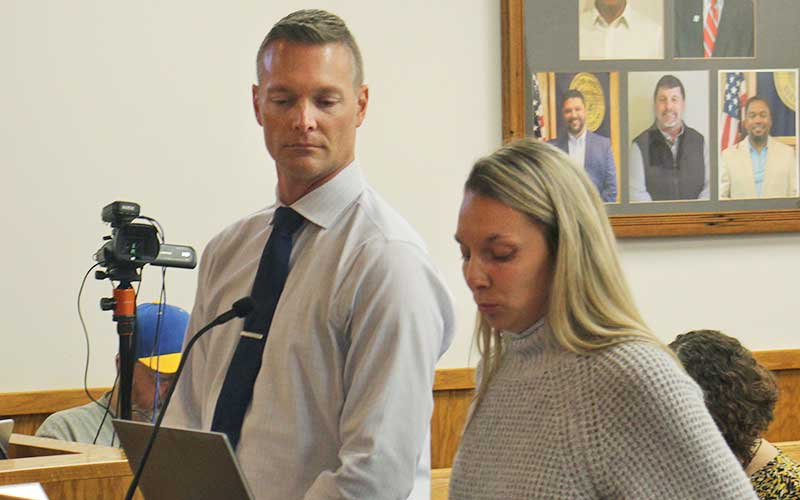
The Macon County Board of Education held a joint meeting with the Board of Commissioners last week to discuss how the county’s budget left the system with a $1.7 million budget shortfall but stopped short of making a formal request for more money.
Neither board made budgetary decisions at the meeting – save for a procedural vote by the county commissioners in preparation for Finance Director Lori Carpenter’s retirement.
The county allocated a total of $9,816,628 to the school system’s 2025-26 operational fund, a $409,380 increase from 2024-25 that includes $200,246 transferred to the operational budget from the county’s contingency fund. Local supplements and Career and Technical Education Internship funding brought the total to $10,595,792. That number fell short of the $12,377,245.68 budget the school requested to maintain current staff and services without funding the school’s top priorities.
The system requested the meeting to bridge the gap between the school system’s request and the county’s funding, with individual board members hoping they could help commissioners understand the importance of fully funding the school system and what services have been put in jeopardy because of the shortfall.
“We have gone line item through line item, especially for programs and things of that nature that, yes, are beneficial, but in any given budget we have to prioritize,” said Superintendent Josh Lynch. “So those were the areas that we could cut, and while those impacts have been felt within the classroom, teachers have been very receptive. They understand where we’re at.”
“One thing that we have been able to do is still preserve positions that are much-needed,” Lynch continued, adding that the system had considered which staff they could do without and still work within the bounds of state-mandates on class size for K-3 education.
Lynch said the system had declined to fill five open positions rather than let teachers go. He said the school system has felt negative effects from the decision but had no other choice.
“We have shaved off of personnel, but the one main thing we’ve not had to do is send anyone home, which is great … but we also have to provide for those individualized needs of students too,” he said.
ESSER positions
Commissioner John Shearl asked how many positions at the school had opened through COVID-19 era ESSER funding and were still active at the school without the funding. Lynch said of the 23 positions, all but one had been closed with one remaining position still funded through a federal grant. He said some of the staff formerly filling those positions had been hired for other full-time positions with the system, and of 11 mental health positions created through ESSER funding, only one was left.
“When the state budget passes, are you going to be able to advertise for these positions, or some of these positions?” asked Commissioner Gary Shields
“We would hope to be able to,” Lynch said.
MCS fund balance
Shearl questioned the school board about an increase to the system’s fund balance that occurred over the course of the 2023-24 school year and asked how the system had been able to build a fund balance while experiencing a deficit.
A report on the school system’s audit at the Dec. 16, 2024, meeting showed the fund balance increasing from $817,027 to $3,752,381 by the end of the fiscal year. The system had performed well on the audit.
School board member Diedre Breeden said, “We’re not overriding the fact that you guys have increased what you’ve been giving to us in the last two years.”
Board member Stephanie Laseter said, “That two million increase is fantastic, but … it’s not at maintain level. So it’s an increase, but for us it’s still a deficit.”
“We built the fund balance right outside of COVID years,” MCS Finance Officer Alayna Ledford said. “So that’s when those ESSER funds came in, we were able to build a fund balance through that. So then this past year we’ve had to dip into fund balance, I think by $1.1 million. I mean, if we keep dipping into that fund balance, we’re not going to have anything left.”
Shearl said, “We’re in the same boat here, but the whole problem is since 2008, the taxpayers of Macon County have spent – we’re at $214,632,395 to schools, new school renovations, everything else.”
“What about the timber sales as passed through funds for the school?” he continued. “We budget $140k, that’s what it usually is. We also budget $50k for that internship program, CTE, $405k for school nurses and $1.29 million for school resource officers at our budget … There’s a lot more stuff out there that we’re paying for out of the county budget. I’m all about education and the kids, but I’m also all about our county that we have to take care of … If the budget does not allow us to give [MCS] employees a 4% increase, we can’t give a 4% increase.”
After a board member pointed out this increase was state-mandated, Shearl said, “So this conversation should be in Raleigh.”
School board member Hilary Wilkes said they decided to build the fund balance knowing the pay increases were coming and that the board cannot cut staff or ignore the raises, so instead saved money through ESSER to make the system better able to respond to an uncertain budget.
“When we brought our budget to you this spring, we gave three different options, and one of them was to maintain what it cost … no extra,” Wilkes said. “And what we received was less amount of money than it was to physically maintain the staff and faculty that we know we had going into this school year.”
“I think it’s important for all of us to lobby our assembly and our senators and our representatives” she said. “Because if they cannot fully fund what they’re mandating, that’s a problem at the county level.”
School board Chair Jim Breedlove echoed the statement about the fund balance, saying, “We built the fund balance off the fact that we took ESSER monies and we kept it, we didn’t spend it. A lot of other districts took that extra money because it was free money, so they would take it and spent it on extra positions … we foresaw what was coming, so we didn’t spend it. We retained $3.7 million of our ESSER funding, that was put in our fund balance to use, so that’s why we had a fund balance increase. It didn’t come from the county.
“We were able to go from $800,000 to where we’re at right now,” he said. “But every cent that we saved, it’s going back into the school system.”
Free lunches
Wilkes lamented how the school was unable to obtain county funding for free and reduced school lunches for students in Franklin High School and Highlands School, which would have cost approximately $200,00 from the county.
“If we had no shortfall, then we would have been able to do that, if we had gotten the minimum that was asked for to maintain,” she said.
Shearl said the county had provided the $200,246 from contingency funds for the system to spend as it pleased, which it could have spent on free lunches.
“You gave it to us as a lump figure … every dollar of that has to go toward maintaining our expenses and we still don’t have enough. That’s what I got frustrated with, because I had a lot of parents coming up to me and saying, ‘Well they said they funded it.’” Wilkes said.
“The people that would qualify for free lunches are still getting free lunches,” Shearl said. “It’s not right for the poor people in our community, in our county, to pay for a millionaire for a child to get free lunch. You can dispute that if you want to, but it is wrong. By all means, a child should have food, but when you are a millionaire, you should not be looking at the taxpayers that can’t afford to survive for a free lunch.”
Proposed solutions
Commissioner Danny Antoine suggested spending some time between the two boards to search for ways to raise funds or decrease expenses, saying, “I think it would be worth looking into if there’s maybe other municipalities or other districts that might have maybe more creative ways for funding that we perhaps have not looked into.”
Breedlove requested the two boards hold joint meetings more often to improve relations between them.
Shields suggested a quarter cent sales tax increase would raise approximately $2 million, enough money to cover the maintain budget.
“I’m hoping in 2026, this piece will go through, but last year we did earmark these monies to go to the school system, but they didn’t make it,” Shields said. “That $2 million would definitely have helped you over the hump.”
Another proposal was to establish a clear percentage of the county’s budget that would go to the school system each year, close to 20%. The idea has come up at multiple meetings of both the school board and commissioners.
Wilkes said, “If we had 20%, we would have that and a little extra to go toward some of our top priorities … I don’t think you need to tell us how to spend it, but we would certainly be appreciative of that amount, so we don’t have to pull from our fund balance going into this year.”
Commissioners Chair Josh Young said he would like to have a percentage of everything the county spends on the school system, including capital funding, debt service, school resource officers and other miscellaneous expenses paid by the county outside of the system’s operational budget.
Breedlove noted that East Franklin Elementary is overdue for a new building and wanted to point out how building updates have been sidelined in the budget for too long. Antoine said if the county had been on the ball about making these updates and improvements, they would not have been as expensive as they are now.
“If you keep playing catch up because we keep pushing everything back, in the long run we end up paying more,” he said. “My point isn’t that I just want to spent money, but the point is if there’s things that need to be taken care of, take care of them … so that you don’t put it off at a later time and you’re going to be paying twice the amount of money.”