
Jim Craig was 10 years old when he first started playing golf. That was in 1931 during The Great Depression.
Four years earlier, Craig’s family in Pennsylvania all had the flu during an epidemic. Fortunately, his uncle was a doctor and helped get them through it.
“He was able to isolate people and actually going about the same thing they’re doing now, keeping people clean and not socializing too much,” Craig said.
Now 98 years old, Craig still plays golf several times a week. He and his wife, Barbara, live in a villa that overlooks the 13th tee and 17th fairway at The Golf Club at Mill Creek.
Golf courses remain open in North Carolina and surrounding states, deemed an essential business in the eyes of governors. However, 13 states – mostly in the north – have shut down golf right now because of COVID-19.
Craig feels it’s safe to continue teeing it up and play a sport he’s enjoyed for close to nine decades.
“I don’t think (playing golf is) much more risky than being home,” he said. “My wife and I are both quarantined in our house. We’re not supposed to have guests or going out any more than we need to. I go shopping at times very few people are there then get back home. Outside of playing golf and working out in the yard, I don’t socialize much.”
When it comes to playing golf, local courses have adopted numerous tactics aimed at making it safe and preventing the spread of the virus. Some of these new rules include:
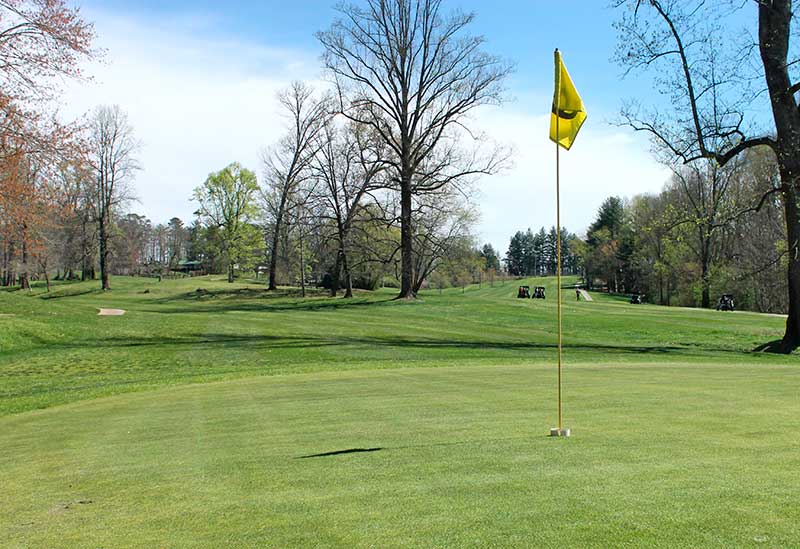
• Not touching the flag
• Not using ball washers
• Removal of rakes in bunkers
• One cart per player (for social distancing)
• Raised cups or pool noodles inside the hole
Franklin Golf Course opted to raise the cup two inches above the ground. Manager Joe Brooks went this route because he deemed it the safest method while still keeping a flag in the greens. He considered removing flags and giving pin sheets, but people would still be putting their hands in the cups to remove balls.
A ball is considered holed upon contact with the raised cup.
“Now all of us guys who can’t putt, we can’t ever lip anything out,” Brooks said, jokingly.
Franklin Golf Course is taking other measures to ensure safety. Golf carts are sprayed down after completion of play, then cleaned with sanitizer wipes.
The door to the pro shop remains open at all times, and the number of people allowed inside at one time is also limited.
Because many other leisurely pursuits have been temporarily halted during the pandemic, people are playing golf more frequently. Also, the weather has finally started to get warmer and drier after a very wet winter.
Subsequently, courses in the area have been very busy in recent weeks. But with players being limited to one cart at most courses, it restricts the number of tee times available.
Franklin has 34 carts. Brooks encourages golfers to check in before coming out to play – particularly on the weekends – to ensure a cart is available.
A common concern now is this is the time of the year when summer residents return from their winter homes in Florida.
Brooks said if he knows someone has just shown up from Florida and hasn’t quarantined for the 14-day period, he would tell them they can’t be at the course until the end of the duration.
“I’m not the law,” Brooks said, “but at the same time I feel like I’ve got a responsibility to try to the best of our ability to protect the people that play here.”
One course in Western North Carolina decided to close, but an additional factor played a role in the decision.
Sequoyah National Golf Club closed after Harrah’s Cherokee Casino shut down March 18. The Eastern Band of Cherokee Indians closed the reservation March 28 in an attempt to prevent the spread of the virus.
Because the golf course sits outside of the reservation, the tribe closed the course in an effort to keep Cherokee people from leaving the reservation.
Craig always has a club in his hand. If anyone approaches and gets too close, he’s got a tool to ensure they keep their distance.
“I’m prepared to hold it up and remind them of the six-foot rule,” Craig said, half-jokingly.
“I don’t have to do that because they’re all responsible. They want to be out there too.”
Craig will turn 99 in October. He fought in WWII and has lived through quite a few historic events.
“You’ve got to count on the Lord sometimes to get you through things: wars, illnesses, automobile accidents, stuff like that,” he said.
“My wife and I both depend on the Lord for a lot of things, and we’re thankful for what He’s done for us all these years.”