
Five individuals, one team named to ninth class
Andy Scheidler
sports@thefranklinpress.com
Athletes from the 1950s, ’60s, ’70s, ’80s and ’90s, plus a community member who covered games for the radio station, were selected to join the latest class for the Franklin Athletic Hall of Fame.
This is the ninth HOF class. The class consists of Keith Brooks, Homer Holbrooks, Audrey Gibson Ledbetter, Jane Bell Morgan, Randy Raby and the 1992 girls cross-country team.
Typically, an official induction ceremony occurs in the fall before an FHS football game. However, like many things in life, those plans are on hold, with a wait-and-see approach.
The Hall of Fame committee selected the 2020 class from a list of more than 75 nominees. Ten years must have passed in order for a former player or team to be nominated; a coach must be inactive.
Once nominated, a team or individual is kept on the list for possible induction.
For a nomination form, contact HOF coordinator Rhonda Blanton at 369-7167 or rhondablanton@frontier.com.
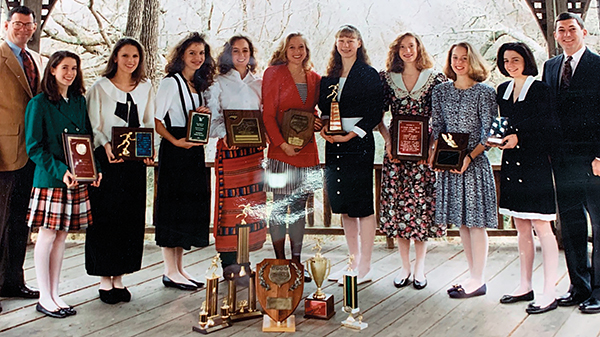
1992 girls cross-country
To explain the dominance of Franklin’s girls cross-country teams in the early ’90s, you have to look back to the 1991 season. The FHS boys claimed their first state title, while the girls placed fourth.
“That didn’t sit well with us. We wanted to be up there,” said Jennifer Wiggins Nelson, who was a freshman in ’91.
“We kind of made a decision: This isn’t going to happen again. Looking back, I really can’t believe that we did. We were what, a bunch of 13- and 14-year-olds?”
The ’92 team was very young. Marla Getford was the only senior. The rest of the team consisted of one junior, six sophomores and three freshmen.
David Morgan, who coached both teams along with Steve Philo, remembers how the girls dedicated themselves immediately following the ’91 state meet in November. Morgan encouraged them to take Sundays off to attend church and be with their family and friends.
“Those girls were really motivated and good encouragers,” Morgan said.
Unless it was a bad snow day, Morgan said they hardly missed a training opportunity. Typically, they ran immediately after school, leaving their backpacks in the gym. After running, they’d walk across the road to the library and work on homework until their parents picked them up.
They held each other accountable, plus they were very competitive.
“We hated to lose,” said Stephanie Hyder Laseter, who was a sophomore.
“It’s cliché, but we won because we worked really hard. Our coaches were wonderful and they were happy to push us. We won because we understood the sport was as much mental as physical.”
Morgan designed the workouts and made sure the girls stayed in physical shape. Philo, who passed away last July, was the one who pushed the girls mentally.
Amy Berger Richmond, also a sophomore, remembers how Philo would try to motivate the girls. One time during a sprint workout, Philo was yelling at the other girls and telling them he could beat Berger, who was leading the pack that day despite not being a sprinter, with his cowboy boots on. The girls still joke about that comment to this day.
Another secret to their training was hill workouts.
“The horrible hills that gave us such an edge at meets,” Richmond said. “We would cruise up those things because of the grueling hill repeats. (Philo) used to tell us they were ‘opportunities’ not hills.”
The Panthers won the Western Athletic Conference title in 1992 by obtaining a perfect score of 15. Taking the top five spots were Wiggins, Getford, Berger, Jessa Brown and Corie Fuchs. Smoky Mountain finished a distant second, 62 points behind the Panthers.
FHS also won the regional, held in Morganton. A runner from West Henderson edged Wiggins, who led a pack of Panthers. Finishing immediately behind her were Fuchs, Berger, Brown and Getford.
The 3-A NCHSAA Championship was held in Charlotte. Franklin tallied 38 placing points. Defending champ Northwest Cabarrus finished second with 61.
It was the first state title for a girls team in Franklin history.
Wiggins (second), Fuchs (fifth) and Brown (seventh) earned all-state honors.
Getford missed earning all-state honors by 20 seconds and finished 11th.
Corie Fuchs Carr recalls the absolute excitement the girls enjoyed after winning. They weren’t surprised because of how much hard work they had put in, but more so grateful. She said the Panthers were blessed with wonderful coaches in Morgan, Philo and girls track coach Sarah Lowell.
“All of them equipped us well,” Carr said. “Living in a small town, people came together and rallied for us. It’s just an awesome feeling to have as a young person knowing so many people are invested in your life. It kind of felt like everybody won. I think that was the feeling, like you were able to give back what everyone had been pouring into you over the past couple years. And then we wanted to keep doing it.”
And keep doing it they did, winning it the next three years.
Erica Riendeau Owen recalls opponents asking them, “Where’s Franklin?”
“After our first state championship,” she said, “they quit asking.”
The girls formed a bond together. Working so hard together did that, but they also had a lot of fun and shared many laughs.
“It felt like a family,” Jessa Brown Stoneburner said. “It was really the first time I had been involved in a sport activity that it really felt like we were a family looking out for each other.”
Those high school years also gave the girls a big confidence boost, said Stoneburner, who is now a physical therapist in Asheville.
Nikki Pons Corbin, who finished 56th at state while running on a sore knee, has encountered many challenges and obstacles throughout her life. She constantly looks back on what she learned during high school to help her push through.
“I have been in some leadership roles, some roles where I had to learn to follow, moments where I have had to learn to speak up, encourage others, figure out group dynamics. … Some moments I have had to learn how to be quiet and listen,” Corbin said. “There has hardly been a moment in these different phases of life that I haven’t looked back on my cross-country days and told myself, ‘If I ran that big mountain without stopping, I can push myself to do this.’ Or, ‘If a group of 12-15 girls can get along in high school, then a group of grown women can get along.’
“Those special years helped mold me into who I am today. I am forever grateful.”
Franklin won 12 of 13 races that year, compiling a record of 132-1. The only team to beat the Panthers was Westminster, coming at a big race in Atlanta.
The FHS girls cross-country program began only a few years before the squad won the state title. It was a rapid rise to the top, one all of the girls are very proud of to this day, and they’re honored to be inducted in Franklin’s Hall of Fame.
“It’s an amazing feeling,” Amy Berger Richmond said. “We were a special group of girls that took a program at a high school in a small town in WNC and made its name known across the state for girls cross country. We deserve this and I’m proud of us!”
Keith Brooks
A four-sport star, Keith Brooks’ list of individual accomplishments at Franklin is extensive. However, the success of his teams means more to him.
“The thing I’m most proud of is the number of championships we won,” Brooks said. “We won four conference track championships; three baseball championships; went to the state finals in baseball; and of course our football (state) championship; and a basketball championship. So that was the big thing, the winning.”
Brooks was a sophomore running back on the 1976 football team that won the state championship.
A 1979 graduate, Brooks lettered four times in track and field; three times in football; three times in baseball; and twice in basketball.
Brooks was a catcher for the baseball team, which advanced to the semifinals of the state playoffs his junior year and lost in the state championship series his senior year to Bunn.
A top-notch sprinter, Brooks found time to run track when he wasn’t playing baseball. Bill Dyar was the track coach and athletic director then, and he allowed Brooks to perform track workouts during physical education class. He’d attend baseball practices after school and compete in track meets when the Panthers didn’t have games.
“It was a full day, believe me,” Brooks said.
Chuck Sutton was a classmate and teammate of Brooks on the football, basketball and baseball teams. Amazingly, they never played for a team that finished with a losing season.
“He’s a very gifted athlete,” Sutton said of Brooks. “Always excelled at what he tried. That athletic ability was just very special. He was a good teammate and a special athlete.”
Brooks garnered all-conference honors in football his junior and senior years, both for offense and defense (as a linebacker), and he played in the East-West All-Star game. It was football that paved his way into college, and he earned a grant-in-aid scholarship to Appalachian State University.
He played running back his freshman year at App and “had some success,” but a coaching change occurred before his sophomore year. The team went from running the wishbone to a one-back offense.
“We had a plethora of running backs and no linebackers,” Brooks said. “The coaches asked if anybody played linebacker. I sort of saw the writing on the wall.”
Brooks volunteered to play defense like he had for the Panthers. He played linebacker his last three years for the Mountaineers, and earned a part-time starter role by his junior year. He was a member of the 100-tackle club his senior year.
The Mountaineers are a Division I FBS program now, coming after winning three straight FCS titles from 2005-07.
“We didn’t have near the success that they are having up there now,” Brooks said. “There’s a lot more money put into that program now than there was back in the late ’70s, believe me.”
Brooks earned a degree in physical education. He taught and coached at Enka for one year before landing a job in Franklin.
He coached football, baseball, middle school track and wrestling during his career. He was the FHS varsity coach from 1985-91, taking over after Billy Vanhook stepped aside.
“That was a blessing for me,” Vanhook said.
“He did a really good job as a baseball coach.”
Brooks compiled a record of 68-62 with the Panthers. Their best year during that span came in 1990. They finished 19-2 overall, including 9-1 in the WAC, and Brooks earned conference coach of the year honors.
He was surprised to learn of his induction to the HOF, and said he’s thrilled.
It’s his memories of team accomplishments and how they played together that still make him very proud.
“We had some really good players and some really good teams,” he said. “We were a good group.”
Homer Holbrooks
Anyone who underestimated Homer Holbrooks solely on his height would quickly find out there was more to him than met the eye. Holbrooks stood 5 feet, 7 1/2 inches when he played football, basketball and ran track for FHS.
“I always tell people, ‘Don’t forget the half,’” he said.
Holbrooks was voted most athletic for the yearbook. He graduated from FHS in 1966, a year before the school officially started a baseball program.
His favorite sport was football. He played offense (right halfback), defense (left cornerback) and was on special teams, where he typically returned punts and kickoffs.
A career highlight on the gridiron occurred his senior year on the gridiron. The Panthers whipped Hayesville 21-0, and Holbrooks scored all three touchdowns.
The game story in The Franklin Press recounted his scores following heavy rains on previous days that soaked the Panther Pit: “Holbrook’s third touchdown found him splitting a mud hole on the south end of the field as he was dropped by tacklers, sending muddy water splattering in all directions.”
Holbrooks was born in Burningtown. He rode the bus to school, but didn’t have a way home after practice (his family owned one car, which his father used to work a construction job out of town).
His mother would pack him five sandwiches each day. Typically, a few were peanut butter and jelly, or bologna. And often two of them would be a special sandwich consisting a hot dog (or a weeny, as Holbrooks called the meat before it was prepared) that was sliced, with banana and mayonnaise. Milk was very cheap then and he’d drink a carton with each sandwich.
He often thumbed rides to return home, and only once did he have to walk the entire 11 miles home.
“It was a lot different then than it is now. Everything is,” Holbrooks said. “That’s a long time ago. I’m lucky to even be talking to you. I can’t remember stuff good. But I can remember all the stuff I did playing these sports.”
Holbrooks ran track his sophomore and junior year. His best event was the 100-yard dash. Typically he’d take off faster than the competitors, but having short legs he’d get passed before the finish line.
However, his prowess on the gridiron drew interest from four colleges, including East Carolina.
“In the letter the coach said, ‘Show me what you got and we’ll tell you what we’ll give you,’” Holbrooks said. However, he wasn’t able to attend the school because his knee was “torn all to pieces” at that time.
Holbrooks worked for A&P, The Great Atlantic and Pacific Tea Company grocery store, for 18 years. He then went to Southwestern for basic law enforcement training, and became a deputy for two years. He became sheriff, and he served four terms and never lost an election.
David Duvall was a close friend of Holbrooks. Duvall is a year younger, and they played baseball and softball together after graduating from FHS.
“If I had a dollar for every team he and I played, I could retire for sure,” Duvall said.
They played together on a fast pitch softball league in Cherokee. Holbrooks could play outfield, third base or catcher.
“He was just a great athlete, there’s no question about that,” Duvall said. “I watched him play football in high school. He didn’t avoid people; he just ran over them. And he was a good basketball player as well, so he was an all-around good athlete.”
Holbrooks has back troubles now and has had multiple surgeries. He takes joy in watching his grandchildren be active and play sports.
He’s very appreciative of being inducted into the HOF. And he still has very fond memories of playing for the Panthers.
“Oh, thousands,” he said. “I remember them all.”
Audrey Gibson Ledbetter
Dolan Bates attended nearly all of Franklin’s basketball games in the 1950s.
His eventual wife, Mavis Gibson, was a standout player during that time. Yet it was her older sister, Audrey Gibson, who really stood out.
“Audrey was the best high school girl I’ve ever seen,” Bates said. “If they would have had college girls teams then, she could’ve went anywhere she wanted to.”
Girls basketball at the time was known as the six-player era. Three players on each team played strictly offense, and three played strictly defense. The thinking, which was clearly antiquated, was that it might be strenuous for girls to play full court like the boys.
Gibson was a forward who scored 1,249 points. During her four-year career, she averaged 15.4 points per game.
Bates called Gibson the fastest high school player he’s ever seen.
“She was a heckuva ballplayer,” he said.
Gibson wed Max Ledbetter. They were married for 55 years, until Audrey died in December 2010. She was 74 years old.
In her obituary, it noted Audrey was a 1955 graduate of FHS, where she had perfect attendance for 12 years. She worked as an office manager for Dr. J. L. Hill Optometrist for 38 years.
Bates said the Panthers had some great team, and they won multiple conference championships in the 50s. Gibson played on the same teams as Jodie Lenoir Sellers, who scored 1,168 career points and was inducted in the HOF last year.
Like many things in life, it’s subjective, but Bates has no doubts who he thinks was the best player of that era.
“I’ve never seen another one that was as good as she was,” Bates said of Gibson. “I went to a lot of ballgames. But that was my opinion. I know other people have opinions too. The people that you’d talk to back in the day, I think would tell you the same thing I have.”
Jane Bell Morgan
Upon learning she’d been selected to Franklin’s HOF, Jane Morgan was pleasantly surprised.
“It’s just been so long ago,” Morgan said.
She was Jane Bell in the 1970s, a two-sport star for the Panthers. She earned all-conference honors in softball three times, and twice in basketball.
The Panthers added a volleyball program the year after she graduated, otherwise she would’ve played that too.
Morgan played third base for the Panthers. They dominated opponents in the 70s, and won the conference championship every year she was in high school (she graduated in ’77).
Shirley Reynolds and Jim Tipton coached the softball program then. Both coaches were inducted in the 2019 HOF.
Morgan said they were phenomenal coaches, which helped guide them to success.
“It just happened to be a really good group of kids and they were great coaches. It was a good combination,” she said.
Morgan also thoroughly enjoyed playing basketball for FHS. Ronnie Ledford, who was inducted in the HOF in 2018, was her coach three out of the four years.
The 3-point line hadn’t been introduced yet. Had there been, Morgan estimated 75-80 percent of her shots would’ve been behind the arc.
Ledford’s ran an offense that featured a double high post. Morgan would run from corner to corner off screens. The initial pass would come to her, and her first option to shoot, then look to see if anyone else was open.
“She could hit them one after the other,” said Paul Corbin Kahn, who was inducted in the inaugural HOF class in 2012 and was two years older than Morgan.
A personal highlight from basketball came when the Panthers beat Sylva-Webster and Morgan scored 22 points.
Kahn played basketball and softball with Morgan and remembers her tremendous work ethic.
“She gave 100 percent at whatever she did,” Kahn said. “She was always team player as well a leader. She led by example with her hard work. She was one of the hardest workers I remember playing with.”
That same hard work paid off in college. Morgan walked on to the softball team at Western Carolina University and earned a starting job at third base.
“Some of the girls were on scholarship were on the bench when I was starting, and I took pride in that,” she said.
Morgan earned all-tournament team honors as a junior and was the team’s MVP her senior year.
She made lifelong friends at WCU, just like she did at FHS.
“I felt like I was fortunate to have the coaches I did in both sports and teammates,” Morgan said. “It’s my best memories of high school, playing sports.”
Randy Raby
He was simply known as “The voice of the Panthers.”
Randy Raby called Franklin football, basketball (and occasionally baseball) games for local radio station WFSC/WRFR for two decades.
Brenda Wooten worked with Raby during that time. He loved sports, and Wooten asked him one time how he learned to do play-by-play. Raby said he was self taught. He watched games on TV and turned the volume down so he could practice doing the play-by-play.
“Randy had that wonderful booming voice,” Wooten said.
While Raby loved watching sports, sadly he wasn’t able to play them. He was born with spinal bifida, and his legs never fully developed. He got around on crutches for many years before using a wheelchair later in life.
However, he always maintained a cheerful spirit and never used his handicap as an excuse.
Rick Cruse worked with Raby at the radio station, beginning when he was hired in September 1974. Raby graduated from FHS in ’72, and Cruse was a year younger.
They became good friends, and one time they were joking around.
“I’ll get you for that,” Raby told him.
“You’ll have to catch me first,” Cruse said.
It then dawned on Cruse what he’d said.
“I’m sorry, Randy,” Cruse said. “I’m around you all the time and sometimes I forget about your handicap.”
“I’m glad you do,” Raby said. “I don’t want you to treat me like I’m handicapped.”
Raby was extremely dedicated to his craft. He worked the sign-on shift, which meant he went on air at 6 a.m. If snow was forecasted, he often spent the night at the radio station and slept on the couch in the lobby.
Other times, there was snow on the ground. The radio station is located on “Radio Hill.” If Raby couldn’t get his car up the driveway, he’d get out on and walk through the snow on his crutches to get to the studio.
“That was real commitment,” Wooten said.
Raby was very strong in his upper body. And he had a tremendous wingspan of 7 feet.
“He could reach about anything he needed,” said Karen Raby, who married Randy in 1992.
Cruse said he could talk to Raby about anything. He read a lot and was well-versed on many topics.
“I felt like when I had a problem or something, Randy would be the one I would want to go talk to. Because, even though Randy didn’t get to live some of the things in life, he could always give you good advice,” Cruse said.
“He was a good friend.”
Raby had what Cruse called “tuthisms.” Some of them included:
• “Anything you do, good or bad, there’s a price you’re gonna have to pay. You have to ask yourself, Am I willing to pay the price?”
• “You have to put it up on the balance beam of life. You have to weight the cons and the pros, and that will help you make the best decision.”
• “Actions speak louder than words. If you really want to know the truth about something and how somebody feels about it, just watch what they do. Their actions will tell you more about them than the words they may be saying.”
The advice Cruse got from Raby still helps him to this day.
“Because of some of the things Randy taught me by being his friend, I was able to do better in life and make better and wiser decisions,” Cruse said.
Raby worked in radio for 30 years, including the final 10 for the Christian station WPFJ. Serious health issues hospitalized him for eight months in 2004.
He was on dialysis for 10 years before he died Dec. 26, 2013.
Through his many operations and healt battles, Raby always remained positive. He attended Cowee Baptist, and his faith was very strong.
“He would not have made it through all those years without his faith in the Lord,” Karen Raby said. “When he would be put to sleep he would witness to the people around him. When he came to, he felt fine. He never was sick from being put to sleep. He would want people to know that his faith got him through the rough times.”
Karen Raby said Randy being inducted into the FHS Hall of Fame is quite an honor for the family.
Wooten said she hates he isn’t around to experience the honor.
“He received some accolades when he was alive,” she said. “I think he knew he was appreciated on his job and in the community. He certainly deserves any recognition.”