
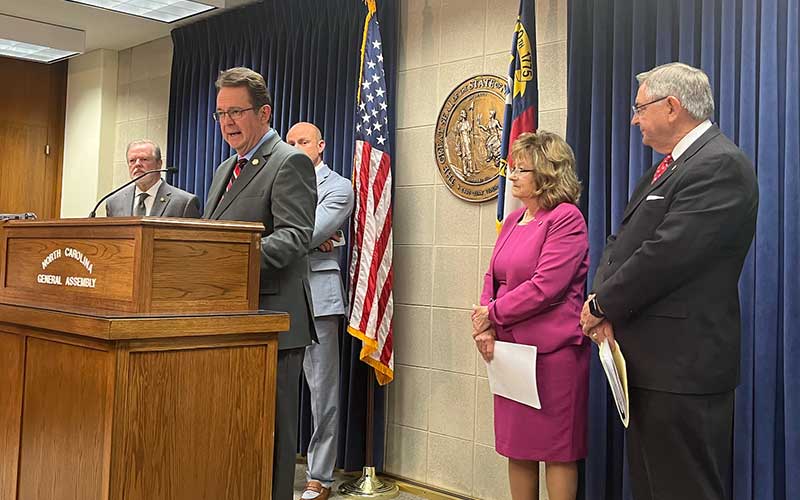
Carter Giegerich for The Franklin Press
A bill proposing an expansion of Medicaid accessibility has made its way through the North Carolina Senate, leaving the years-in-the-making expansion in the hands of the state House of Representatives.
If passed, the bill would expand coverage to around 500,000 North Carolinians who currently fall into the “coverage gap.”
“They’re a group of people who do not qualify for Medicaid but also do not qualify for a tax credit for coverage under the Affordable Care Act,” said State Sen. Kevin Corbin (R-Macon), one of the authors of the bill. “This way, they can buy insurance through the Marketplace.”
Corbin said the bill has received widespread support from the rural counties he represents, and he feels the bill would be an overwhelmingly positive change for his constituents and healthcare providers in his district.
“Six of my seven county boards of commissioners have sent me resolutions supporting expansion,” Corbin said. “It would definitely help rural hospitals, that would be a big win for us in rural North Carolina, and also just the number of people that would be covered that aren’t covered now with insurance. I think it’s a big win all the way around.”
Medicaid expansion has long been on the Democratic party platform in North Carolina, but Corbin said it’s been in the last year that many of his conservative colleagues have warmed up to the idea. He said he sees himself as a key player in that shift among other Republicans in the state legislature.
“I was probably one of the first conservatives to support this, to feel like it made sense, and, quite frankly, I was instrumental in convincing my colleagues it made sense to do it,” Corbin said.
A major motivator in this policy shift, Corbin said, was Medicaid Transformation, a statewide change in the way Medicaid funds are distributed and reimbursements are issued. The change happened last year, and in the wake of this change a number of Republican lawmakers in Raleigh showed support for the expansion plan.
“Medicaid Transformation, basically, is taking the Medicaid dollars from the government and having those dollars spent by and applied by private insurance companies. So now, Medicaid claims are being administered by Blue Cross Blue Shield or one of the six different companies in North Carolina doing it,” Corbin said. “That was a gamechanger for most conservatives that saw Medicaid as a wasteful government program.”
Corbin’s bill also transfers some of the financial burden of Medicaid expenses to the hospitals and healthcare companies providing services, a move he said will ultimately save taxpayers money.
“The federal government is willing to pay 90 percent of these costs, and that left 10 percent for North Carolina,” Corbin said. “Our bill tasked the hospitals with paying that 10 percent, so the hospitals who will benefit from this money anyway will come back and pay that 10 percent for the state match.”
Although the bill has made its way through the senate, it appears unlikely that it will be passed by the North Carolina House of Representatives right away – with just two weeks left in the short session in Raleigh, the House is currently in the process of crafting a state budget and North Carolina House District 119 Rep. Mike Clampitt said that has been their primary focus of late.
“We’ve been in budget mode and today was our deadline,” Clampitt said on June 3. “We haven’t taken the time to discuss anything to do with Medicaid expansion.”
If the bill is not brought before the House before the end of the short session, Corbin said it would likely be January before it sees a vote in the house. He said he has high hopes for its success once it does make its way to a vote, though, and he believes the impact its passage would have cannot be overstated.
“I think it’s the biggest thing to happen in North Carolina politics in the last 100 years – certainly the past 10 years,” Corbin said. “You’re talking about 500,000 people covered who aren’t covered now, you’re talking about helping rural hospitals, you’re talking about helping rural North Carolina. I’m about rural North Carolina, and that’s who I think it’s going to help.”