
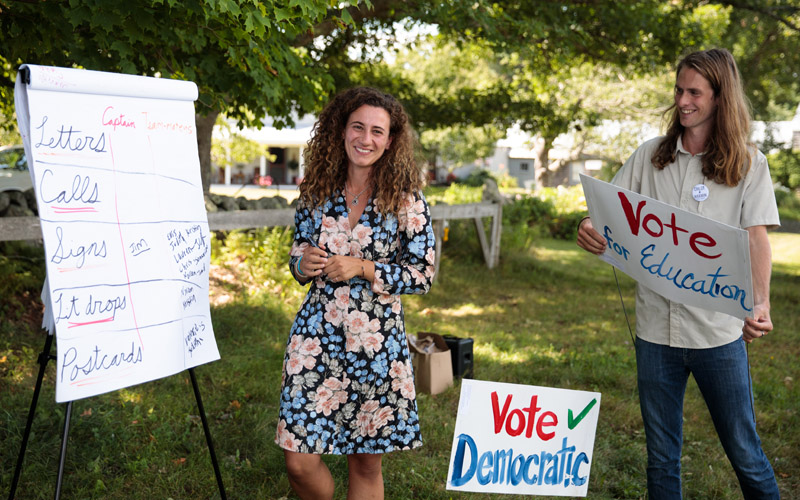
For the past several years, Canyon Woodward has spearheaded a unique movement in state-level electioneering, managing the campaigns of his friend and Maine’s youngest-ever female state senator Chloe Maxmin. With a bold back-to-basics approach of actually speaking face-to-face with their constituents, Woodward and Maxmin have successfully bucked decades of Democratic Party dogma in a method laid out in their new book, “Dirt Road Revival.”
“It came primarily out of the two campaigns that Chloe and I ran in Maine in 2018 and 2020,” said Woodward of the idea for the book. “She ran for State House in 2018 and won as a 25-year-old Democrat in a district that had gone Republican by 16 points on average over the [previous] three elections. In 2020, she became the youngest woman Senator in Maine’s history.”
Former classmates at Harvard University, Woodward and Maxmin originally met while working for Divest Harvard, a campaign co-founded by Maxmin to pressure the university to divest its more than $40 billion endowment from all holdings in the fossil fuel industry (Harvard’s president announced it would do so last September). Upon leaving the university in the mid 2010s, Maxmin returned to her home in coastal Maine to run for her local State House seat and brought Woodward on as campaign manager.
“I think it was something she had thought about before – she always knew that she wanted to move back to her hometown,” he said. “It was in the wake of the 2016 election and, like a lot of us, we were looking for ways to positively engage with politics. We had both worked on campaigns by that point in our lives, and sort of had a feeling that there was a better way to do things that could leave the community better off than when we started no matter the outcome, just by getting people together, organized and really being rooted in community.”
As a twentysomething Democrat in a deep-red part of the state, Maxmin faced long odds in a district that had never before voted blue for State House. In a radical departure from national party doctrine however, she and Woodward made a surprising amount of headway in an era of polarization.
“I think the biggest thing was being willing to invest most of our time and resources in just going and having face-to-face conversations with people, which unfortunately, with tons of notable exceptions, Democrats haven’t been doing much of in rural America, especially over the past decade,” he said. “There just hasn’t been much investment in grassroots organizing, going door-to-door and filling these huge volunteer communities. That was the biggest thing that we did differently and that really set the campaign apart from other ones. We knocked on so many doors and were willing to talk to a lot more different people than the party normally would.”
In an era when the national party has prescribed a one-size-fits-all approach to organizing, using the same messaging and strategies for thousands of races across the country, Maxmin and Woodward opted for a radically interpersonal approach. With a base of hundreds of local volunteers, the campaign approached the district’s voters as neighbors and equals, handwriting thousands of postcards, knocking on thousands more doors and refraining from the political mudslinging that has come to dominate modern campaigns.
“Even running as a Democrat, we had no qualms with going up to doors that had Trump signs and flags on their property, and just having an honest conversation and seeing what happens,” he said. “It was certainly exhausting in a lot of ways, but also not completely surprising – Chloe signs would go up alongside Trump signs in some instances. There certainly wasn’t a ton of that, but it wasn’t an isolated incident, either. … I would say the biggest [issue] was an overwhelming frustration with politics in Washington and at the state level – folks just feeling left out of the political process, unheard and frustrated.”
Despite disagreeing with constituents on several issues, Maxmin’s personable and up-front campaign left an impression on District 88’s voters, who elected her over her Republican opponent 53%-47%. Two years later, she and Woodward completed an even more impressive feat, using the same hyper-local strategy to topple the state’s sitting Senate Minority Leader and send shockwaves through the state’s political system.
“It was pretty wild,” said Woodward of the improbable State Senate victory. “I remember the state’s public radio did a special edition the day after the election rounding everything up, and they called it the most surprising win of 2020. The Bangor Daily News gave her the Buster Douglas Award in reference to Buster Douglas upsetting Mike Tyson, which had crazy odds. It definitely shocked people.”
Following their improbable victory over State Senate Minority Leader Dana Dow, Maxmin and Woodward recorded their experience, co-authoring Dirt Road Revival as a kind of study on rural America’s rightward shift (accelerated by Democratic Party missteps) and the factors that led their campaign to success. Rather than seek Maxmin’s reelection in 2024, the two friends have opted to share these lessons with other candidates, founding a nonprofit organization called Dirt Road Organizing and consulting for campaigns across the country. Through it all, Woodward has also found the time to stay in shape, as the elite ultra-marathoner is currently training for this August’s Ultra-Trail du Mont Blanc, an annual 106-mile trail race through the French, Swiss and Italian Alps that has been dubbed “arguably the World Cup of trail running” by Runner’s World magazine.
While Maxmin and her Maine constituents don’t always see eye-to-eye, her campaign manager says that simply discussing issues in good faith can go a long way toward rebuilding trust between both sides of the ideological divide.
“We would often [say], ‘Hey, we are all about listening – here’s Chloe’s phone number,” he said. “Chloe was going out there and having those big conversations. She knocked on over 20,000 doors over the course of the two campaigns, and hosted ‘Coffee with Chloe’ every single month that she was in office. She was super, super responsive and transparent and willing to talk to folks, even if they ended up disagreeing, and I think that was really refreshing to people. That, more than any single issue, is what really resonated with people.”
“Dirt Road Revival: How to Rebuild Rural Politics and Why our Future Depends on it” is on sale now at www.dirtroadrevival.com.