
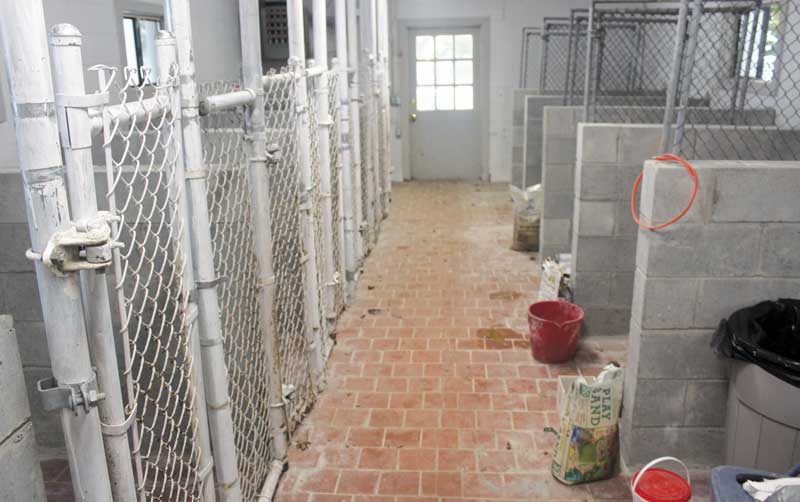
Work on the new intake building at the Appalachian Animal Rescue Center has been halted due to a lack of funds, but a new trail for AARC dogwalkers recently opened.
The new intake building, which will include an office, restrooms, washing facilities, kennels and runs for cats and dogs, has been a work in progress for three-plus years. And now it’ll take a bit longer.
AARC Director Cathy Howman said the reason for the work stoppage is that the AARC has taken in more than 100 puppies so far in 2023. In those intakes, Howman said there’s a high chance of puppy litters having parvo because many people don’t take care of their dogs and let them run loose. This has led to skyrocketing vet bills for the AARC due to continual canine parvovirus cases.
“As much as we want to finish the intake shelter, we must remember that we take in animals every day that need to be fed and medicated,” Howman said. “We can’t ignore them.”
Parvo is a highly contagious virus in dogs and can spread through contact with their feces. There is a parvo vaccine, but untreated parvo in a dog often leads to death, especially in puppies. Howman said it can take from 3-10 days for signs of parvo in a dog to show.
Howman said the intake building work is dependent on AARC buying materials. Much of the work has been done by Habitat for Humanity, which donates its time when building materials are available.
“It’s kind of stopped, but they’re still helping us,” Howman said, specifically referring to Habitat for Humanity and the painting and fencing work. “Everything that is done is paid in full.”
AARC Shelter Director Todd Ortiz estimated that 75-80% of the work on the intake building is done.
Completed work includes the donation of commercial washers, installation of a hot water heater, HVAC system and all new block work on the kennels.
“A lot of it looks like we haven’t done a lot,” Howman said, adding that work was ongoing until mid-May. “But the HVAC system was put in, the electric had to be updated, plumbing, sewer, septic and more.”
The new building specifically will be an intake facility, which will include a 10-day quarantine to make sure the new arrivals don’t spread a communicable disease, such as parvo.
Currently, with only one operational building, any communicable disease being brought inside could result in the center closing for at least 10 days. The new intake building, connected to the main building by a fenced-in path, will help the AARC keep adoptions open.
Howman and Ortiz said AARC has raised and spent $63,000 on the new intake building over the last three years. Ortiz said the septic system cost $10,000, the plumbing was $10,000 and the electrical was $15,000.
Other items, such as the fencing, two washing machines, a tub, plus Habitat for Humanity’s time, have been donated.
A big piece left will be the installation of a new roof. Ortiz said they’re going to have to raise $12,000 for the roof, which will replace the decades of shingles stacked on top of each other with a metal roof.
Other pieces to be done include the installation of new windows and doors, plus plexiglass for the kennels, which Ortiz said can limit the spread of communicable diseases, plus guillotine dog doors separating the inside and outside kennels.
Marco’s Trail
Next to the parking lot of the main building, there is a new trail that loops around the facility into the mountainside and ends at the back of the building.
Known as Marco’s Trail, Howman says this will make dog walking at the AARC safer. Previously, volunteer dogwalkers would only be able to take the dogs up and down the one-lane driveway connecting the shelter to Lake Emory Road.
“Before this was built, [volunteers] would walk [dogs] down the driveway, dodging cars,” Howman said. “And now they have this really nice trail. There’s three benches up there to sit with the dog and visit for a little while.”
Funds for the trail came from Marco’s owner, who adopted him from the AARC. Howman said the owner was devasted by Marco’s death and sought to maintain his legacy through a monetary donation for a new trail.
The center installed a sign marking the trail in late May after finishing the trail. Howman wants to hold a grand opening day on the trail.
For insurance reasons, only AARC registered volunteer dogwalkers can walk AARC dogs on the trail.
Funds mishandled
According to a May statement by the AARC executive board of directors, they found out about “mishandled organizational funds by a board member on March 6 through their accounting firm.”
“The executive board took immediate action by meeting with our accounting and investing firms,” AARC stated. “After many weeks of inquiry, we confronted the board member and came to the conclusion that immediate removal of the board member was necessary.
“You can rest assured that the individual mishandling money no longer has any access to the funds or properties of the Macon County Humane Society, Inc/d.b.a. Appalachian Animal Rescue Center.”
When asked if the “mishandling of funds” impacted AARC’s new intake building funds or normal operations, Howman said no.
“No, we just ran out of building funds,” Howman said of the under-construction intake building. “Those were kept separate from what they did.”
Howman added the incident didn’t affect operational funds. “We’re doing OK, let me put it that way,” she said.
Howman declined to specify how much was “mishandled” or whether AARC would pursue legal action. AARC did not identify the now-former board member.