
The work of the Noquisi Initiative continues to connect locals to Cherokee heritage in cooperation with the Eastern Band of Cherokee Indians as well as inspire a relationship to traditional food production, nature and the land.
A Cherokee Food Forest and the apple orchard along the Greenway are some of the projects the organization has worked on during the past year.
“Our primary focus is in what we call the cultural corridor – that’s essentially from Georgia to Tennessee up through this area,” said Executive Director Elaine Eisenbraun. “And within that framework, we’ve been doing a lot of different projects that have been building on themselves and growing.”
Along the corridor, visitors would have access to cultural information and interpretation to contextualize and draw attention to Cherokee landmarks and historical sites. Among such sites include the Noquisiyi Mound in Franklin, where the initiative has a cultural kiosk.
Food and the land
Using grants from the Cherokee Preservation Foundation, National Park Service and Tennessee Valley Authority, the initiative set markers along the Little Tennessee to showcase native wildlife and their connection to the Cherokee. The signage is being actively maintained.
“Most of the signs are down by Needmore, but there’s a … welcome sign over by Currahee Brewing,” Eisenbraun said. “And the other signs, they’re gorgeous. They introduce different elements of the river. One shares information about mussles, one about fish in that river, one about kingfishers and each time tells the natural history of that particular element along with a Cherokee story about it. The goal is to educate people about the Cherokee heritage as well as learning more about the natural environment.”
“We’ve helped fund the food forest in Cherokee,” she continued. “The food forest is mostly native plants; it’s grown as a natural forest would grow but all the plants have edible components. There’s trees, shrubs, vines, ground cover, herbs and they will someday provide cost-free food for members of the EBCI.”
The initiative was part of a tour on Oct. 23 to showcase the forest and the plants that had been grown in the forest. Ed Jenks and Carla Luna presented and explained the plants while ECBI member Juanita Wilson described the plants’ relationship to the Cherokee and how the people used these plants to live equitably with the landscape. The initiative toured the forest as well as a biodynamic farm in the Burnsville area with EBCI members, University of Tennessee students, the National Park service and Franklin residents.
“We’ve been working with the U.S. Biosphere Network,” Eisenbraun said. “It’s a worldwide organization about preserving special landscapes, special ecosystems and we mostly worked with them on the food forest but we have developed a close relationship with them.”
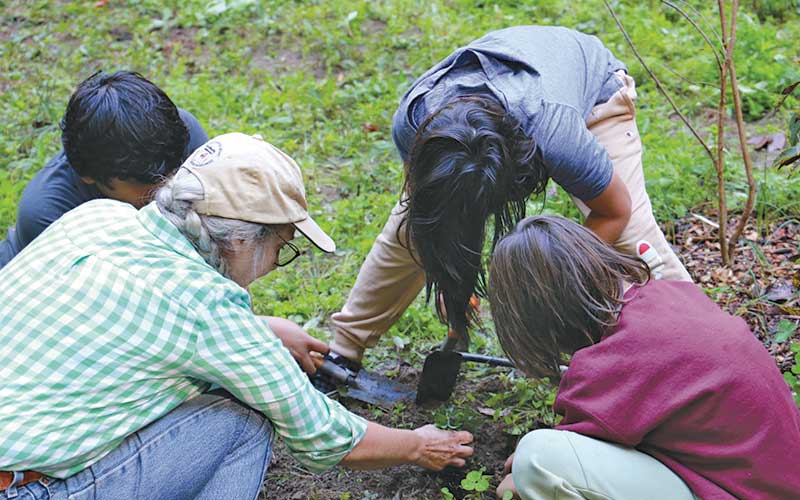
New trees have been planted in the Cherokee Heritage Apple Orchard along the Little Tennessee River Greenway in Franklin, and Eisenbraun said at least one new Cherokee variety was on the way. The orchard was established to highlight Cherokee apple varieties.
“When the Spanish first brought apples to this continent … the Cherokee, when they had contacts with them, recognized that those apples were something that they could grow in a way that was compatible with the landscape here and they could grow a better apple,” Eisenbraun said. “So they started developing new varieties of apples and that integrated with their food forest farming techniques, you might call it what today we call permaculture-type growing.”
Some advocates managed to preserve some of the traditional Cherokee varieties as the Cherokee were expulsed from the region.
Heritage
The initiative has helped raise money for Igali, a troop of puppeteers that use puppet theatre to teach about the Cherokee language. The troop operates usually in and around Cherokee, but travels on occasion, Eisenbraun said.
The Noquisi Initiative was also active in the annual Honoring Long Person celebration in Cherokee, an event focused around valuing, cleaning and respecting the river.
“A long person is what traditional Cherokee called the river because its head is in the mountains and its feet in the sea,” Eisenbraun said. “And the Honoring Long Person celebration involves getting people together to honor the river, do a cleanup, have a meal together.”
The initiative is working toward converting the building near Noquisiyi Mound to facilitate Cherokee education. The building would be named “Gaduni Kanogesgi,” roughly translated to “Franklin Storyteller,” and would be based out of the old auto repair station on East Main Street. Eisenbraun said this project has been in progress for a long time.
Eisenbraun said the initiative has faced some challenges in the last year, primarily as Hurricane Helene’s impact shifted funding priorities from preservation to reconstruction, but the nonprofit has been “moving steadily forward.”
She said the initiative retains its importance because of its ability to bring people together across cultural lines in the face of an often antagonistic world.
“In this country and world, we need to develop more intercultural understanding and intercultural empathy and concern,” she said. “That’s our role. We are a bridge organization that helps to connect the ends of the thread between Native American — specifically, Tsalagi or Cherokee — and non-native peoples so that we can create … harmony amongst people going forward and prevent some of the antagonism that occurs, that is becoming so prevalent in our world.”
“We’re all connected to the land, whether we were born here or not, and I think that’s an important piece,” Eisenbraun said. “Longevity on the land is not as important as connection to the land. It’s really where our past and our future lie — in the landscape.