
Macon County has the potential to protect some of the darkest skies on the east coast — here are some of the things you can do to keep light pollution low.
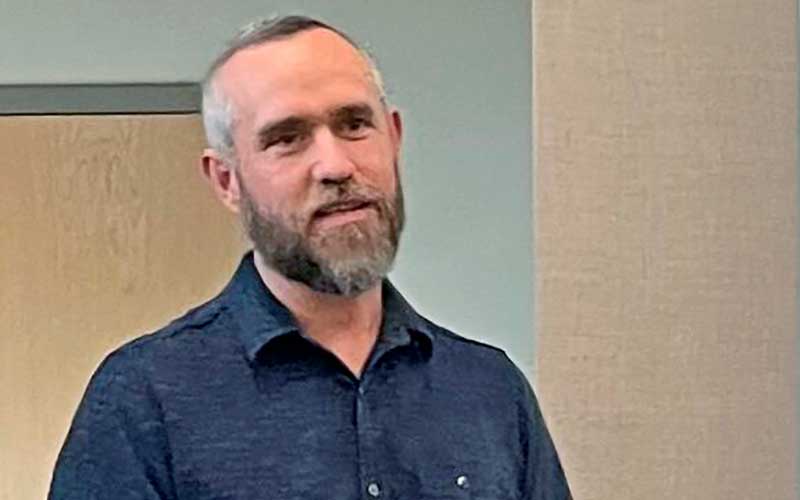
Bobby Bradley, a lighting designer and principal of LARC lighting and nighttime photographer, spoke April 23 at the Macon County Public Library about the Dark Sky Movement, light pollution and what individuals, businesses and municipalities can do to protect the animals and the night sky.
Bradley started the conversation by discussing the kinds of needs people and animals both have for both light and darkness, listing the need for safety and security for nocturnal animals as they hunt as well as prey animals to remain hidden. He said periods of both light and darkness are important for people and animals to maintain their circadian rhythm and wake and sleep regularly and to see well at night. Many animals like birds, sea turtles, moths, beetles and fireflies have species which depend on certain amounts of light and darkness to navigate, migrate and reproduce.
Specifically, Bradley mentioned the Blue Ghost Firefly, endemic to the southern Appalachians, which glows dimly during its mating season in May. The firefly can be outshined by the moon and bright, artificial lights can outshine the bioluminescence the beetles use to find mates. He said excessive light pollution can also interfere with birds’ reproductive cycles.
Light pollution is caused by excessive or irresponsible nighttime lighting which casts light up into the atmosphere. In addition to interfering with humans’ and animals’ lives, the pollution also reduces the amount of light visible in the night sky, smothering the light of stars.
“Sky glow happens … when you have a city center and there’s just a bunch of light kind of going up around it,” Bradley said. “It kind of creates a little dome over the city. And so if you’re looking through a telescope or trying to take pictures at night you’ll see that yellow haziness over the city. But if you turn away, look away from the city, you can look a little clearer.”
“Something light 80% or more, it’s estimated, of people are affected by light pollution,” he said. “We are lucky here in the mountains. We have dark skies, and so it’s great. I think we in Southern Appalachia are in a really unique spot in that we have a good opportunity to protect it and take some action.”
Dark sky maps show, while Macon County is not perfect, some places in the western part of the county see some of the darkest skies in the eastern United States.
In general, the Dark Sky Movement advises residents consider the “five principles of responsible outdoor lighting,” listed in its Responsible Outdoor Lighting at Night (ROLAN) manifesto. These principles encourage residents to ensure lighting is only installed where it is necessary and only because it is necessary. The light should be directed to where it is necessary through the use of hoods which ensure light is not projected in wide arcs to the sides of the fixture, which can produce glare and reduce overall visibility, or upward, which Bradley said was “unacceptable.”
Lighting should also no brighter than necessary to ensure visibility for its designed purpose and should be warm, rather than cool. Lights which appear to be redder or orange are often described as “warm” lights, whereas white, blue or purple lights are “cool.” Cool lights can suppress the production of melatonin in humans, Bradley said, and interrupt the sleep cycles of animals. At night, warm lights are less disruptive. Options for a range of lighting “temperatures” have become more common with LED production, and are measured in Kelvin. Lights in a 1,000 to 3,000 Kelvin (K) range are warmer, while lights ranging up to 10,000 Kelvin are cooler. Bradley said this temperature rating should be listed somewhere on a bulb’s box, and some slightly warm bulbs are often described as “soft white.”
Lighting should only be active when necessary. The Dark Sky Movement says lights should be dimmed or turned off whenever possible, and Bradley said light fixtures with adjustable timers or brightness settings or motion detectors were ideal because they can prevent lighting from being active for long periods when no one is using it.
In particular, Bradley mentioned he knew of some northern European countries which were testing street lighting which detects when vehicles are approaching and only stay on until the vehicles are gone. The scale to which a local individual, organization or municipality may be able to replicate these results depend on how much money they are willing to spend.
Bradley also lamented how preferable lighting options may not be as commercially available, and information on what fixtures are designed to do is too often obfuscated from consumers.
“It’s hard. I wish it was easier. I think that Home Depot is like a good start if you’re just looking for kind of basic things,” Bradley said.
Darksky.org contains a search tool to identify brands and products when are approved by the Dark Sky Movement. Other products may be easier to find and order online.
On a larger scale, Bradley said implementing zoning and planning regulations to discourage businesses and local buildings from lighting irresponsibly is a good tool to protect the night sky, and these standards are easier to implement for new construction. He encouraged visitors to the event to speak to their local officials to push for these changes.
“The technology’s certainly out there. I think we can push for it. We can talk to the cities, talk to the counties and say what’s important,” Bradley said. “Community support for those types of things is where we start."