
Macon County students are making gains in the learning loss that occurred due to the COVID pandemic and the resulting school closings and online learning.
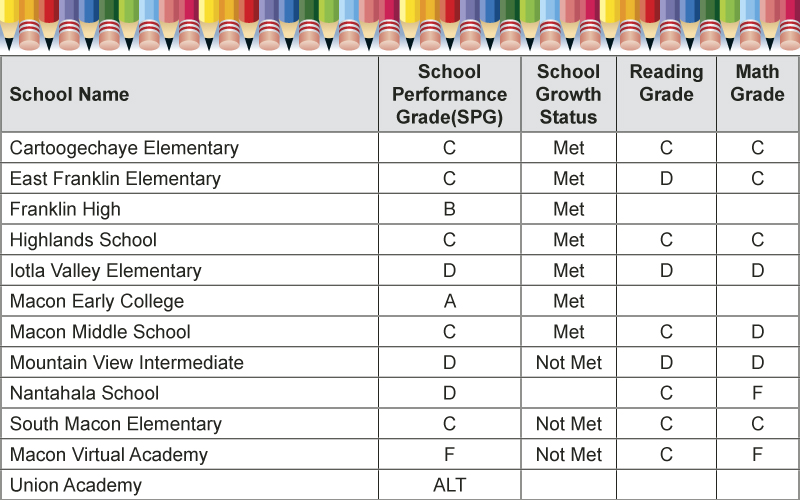
Associate Superintendent Josh Lynch reviewed information from the state school report card at the Oct. 24 Board of Education meeting. He said school performance is measured primarily by student performance on the North Carolina End-of-Grade and End-of-Course reading, math and science assessment results.
In 2017, 2018 and 2019 Macon County Schools showed 62% proficiency, compared to the state average of 59% during those same years. There was no reporting in 2020 due to COVID.
In 2021, Macon County’s proficiency score dropped to 50% and showed a slight improvement to 53% in 2022. The state proficiency score in 2021 was 45% and improved to 51% in 2022.
“We’re doing very well; we remain above the state average,” Lynch said. “Looking at that we are very hopeful; we have done a fine job. The principals and teachers have really put in the work, as well as the parents, to get through that recovery period, and that’s kind of what we’re looking at it as - a recovery period from COVID. Now we have the opportunity to really get in there and focus on what the gaps are and make the needed changes.”
Lynch said using feedback from principals and teachers at the end of the last school year, they knew math was one area where students needed extra help. He said the teachers requested a math curriculum, which is now in the implementation stages in grades K-6 with plans to provide continued support in seventh and eighth grades.
“We feel like we’ve seen this coming, so we wanted to make sure we had a plan in place to address it,” he said.
Lynch said the research-based curriculum meets the students where they are on an individual level and provides professional development for the teachers. “We really feel like we can make some movement and close the gaps in math.”
Superintendent Chris Baldwin said the decline in proficiency scores between 2019 and 2021 could be attributed to COVID and the learning difficulties that occurred with students being absent from school and adapting to online learning, but it also accentuated the flaws in the school report card model.
“In 2021, everyone knew students were behind,” he said. Then those students advanced a grade, took the tests at the end of the next school year and they were still behind.
“The problem with the school report card model is that it doesn’t take into account COVID,” Baldwin said. As an example, he said that while the 3% growth between 2021 and 2022 is a sign of improvement, it did not have much impact on the overall school report card.
However, he is optimistic that there is an effort to develop a new model. “The new model should be, we anticipate, more weighted toward growth and I certainly think our schools will benefit from that.”
When the state released the school performance reports in August, the Department of Public Instruction noted that the 2021-22 school year was the third school year with impacts from the pandemic. While face-to-face instruction had resumed, students and their communities continued to be affected by COVID, particularly when COVID exposures required students to be absent from school or revert to remote learning. The DPI website includes the following statement: “These reports must be reviewed within that context, meaning, though instructional delivery was not as varied as in the 2020–21 school year, it continued to be an anomaly in comparison to the 2018–19 school year, which was prior to the onset of the pandemic.”
The school performance report can be viewed at dpi.nc.gov; click on Districts and Schools then select Testing and School Accountability.