
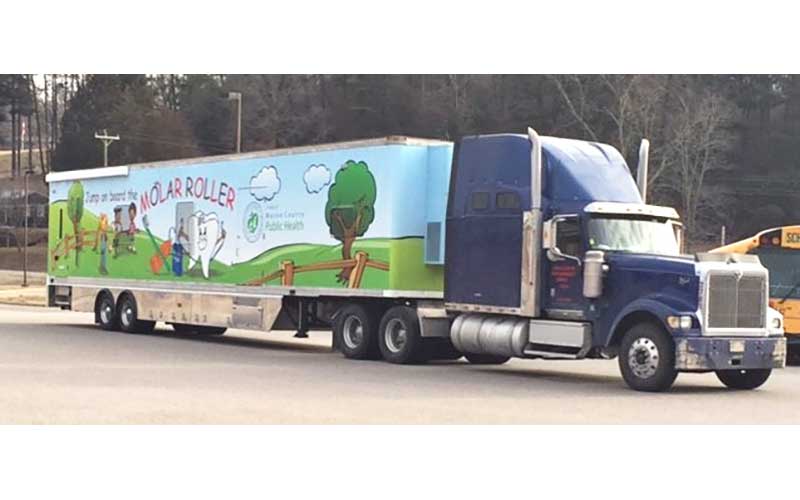
The county’s mobile dental clinic is nearly 20 years old and may need more than a regular check-up to keep it rolling.
Public Health Director Kathy McGaha came before the Macon County Board of Commissioners earlier this month to give an update on the clinic and to make a Capital Improvement Plan request for a new mobile clinic.
The Molar Roller is a mobile clinic that travels to county schools and Macon Program for Progress to provide dental care for children under 19 years of age and helps reduce the time kids miss out of school for dental appointments.
The unit is built on a tractor trailer bed, but the inside is equipped to provide dental screenings and treatments. “It looks like a regular dentist office,” McGaha said at the Aug. 9 meeting.
McGaha said much of the dental clinic staff has been with mobile unit since it started, and they have taken good care of it. “It is something I think the county can be really proud of.”
McGaha said 9.1% of Macon County kids did not have any form of health insurance in 2019 and 43.1% were enrolled in Medicaid. In its first full year of operation (fiscal year 2005), the clinic had 2,231 visits. The number of visits had increased to an average of 9,370 visits per year from 2013-2019. During that same time, the child dental program generated an average surplus of $67,580 per year.
According to state statistics, in Region 1 (which includes Macon County), 23% of fifth graders had untreated tooth decay in fiscal year 2001. “That’s improved over time,” McGaha said. In fiscal year 2018, 11.8% of third graders had untreated tooth decay.
“We know the health of the kids and their dental health leads to the overall health of their bodies,” McGaha said.
The county purchased the mobile clinic in 2003 and it was expected to have a 10-year lifespan. The clinic was remodeled in 2015, but now it has several malfunctions and outdated parts that make it difficult to use as a mobile clinic. One of the problems is with the system that is used to level the unit when they set it up at a site. There are also issues with the air system controls, the electric system, the air conditioner and a leak in the diesel carriage heater.
Maintenance Director Mike Cope said they talked to the manufacturer about rebuilding the leveling/hydraulic system and they were told there was a 50-50 chance it would work. Because of the equipment problems he has concerns about moving the 87,000-pound unit. He and McGaha are recommending setting it up at a permanent location. However, that defeats the purpose of having a mobile unit.
“Without it being mobile, a lot of these kids don’t get dental care,” said Melissa Setzer, finance director for the Health Department. She said the benefit of having the mobile dental clinic at the schools is that students can come get treatment then go back to class, so they lose less time in the classroom. “It’s a great experience for the children.”
Commissioner Ronnie Beale pointed out it’s not only underprivileged kids who use the dental clinic. “It’s across the board kids,” he said.
Commissioner Josh Young asked if there was a possibility of making repairs to the unit rather than taking on the expense of buying a new one.
Cope said he wasn’t saying some of the things on the unit could not be repaired, but in the long-run the cost of repairing and maintaining a 20-year-old unit may outweigh buying a new unit with less maintenance.
The estimated cost of a new unit is $630,000. McGaha said the manufacture would require a 50% down payment, then 40% at construction and the final 10% at delivery. It would take 18-24 months to get the new unit.
The commissioners agreed to put it out for bid and in the meantime asked McGaha to determine how much the Health Department could put toward a new clinic, possibly using medical cost settlement money and grants to help cover the cost.