
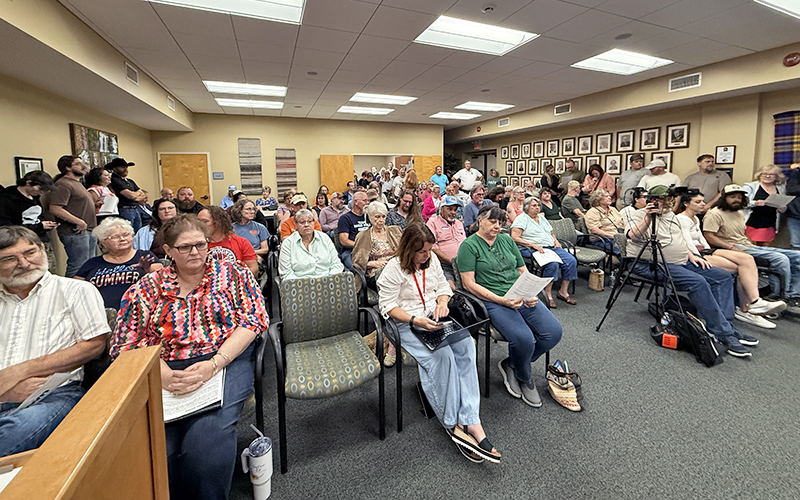
Cheers and applause filled the board room at Franklin Town Hall Monday night as the Town Council unanimously approved an ordinance that will establish a 12-month moratorium on data center development.
The seats in the board room were filled and people stood along the walls, with the crowd overflowing into the adjoining kitchen. Sixteen people signed up to speak during the public hearing.
With it being the Monday after the July 4th holiday, Mayor Stacy Guffey opened the meeting by talking about patriotism, saying it is more than flags or national symbols: “Patriotism is the hard work we get up and do every day for our communities.”
Before opening the public hearing on the ordinance, Guffey said, “There is not a member of this board up here who wants to see a data center inside the town of Franklin.” The crowd applauded and went on to applaud each speaker who voiced support for the moratorium. No one spoke against the moratorium and some asked that it be longer than the proposed 12 months.
Town attorney John Henning spoke about why the ordinance is needed, what happens after the 12 months, and that there is an option to extend the moratorium. “We have to show that we are studying the issue and moving forward,” he said.
Henning said the town’s ordinances currently do not address data centers. “If somebody showed up with an application for zoning that says, ‘Here’s where I want to put my data center,’ before tonight and adoption of this ordinance, you would have been in a tough spot to prevent that from happening.”
Henning said there has not been an application for a data center and they don’t anticipate having one.
He explained that while the law does not allow the town to outright ban data centers, the town can develop regulations that would “discourage that kind of development inside the town limits.”
The 12-month moratorium is intended to give the town a chance to look at the environmental issues related to data centers, the impacts to the town’s infrastructure, and what regulations are needed.
“This moratorium is the best legal mechanism we have to address it,” said Henning.
Vice Mayor Mike Lewis said, “We have to find a way; if they’re going to come, then we need to make sure it doesn’t use our water, use our electricity, and keep our neighbors up. It’s going to be as low impact as possible, and I promise you that is what this board is committed to doing.”
Guffey gave each council member the opportunity to share their views on the moratorium.
“I want this place to be somewhere that is a priority for family, for jobs, for recreation, and for visitors,” said council member Robbie Tompa. “A data center isn’t for any of those things – it only takes from all that.”
Council members Rita Salain and Joe Collins also said they are committed to making sure the town does what it can to prevent data center development, and council member Travis Higdon said a data center is a “hard no.”
The ordinance will apply to property with the Town of Franklin limits and its extra territorial jurisdiction (ETJ). Some speakers asked about regulations at the county level and were encouraged to attend the county commissioners’ meetings and speak to state legislators.
“We have got to reach out to all those folks and say this is not what we want or what we can have in our community,” Salain said. “It’s just not what we need and not what we want.”
“As the attorney explained, we are very limited in what we can do,” said Guffey. “But I can guarantee you that we are going to find a way to make sure that it is virtually impossible to do it in the Town of Franklin.”
Public concerns
Judy Hartley opened the public comment period by talking about the disadvantages of data centers.
“They take a lot of water. They make a lot of noise. They use a lot of electricity,” she said, adding there is also light pollution and toxic waste associated with the centers.
“I wouldn’t want to live next to one,” she said. “And we really don’t know what they generate.”
Hartley said a data center might create some jobs while the facility is being built, but after that jobs would be limited. She had read about a facility where there were just two people employed. “The computers are doing all the work,” she said.
Blaine Kaaa doubted local contractors would get any of the construction jobs as the companies would use contractors they have previously worked with.
“None of this money is going to recirculate back eventually to the Town of Franklin,” he said. “We need jobs here. We need money to stay here. We need money to circulate here to help local people pay their bills.”
Michael Scarborough said he has worked in IT for more than 40 years and from what he has seen with the changes in technology, a data center built today would last maybe 10 years.
David Medlock, who said he also worked in IT, countered that once a data center is here it would be permanent “and you’re going to have a hard time getting rid of it.”
Scarborough said the data center companies would reap more benefits than the community would.
“They don’t employ anybody. The jobs that will be there will be security jobs and routine maintenance. All the IT jobs, remote jobs, high-paying jobs, will not be brining any money to this community,” he said.
Rob James said “For the last several years, I’ve watched as tech CEOs have lost their minds and sold their souls trying to sell everyone a bright AI-powered future. What they tend to gloss over is the cost of this inevitable bright future. These same CEOs are doing to small towns what the coal companies and industries of the recent past did to towns like ours, bulldozing our forests, overdrawing and poisoning our water, exploiting our friends and neighbors.”
He said a data center would impact the town’s tourism and income. “Our dark skies, all of the wildlife that we have here would all be permanently affected and most likely would be driven off.”
Local real estate agent Matt Jackson encouraged the board to pass the moratorium and “commit to the next step of putting into our code that these projects are not allowable use on our land or natural resources so Franklin can stay a place of rivers and ridge lines and not of data centers.”
John MacLean, a photographer, said “Besides data, what else it creates is an environmental disaster. Our most valuable assets here, and in many parts of the world, are the natural resources, along with the beauty and habitat they provide. Once built, they forever scar a pristine landscape and surroundings. What unlucky people and wildlife near these monstrosities deal with is air, water and sound pollution.”
Several speakers noted the ongoing drought and the occasional voluntary water restrictions the town has in place and noted data centers would place a bigger drain on the town’s water system. Many of the speakers thanked the council members for being proactive in addressing the issue.
“I can’t believe I’m saying this about a government, but I’m proud of y’all” said Nathan Pannell. “This is my home. I love it.”
Pannell encouraged others in the crowd to use their vote. “Raleigh and the federal government has really tied their hands about what can be done. What they can do for us,” he said. “But what every politician wants is a vote. If we all band together, we can keep these data centers not just out of Franklin, not just out of Macon County, but out of Appalachia, period. But we have to organize. We have to say, ‘We ain't going to vote for you. … We're going to withhold our vote and we're going to go and give it to people who are going to take care of us, protect our communities, protect our country.’”
Betsy Baste also urged people to attend the county commissioners meeting and said she was discouraged at last week’s county planning board meeting when she did not see the same kind of commitment to stopping data center development.
“If you think your voice doesn’t matter, it does matter, because this is a very diverse group of people. This is not just all one way of thinking. This is a community coming together and caring about our space.”
Baste also noted that while everyone speaking was against a data center being built here, that each person has a responsibility to minimize their use of AI.
In closing the public hearing, Guffey commented the room was filled with Democrats, Republicans and independents “united by one thing, and that is that they care for this community.”
The Macon County Board of Commissioners meets at 6 p.m. Tuesday, July 14, at the Macon County Courthouse. The next Franklin Town Council meeting will be at 6 p.m. Monday, Aug. 3. Look for more coverage from this week’s council meeting in the July 15 edition of The Franklin Press.