
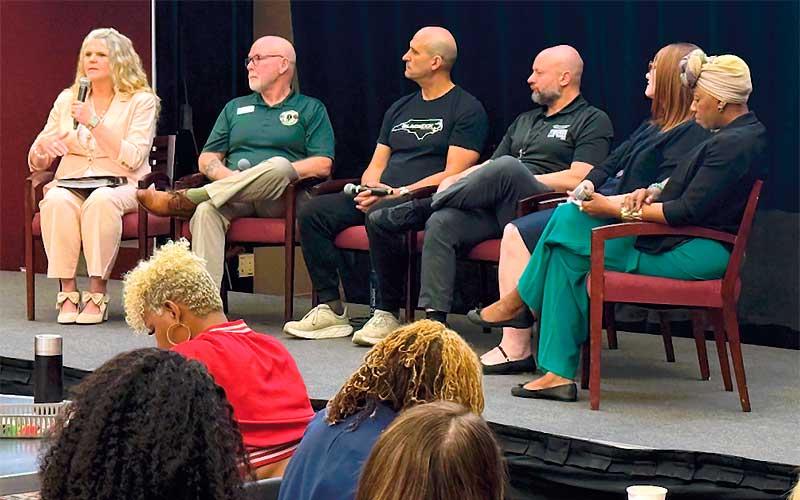
Macon County Veteran Services director Leigh Tabor has been busy lately, advocating for veterans at the local, state and federal level.
Tabor, who also serves as the president of the N.C. Association of County Veteran Service Officers (NCACVSO), was tapped to attend a panel with the Governor’s Institute and recently took a trip to Washington, D.C. with the national organization (NACVSO) to advocate for veterans’ protections against predatory “claim sharks.”
The GUARD Act, first introduced in October 2025, would criminalize what Tabor described as claim sharks, unaccredited agencies charging veterans for services they would get for free through Veterans Affairs.
“Right now, it’s not against the law for them to do that,” Tabor said. “So they’re able to profit off the veterans when they could come into an office like here … or any VSO office across the state.”
Tabor said the group spent time speaking with Senators Ted Budd and Thom Tillis to request they pass the act. Materials distributed from the NACVSO advocated the GUARD Act alongside the S. 2344, a bill to apply warnings about using unaccredited representatives to public VA websites, and the SAFEGUARD Act, which would establish penalties for and allow easier research into sharks.
The VFW describes a list of common practices of sharks as “promising or guaranteeing an increased disability rating or percentage increase. Advertising expedited VA claims decisions. Requesting login credentials to access a veteran’s personal information through secure VA websites like eBenefits or VA.gov using confusing tactics or ambiguous language to mislead claimants or coerce them into signing a contract. Telling veterans to forego VA exams and offering health consultations within their own network of doctors.”
Veterans can protect themselves by working with VA representatives and keeping their personal information and login credentials private.
While in D.C., Tabor was also working to get the EVEST Act (HR 4114) passed, which would automatically enroll service members in VA healthcare as they discharge.
“Right now, that doesn’t happen,” Tabor said. “Whenever they get out, they’ve got five years to sign up.”
If a veteran exceeds that time, if they do not have a service connection, do not meet income criteria or have the right deployment, they may not be able to receive healthcare through the service.
“This is something that goes all the way back to Abraham Lincoln, to care for the veterans and the orphans and Congress put stipulations on it,” Tabor said. “A while back, veterans actually had to report not only their earned income but their net worth. They removed the net worth portion but now there are veterans who don’t fall within those criteria.”
Governor’s Institute
At the Governor’s Institute, a little more than 200 people joined an action team to help discuss access to veteran services, including mental health services. Tabor said she attended with the writing group Brothers and Sisters Like These, the Veterans Healing Farm out of Asheville and the Black Box Dance Theatre.
“It was like Western North Carolina was heavily represented on that panel, which normally doesn’t happen down in Raleigh,” Tabor said. “The Governor’s working group trying to bring together resources for veterans all across the state – they specifically had an interest in Western North Carolina, which was refreshing.”
Rural areas in North Carolina see higher rates of veteran suicide than urban areas in particular because of the lack of resources. Most federal resources end up in metropolitan areas like Asheville, and while Tabor said Western North Carolina has decent access to mental health services for veterans thanks to the Asheville VA Medical Center, the center’s limited hours combined with the far west’s lack of general mental health facilities further reduce access.
She said the institute’s panel was mostly focused on organizations like the writing group and dance theatre, which can help provide community and coping strategies veterans can use to navigate their mental health. Veteran’s Purpose, which meets at No Wrong Door, is also a group working to build community and relationships among veterans.
“Because one of the things with rural suicide is isolation, one of the main risk factors,” Tabor said. “We’ll do events too, like we’ll host a bowling night or a movie night or the pool halls … we’ve done it where we get veterans and their families together and they can get out and play pool together and just get them together and get a network, build their community.”
USO
Tabor said the United Service Organizations, which was present at the panel, has been in dire need of volunteers given the current number of military deployments. She said building care packages, making financial donations or volunteering at welcome home and send-off events through USO may be a good service project for veteran organizations, churches, civic clubs, student groups and community volunteers. Tabor recommended those interested may visit uso.org/take-action/volunteer or call 919-981-9707.