
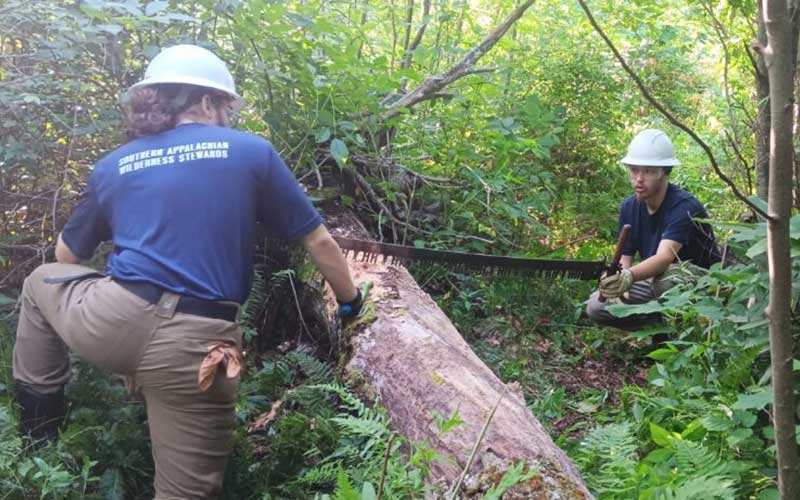
Macon County will join Clay, Graham and Haywood counties as the recipients of more than $250,000 in grant funding for emergency trail restoration.
The N.C. General Assembly appropriated more than $11 million in funding for the Great Trails State Program, which funds development and extension of North Carolina trails. Other counties in the region receiving funding are Jackson, Graham, Clay and Cherokee, according to Gov. Josh Stein’s office.
Macon County’s allotment comes in the form of a grant of $253,731 to the Southern Appalachian Wilderness Stewards for “urgent wilderness restoration: trail stewardship and recovery after the storm.” SAWS is a conservation nonprofit that seeks to both take care of wild public land and organize learning opportunities to connect young people to that natural heritage.
SAWS director Kaitlin de Varona shared that SAWS crews are planning to work on a pair of key Macon County trails — the Big Indian Loop Trail and the Beech Creek Loop Trail. De Varona said these trails have long-needed maintenance, but that storm and wildfire damage pushed them to the point of needing more active restoration work.
“Even though there’s some great volunteer groups that maintain these trails, we can bring in some crews that can stay overnight in remote areas,” de Varona said. “We have an office here in Asheville and an office in Roanoke. We work regularly across seven southern states in the Appalachian Mountains.”
Crews will collect supplies out of Asheville and spend two weeks traveling with equipment dedicating to trail maintenance.
“It is not just as simple as downed trees … some of our trails suffer from some chronic maintenance needs,” she said.
Crews will need to install rock staircases to help divert more water from trails to prevent erosion, remove fallen trees that have overlapped or tangled together and cut back overgrowth. De Varona said SAWS partners with existing hiking and trail maintenance groups in the area, but it can be difficult to keep up with maintenance needs when needs are so great in locations that are miles out from the trailheads.
It will take a couple of years to execute the grants, de Varona said, but if money is left over after planned maintenance is completed SAWS will likely work to identify maintenance needs in the event of future disasters.
Tim Lindler of Nantahala Hiking Club, said the Nantahala range managed to avoid the same significant storm damage seen on the Appalachian Trail, and saw no damages to shelters and privies. Lindler said more than 3,600 volunteer hours were put into trail maintenance to clear various debris from trails, with crews working every Wednesday to clear damage that was caused not just by Helene, but by a particularly rainy and windy season.
Lindler said the Beech Creek and Big Indian Loops where SAWS plans to work are not maintained by the club, and the work will be conducted in cooperation with United States Forest Service officials. He said SAWS occasionally coordinates with the club’s trail manager when their goals align.
“As Western North Carolina continues to recover from Hurricane Helene, this funding for trails will help local communities increase tourism, promote healthy living, and improve quality of life for all North Carolinians,” Stein said.
“Trails bring incredible benefits to both urban and rural communities, boosting tourism and economic development,” said Pamela Cashwell, N.C. secretary of the Department of Natural and Cultural Resources. “This generous funding made possible by the N.C. General Assembly will help transform the state trails system in the Great Trails State.”
Sen. Kevin Corbin supported the legislation, “The Great Trails State Program legislation was established through the General Assembly in 2023, representing a historic investment for North Carolina trails. The program offers matching grants to North Carolina local governments, public authorities, regional council of governments and nonprofit organizations.”